

Every NAC evaluation eventually becomes a three-horse race: Cisco ISE, Aruba ClearPass, and Forescout. Each platform approaches network access control from a different angle, and the right recommendation depends on the customer’s existing infrastructure, device landscape, and operational maturity. This guide gives you the feature-by-feature comparison, deployment model differences, and conversation frameworks you need to position confidently in any NAC deal.
⚡ Key Takeaways
- Cisco ISE and Aruba ClearPass are RADIUS/802.1X NAC platforms; Forescout is agentless - it doesn’t need 802.1X and discovers devices passively.
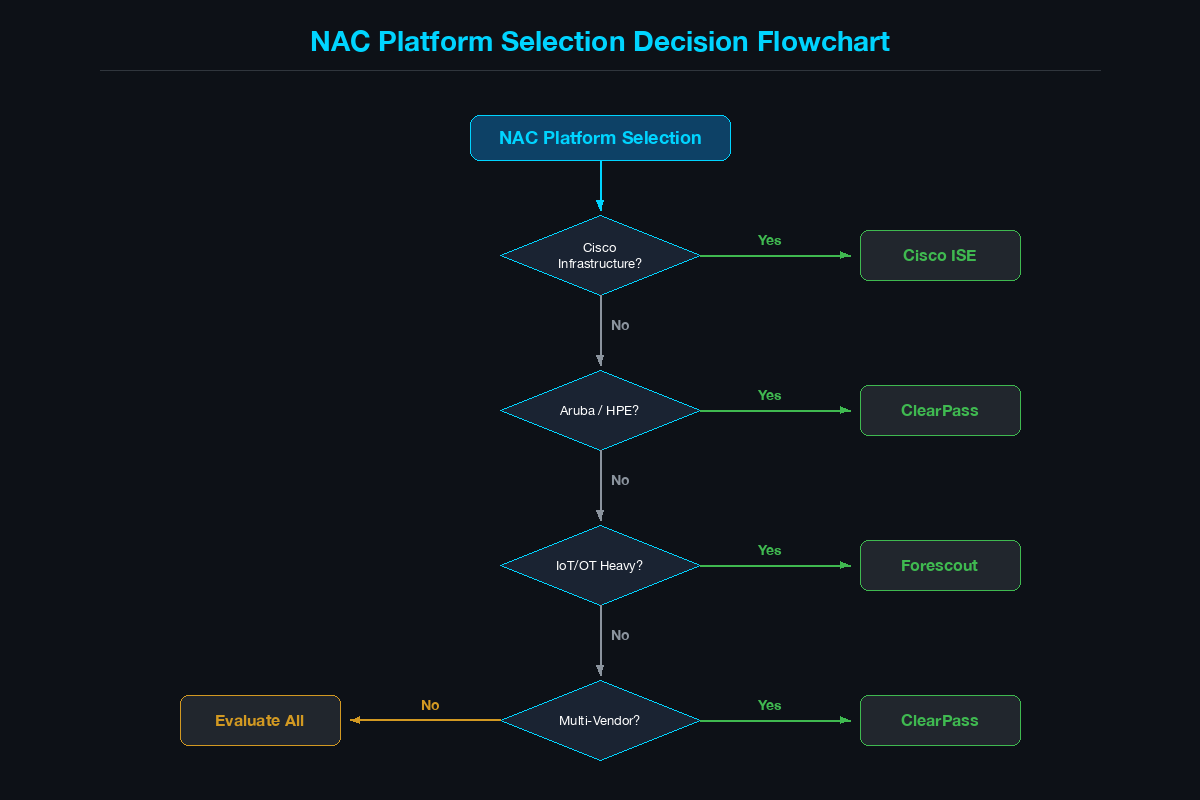
- Choose ISE for Cisco networks needing 802.1X + TACACS+ + SD-Access/TrustSec; ClearPass for multi-vendor/Aruba with heavy BYOD; Forescout for agentless IoT/OT visibility.
- They frequently run together: ISE as the RADIUS policy engine, Forescout for unmanaged IoT/OT.
- In 2026 ISE runs in the cloud (AWS/Azure/OCI) and feeds the Cisco Security Cloud for Zero Trust - its strongest current differentiator.
Architecture: Three Different Philosophies
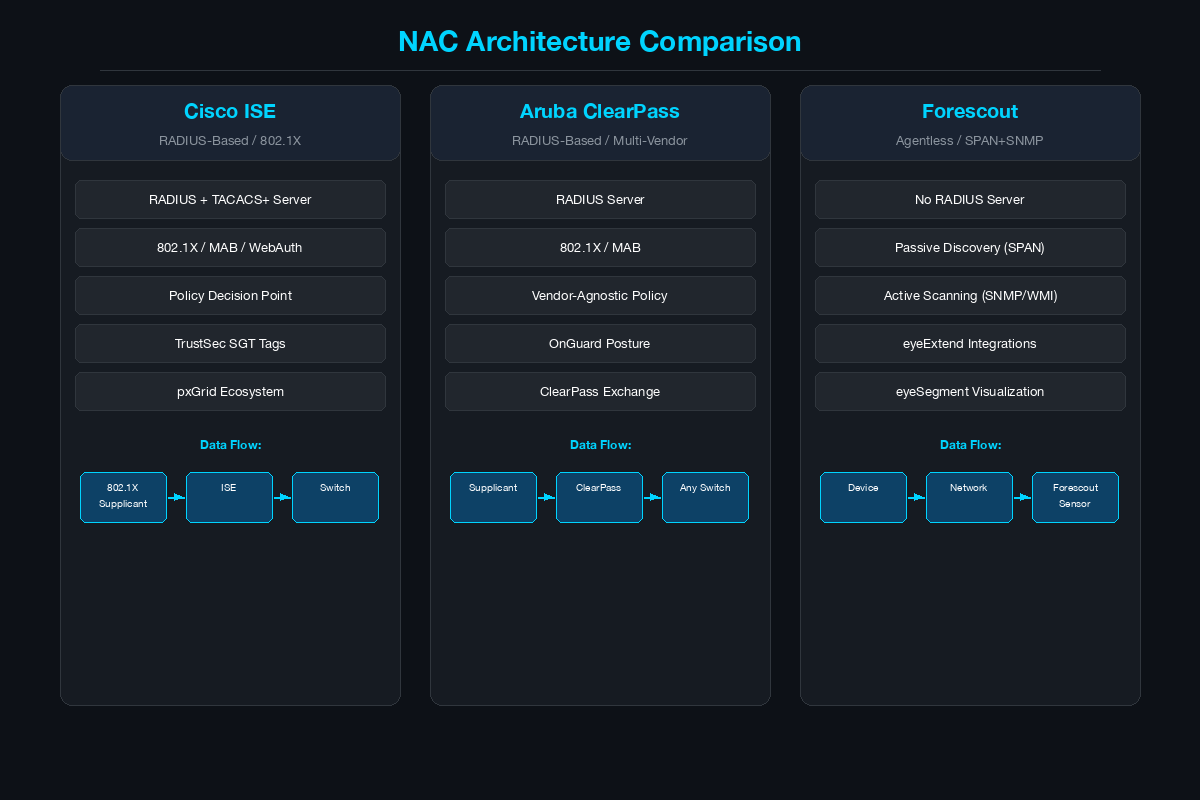
Before comparing features, understand that these three platforms solve NAC differently at the architectural level.
Cisco ISE is a policy decision point that acts as a RADIUS and TACACS+ server. It authenticates endpoints via 802.1X, MAB (MAC Authentication Bypass), or Web Authentication, then assigns authorization profiles (VLANs, dACLs, SGTs) based on identity, device type, posture, and location. ISE is the policy brain behind Cisco SD-Access and TrustSec. Deployment requires ISE appliances (physical or virtual), integration with Active Directory or LDAP, and certificate infrastructure for EAP-TLS.
Aruba ClearPass is also a RADIUS-based policy platform, but it is designed to be vendor-agnostic. ClearPass can authenticate and authorize endpoints on any 802.1X-capable infrastructure - Aruba, Cisco, Juniper, or mixed environments. ClearPass Policy Manager handles authentication, profiling, and guest access, while add-on modules (OnGuard, OnBoard, Insight) cover posture, BYOD, and analytics. ClearPass fits naturally in Aruba/HPE environments but positions itself as the multi-vendor alternative.
Forescout takes a fundamentally different approach. It does not function as a RADIUS server and does not require 802.1X. Instead, Forescout uses passive network monitoring (SPAN/TAP), active scanning (NMAP, WMI, SSH, SNMP), and API integrations to discover and classify every connected device - then enforces policy through SNMP VLAN changes, ACL pushes, or integration with existing RADIUS/firewall infrastructure. This agentless, 802.1X-free model makes Forescout the fastest to deploy but the least integrated with RADIUS-based enforcement workflows.
Feature Comparison Table
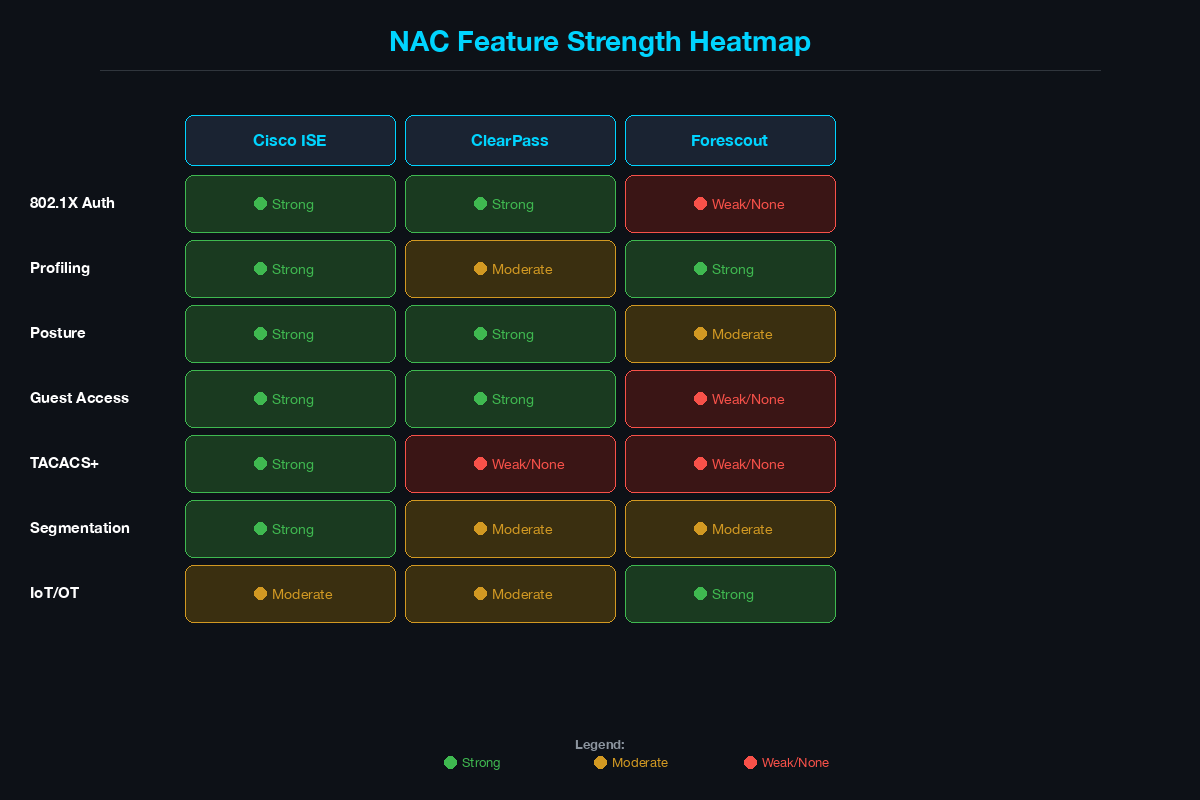
| Feature | Cisco ISE | Aruba ClearPass | Forescout |
|---|---|---|---|
| 802.1X Authentication | Full RADIUS server, EAP-TLS, PEAP, EAP-FAST | Full RADIUS server, EAP-TLS, PEAP, EAP-TTLS | Not a RADIUS server; relies on external RADIUS or 802.1X-free enforcement |
| MAB (MAC Auth Bypass) | Native support | Native support | Uses MAC-based classification without RADIUS |
| Device Profiling | 12+ probes (DHCP, HTTP, NMAP, DNS, NetFlow, SPAN) | Fingerprinting via DHCP, HTTP UA, SNMP, TCP, mDNS | Deep passive + active profiling; strongest for IoT/OT |
| Posture Assessment | Agent-based via AnyConnect ISE Posture module | Agent-based via ClearPass OnGuard | Agentless posture checks via WMI, SSH, SNMP; optional agent |
| Guest Access | Built-in guest portals (hotspot, self-reg, sponsored) | Built-in guest portals with branding and SMS/email | Limited; typically handled by partner integration |
| BYOD Onboarding | Native certificate provisioning and supplicant config | ClearPass OnBoard - certificate + supplicant provisioning | Not a core use case |
| TACACS+ Device Admin | Full TACACS+ server for network device administration | TACACS+ available but less commonly deployed | No TACACS+ capability |
| Segmentation | TrustSec SGTs, dACLs, VLAN assignment | VLAN assignment, role-based access, dynamic segmentation | eyeSegment for traffic-based segmentation visualization; VLAN/ACL enforcement via SNMP |
| Scalability | Up to 2M concurrent sessions (distributed deployment) | Up to 500K endpoints (clustered) | Up to 2M+ devices (Enterprise Manager architecture) |
| High Availability | Active/Standby PSN pairs, distributed PAN/MnT | Active/Standby clustering | Enterprise Manager with redundant appliances |
| Deployment Model | Physical appliance (SNS 3x00) or VM (VMware, KVM, Hyper-V, cloud) | Physical appliance or VM (VMware, Hyper-V, KVM, cloud) | Physical appliance or VM (VMware, Hyper-V, KVM, cloud) |
| Cloud Option | ISE on cloud VMs (AWS, Azure); no full SaaS yet | ClearPass on cloud VMs; Aruba Central for cloud management | Forescout Cloud; eyeSight SaaS for visibility |
| Integration Ecosystem | pxGrid (75+ partners), REST API, syslog, LDAP | ClearPass Exchange (REST, syslog, IF-MAP), REST API | eyeExtend modules (30+), ORB, REST API |
| MDM Integration | Integrates with Intune, JAMF, MobileIron, AirWatch via MDM API | Integrates with major MDM platforms via ClearPass Exchange | Integrates with MDM via eyeExtend modules |
| SIEM Integration | Syslog, pxGrid to Splunk, Sentinel, QRadar | Syslog, ClearPass Insight analytics, REST to SIEMs | Syslog, eyeExtend for Splunk, QRadar, Sentinel |
Deployment Model Differences
Cisco ISE
ISE deployments use a distributed architecture with three persona types: Policy Administration Node (PAN), Monitoring Node (MnT), and Policy Service Node (PSN). Small deployments can run all personas on a single appliance; large enterprises distribute across dedicated nodes. A typical enterprise deployment runs two PANs (active/standby), two MnTs (active/standby), and PSNs in each geographic region.
Time to deploy: 4-12 weeks for a full production deployment with 802.1X. The complexity comes from certificate infrastructure, supplicant configuration, phased rollout (monitor mode to closed mode), and policy tuning.
Where it fits best: Cisco-centric networks, SD-Access environments, organizations that need 802.1X + TACACS+ on a single platform.
Aruba ClearPass
ClearPass uses a simpler clustering model. Up to six ClearPass Policy Manager appliances form a cluster with a designated Publisher (primary) and Subscribers (secondary). Guest, OnGuard, and OnBoard run as services on the same appliances or on dedicated servers for scale.
Time to deploy: 3-10 weeks. ClearPass is generally considered faster to deploy than ISE because its UI workflow is more linear and it handles multi-vendor environments without requiring vendor-specific configuration (like TrustSec).
Where it fits best: Aruba/HPE wireless environments, multi-vendor wired/wireless networks, organizations that want vendor-agnostic NAC.
Forescout
Forescout uses a three-tier architecture: Enterprise Manager (central management), CounterACT Appliances (distributed sensors/enforcers), and optional eyeSight cloud for SaaS visibility. Appliances connect to the network via SPAN ports or inline TAPs and discover devices passively.
Time to deploy: 1-4 weeks for visibility; enforcement takes longer. Because Forescout does not require 802.1X or supplicant changes, initial visibility can be achieved in days. Moving from visibility to active enforcement (VLAN changes, ACL pushes) requires careful policy tuning.
Where it fits best: OT/IoT-heavy environments (manufacturing, healthcare, energy), organizations that cannot deploy 802.1X to all endpoints, customers who want immediate visibility without network changes.
Pricing Model Comparison
| Aspect | Cisco ISE | Aruba ClearPass | Forescout |
|---|---|---|---|
| Licensing Unit | Concurrent endpoint sessions | Concurrent endpoints | Managed devices |
| License Tiers | Base, Plus (profiling + posture), Apex (TACACS+ + MDM) | Access (base), OnGuard (posture), OnBoard (BYOD) | eyeSight (visibility), eyeControl (enforcement), eyeSegment (segmentation) |
| Model | Subscription (1, 3, 5 year) | Perpetual or subscription | Subscription-first; some perpetual options |
| Appliance Cost | SNS 3615/3655/3695 physical; VM license included with software | Hardware appliances or VM licenses | Hardware appliances or VM licenses |
| Typical Entry Point | ~$15-25 per endpoint/year (Base) | ~$12-20 per endpoint/year (Access) | ~$15-30 per device/year (eyeSight + eyeControl) |
| Support | Cisco SmartNet / SWSS required separately | Aruba Foundation/Advanced support | Forescout support tiers |
Pricing is highly deal-dependent. All three vendors offer significant volume discounts, ELA (Enterprise License Agreement) options, and competitive displacement pricing. Always engage your vendor’s pricing team early in the deal cycle.
When to Recommend Each Platform
Recommend Cisco ISE When
- The customer runs a Cisco network (switches, wireless controllers, Catalyst/Nexus)
- SD-Access or TrustSec segmentation is on the roadmap
- The customer needs both NAC and TACACS+ device admin on one platform
- There is an existing Cisco security stack (Secure Firewall, Duo, Stealthwatch) that benefits from pxGrid integration
- The customer has mature IT operations and can manage 802.1X infrastructure
Recommend ClearPass When
- The customer runs Aruba/HPE wireless or a multi-vendor wired environment
- The customer explicitly wants vendor-agnostic NAC
- BYOD self-onboarding (certificate provisioning) is a primary use case
- The customer wants perpetual licensing rather than subscription-only
- The IT team is smaller and prefers a more streamlined UI workflow
Recommend Forescout When
- IoT/OT visibility is the primary driver (healthcare, manufacturing, energy)
- The customer cannot deploy 802.1X across all endpoints
- Immediate visibility without infrastructure changes is the priority
- The environment has a high percentage of unmanaged or unmanageable devices
- The customer wants to see everything on the network within days, not months
Customer Objection Handling
“Why ISE over ClearPass?”
What they are really asking: “We do not run all Cisco, and ClearPass seems more open.”
Your response framework:
- Acknowledge that ClearPass is a capable platform, especially in Aruba environments
- Pivot to pxGrid - ISE shares context with over 75 technology partners, making it the most connected NAC platform in the industry. pxGrid is not Cisco-only; partners include Splunk, ServiceNow, Palo Alto, and CrowdStrike
- Highlight TrustSec and SGTs if the customer has any Cisco switching - this is a differentiation ClearPass cannot match natively
- Mention TACACS+ - if they need device administration and NAC on one platform, ISE delivers both
- Reference scale - ISE supports up to 2 million concurrent sessions in a distributed deployment
“Why ClearPass over ISE?”
What they are really asking: “We have Aruba wireless, but Cisco switches. Which NAC?”
Your response framework:
- ClearPass is genuinely multi-vendor - it works equally well as a RADIUS server for Cisco, Juniper, and Aruba switches
- Perpetual licensing option reduces long-term cost if the customer resists subscription models
- ClearPass OnBoard provides a smoother BYOD self-service experience for certificate provisioning
- The UI is more approachable for smaller IT teams
- If the customer is migrating to HPE/Aruba for switching, aligning NAC with the new infrastructure makes sense
“Why not just use Forescout for everything?”
What they are really asking: “Forescout showed us visibility in a 2-hour PoC. Why do we need 802.1X?”
Your response framework:
- Visibility and enforcement are different problems. Forescout excels at showing you what is on the network, but enforcement without 802.1X is limited to SNMP-based VLAN changes and ACL pushes - which are less granular and harder to scale
- Forescout does not replace your RADIUS server. If the customer needs 802.1X for compliance (PCI DSS, HIPAA), they still need ISE or ClearPass
- Position Forescout as the IoT/OT visibility layer that complements a RADIUS-based NAC for managed endpoints - many enterprises run both
- Ask about the customer’s compliance requirements. If they need certificate-based authentication, posture assessment with remediation, or TACACS+ device admin, Forescout does not cover those use cases natively
“We already have one of these. Why switch?”
Your response framework:
- Never lead with “rip and replace.” Lead with the gap the current platform leaves unfilled
- If they have ISE but struggle with IoT visibility, position Forescout as a complementary overlay
- If they have ClearPass but are migrating to Cisco infrastructure, ISE aligns with SD-Access and DNA Center
- If they have Forescout but need 802.1X for compliance, ISE or ClearPass fills the RADIUS gap
- Always quantify the operational cost of running two platforms vs. consolidating - this is where the real conversation happens
Integration Ecosystem Comparison
Cisco ISE - pxGrid
pxGrid (Platform Exchange Grid) is ISE’s integration backbone. It publishes endpoint context (identity, device type, posture status, location, threat score) to subscribers in real time. Key integrations:
- Cisco Secure Firewall (FMC): Identity-based firewall policies using SGTs and user identity from ISE
- Cisco Stealthwatch / Secure Network Analytics: Network behavior analytics enriched with ISE endpoint context
- Cisco Duo: MFA integration for VPN and network access
- Splunk: ISE syslog and pxGrid data ingestion for SIEM correlation
- ServiceNow: Automated incident creation based on ISE posture failures or threat events
- Palo Alto Networks: User-ID and IP-to-user mapping from ISE for firewall policy
Aruba ClearPass - ClearPass Exchange
ClearPass Exchange is the integration framework. It uses syslog ingestion, REST API calls, and IF-MAP to share context with third-party platforms:
- Aruba Central: Unified management of ClearPass policies alongside Aruba wireless and switching
- Palo Alto Networks: User-ID integration via syslog
- Splunk: Log forwarding for SIEM correlation
- MDM platforms (Intune, JAMF, AirWatch): Device compliance status used in access decisions
- ServiceNow: CMDB integration for asset context in access policy
Forescout - eyeExtend
eyeExtend modules are pre-built integrations that connect Forescout to specific platforms:
- CrowdStrike: Endpoint detection and response data enriches Forescout device classification
- Palo Alto Networks: Dynamic address group updates based on Forescout device classification
- ServiceNow: CMDB synchronization and automated incident response
- Splunk: Device inventory and compliance data forwarded for SIEM analytics
- VMware vSphere: Virtual machine discovery and policy enforcement
- AWS/Azure: Cloud workload visibility and tagging
Real-World Deployment Scenarios by Vertical
Healthcare
A 500-bed hospital with 15,000 connected devices - half of which are medical IoT devices that cannot run 802.1X supplicants.
Best fit: Forescout for IoT/OT device visibility and classification, combined with Cisco ISE for 802.1X on managed workstations and TACACS+ for network device administration. Forescout identifies and segments medical devices; ISE handles staff and contractor authentication.
Financial Services
A regional bank with 200 branches, PCI DSS compliance requirements, and a Cisco network infrastructure.
Best fit: Cisco ISE. PCI DSS requires strong authentication and network segmentation. ISE delivers 802.1X authentication, TrustSec segmentation (SGTs to isolate cardholder data environments), posture assessment to verify endpoint compliance before granting access, and TACACS+ for change control on network devices. The Cisco-to-Cisco integration with DNA Center streamlines branch deployments.
Higher Education
A university with 40,000 students bringing personal devices, a mix of Aruba wireless and Cisco switching, and a requirement for self-service device onboarding.
Best fit: Aruba ClearPass. The multi-vendor environment (Aruba wireless + Cisco wired) plays to ClearPass’s vendor-agnostic strengths. ClearPass OnBoard handles BYOD certificate provisioning at scale - students enroll their own devices through a self-service portal. The perpetual licensing model also appeals to education budgets.
Manufacturing / OT
A manufacturing plant with 5,000 OT devices (PLCs, HMIs, SCADA systems), no Active Directory integration for shop-floor devices, and a need for network segmentation between IT and OT.
Best fit: Forescout. OT devices cannot run agents or participate in 802.1X. Forescout’s agentless discovery and eyeSegment module map traffic flows between IT and OT zones, then enforce segmentation policies through VLAN and ACL changes. Forescout’s OT-specific profiling (Purdue Model awareness, industrial protocol recognition) is a differentiator in this vertical.
Enterprise (General)
A 10,000-employee enterprise running Cisco Catalyst switching, Cisco wireless, and Cisco Secure Firewall, with plans to adopt SD-Access.
Best fit: Cisco ISE. When the customer is committed to the Cisco ecosystem, ISE is the only NAC platform that integrates natively with SD-Access, DNA Center, TrustSec, and pxGrid. Running ClearPass or Forescout in a Cisco SD-Access environment creates integration friction that ISE eliminates by design.
Migration Considerations
If the customer is evaluating a migration from one NAC platform to another, set expectations:
- Policy migration is manual. There is no automated tool to convert ISE policies to ClearPass or vice versa. Every authorization rule, profiling policy, and posture condition must be rebuilt in the new platform
- Run parallel during migration. Keep the old NAC running while phasing in the new one site by site. Dual-RADIUS configurations on switches allow testing without disrupting production
- Profiling data does not transfer. The new platform must re-learn device profiles from scratch. Plan for a profiling burn-in period of 2-4 weeks before trusting classification data
- Certificate infrastructure may need changes. If moving between ISE and ClearPass, the CA trust chain and certificate templates may differ. Plan for re-enrollment of endpoints using EAP-TLS
- Budget for professional services. NAC migrations are complex. Estimate 3-6 months for a full production migration in an enterprise environment
Summary: Quick-Reference Decision Matrix
| Decision Factor | Choose ISE | Choose ClearPass | Choose Forescout |
|---|---|---|---|
| Network vendor | Cisco | Aruba/HPE or multi-vendor | Any (vendor-independent) |
| Primary use case | 802.1X + TACACS+ + segmentation | 802.1X + BYOD onboarding | IoT/OT visibility + agentless NAC |
| 802.1X requirement | Yes | Yes | No (agentless) |
| Deployment speed | Weeks to months | Weeks to months | Days to weeks (visibility) |
| Compliance driver | PCI, HIPAA, SOX | PCI, HIPAA | OT segmentation, asset inventory |
| Licensing preference | Subscription | Perpetual or subscription | Subscription |
| Integration priority | Cisco ecosystem (pxGrid) | Aruba Central + multi-vendor | EDR/SIEM/CMDB (eyeExtend) |
The right NAC platform is the one that solves the customer’s specific problem - whether that is 802.1X enforcement, IoT visibility, or vendor consolidation. Know all three well enough to recommend honestly, and you will earn trust faster than any competitive positioning slide ever will.
2026 Update: NAC in the Cloud-First Era
Two years of platform evolution have shifted the NAC conversation, so here’s where each vendor now sits:
- Cisco ISE has moved decisively toward cloud-delivered operation. ISE runs natively on AWS, Azure, and OCI, and Cisco positions it inside the broader Security Cloud alongside Cisco Secure Access (SSE) and Duo - so identity and device context flows from ISE into cloud-delivered Zero Trust enforcement, not just campus 802.1X. (Note: the AnyConnect agent used for posture is now Cisco Secure Client.)
- Aruba ClearPass, under HPE, is increasingly operated through Aruba Central and HPE GreenLake, pushing cloud-managed NAC for distributed sites while keeping the on-prem Policy Manager as the enforcement engine.
- Forescout has doubled down on OT and IoT, with eyeSegment for microsegmentation and deeper EDR/XDR integrations - reinforcing its role as the agentless visibility layer that complements, rather than replaces, an 802.1X platform.
The macro trend to lead with in 2026: NAC is converging with Zero Trust. The question is no longer just “who authenticates the endpoint on the LAN” but “how does device and identity context follow the user to cloud apps and remote access.” ISE’s tie into the Cisco Security Cloud is its strongest 2026 differentiator; ClearPass’s multi-vendor flexibility and Forescout’s agentless OT/IoT coverage remain their respective anchors.
Related Posts in This Series
- How to Build a Business Case for NAC - Build the financial justification after selecting the right NAC platform
- Running a Cisco ISE POC: Timeline, Scope, and Gotchas - Plan and execute the POC once ISE wins the bake-off
- Network Segmentation Pitch - Connect NAC enforcement to the segmentation strategy it enables
- Secure Campus Network Reference Architecture - See where NAC fits in the full campus security design
- IoT Security Architecture - Address the IoT visibility gap that drives many NAC evaluations
Practice with free flashcards, quizzes, and hands-on lab scenarios at cciesec.it-learn.io — built specifically for the CCIE Security v6.1 written (350-701 SCOR) and lab exam.


