
Every SSE evaluation in 2026 comes down to the same three platforms: Cisco Umbrella, Zscaler, and Palo Alto Prisma Access. Each takes a different architectural approach to solving the same problem - securing users, devices, and data when the network perimeter no longer exists. As an SE, you need to understand not just the feature checklists but the architectural trade-offs, deployment realities, and customer profiles that make each platform the right or wrong fit.
Three Architectures, Three Philosophies
Cisco Umbrella: DNS-Layer First
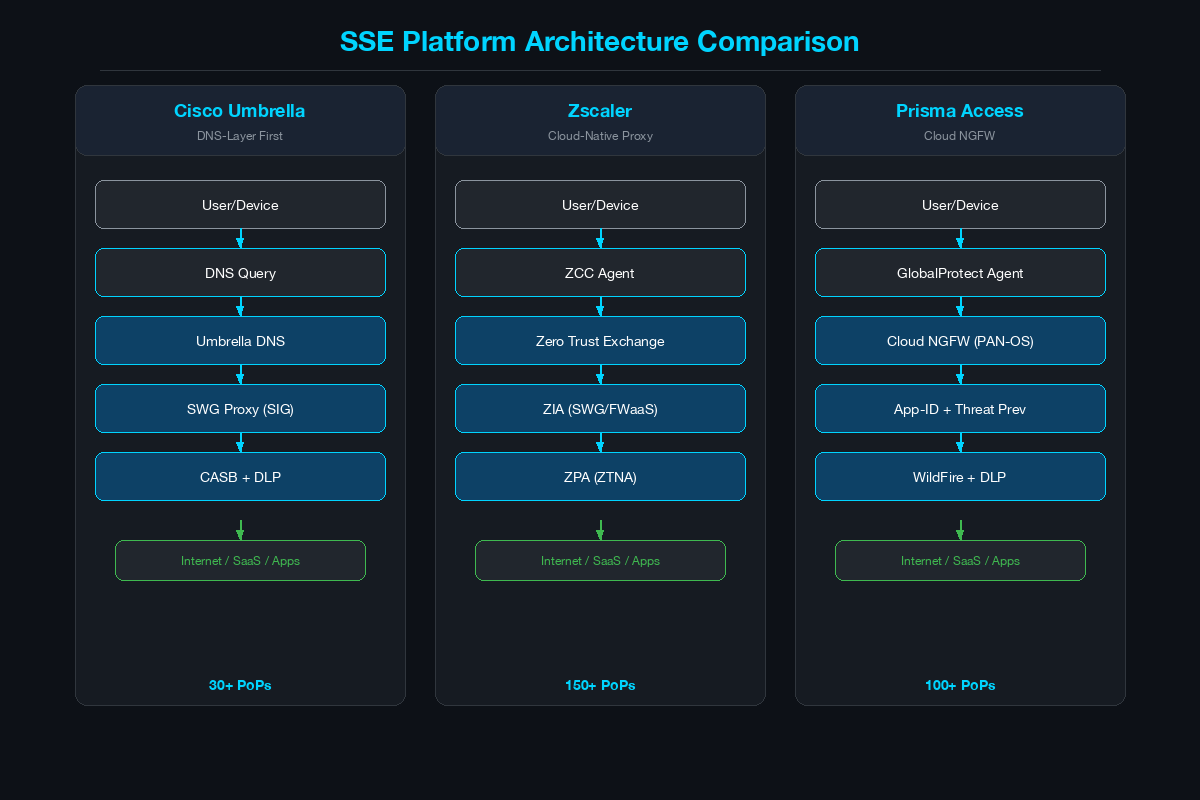
Umbrella started as OpenDNS - a cloud-delivered DNS security service. Its architecture begins at the DNS layer: every DNS query from a protected endpoint is resolved by Umbrella’s global DNS infrastructure, which blocks requests to malicious, phishing, and policy-violating domains before a connection is established. On top of this DNS foundation, Cisco has layered a Secure Web Gateway (SWG), Cloud-Delivered Firewall (CDFW), CASB, DLP, and Remote Browser Isolation (RBI) to build a full SSE platform.
Architectural advantage: DNS-layer security is agentless for basic protection - just point DNS resolvers to Umbrella. This provides immediate, lightweight coverage for every device on the network, including IoT and unmanaged endpoints that cannot run agents.
Architectural limitation: DNS-layer security cannot inspect content within allowed connections. For full SSE functionality (SWG, CASB, DLP, FWaaS), Umbrella requires the AnyConnect or Cisco Secure Client agent, or a PAC file/proxy configuration - moving beyond the simplicity of DNS-only deployment.
Zscaler: Cloud-Native Inline Proxy
Zscaler was built from the ground up as a cloud-native inline proxy. Its architecture routes all user traffic (HTTP, HTTPS, and optionally all ports/protocols) through the Zscaler Zero Trust Exchange - a globally distributed proxy infrastructure. Every connection is inspected inline: TLS decrypted, scanned for malware, checked against DLP policies, evaluated for CASB controls, and filtered by web policy before reaching its destination.
Architectural advantage: Full content inspection on every connection. Zscaler sees and controls everything - not just DNS requests. The inline proxy model provides the deepest visibility and most granular policy enforcement of the three platforms.
Architectural limitation: All traffic must be steered to Zscaler, typically via the Zscaler Client Connector (ZCC) agent on managed endpoints or GRE/IPsec tunnels from branch offices. Agentless coverage is limited. If the agent is not installed, traffic is not inspected.
Palo Alto Prisma Access: NGFW in the Cloud
Prisma Access extends Palo Alto’s Next-Generation Firewall (NGFW) into the cloud. The architecture deploys virtual NGFW instances across 100+ cloud PoPs, creating a globally distributed firewall fabric. Users connect via GlobalProtect agent (the same agent used for Palo Alto on-premises VPN) or through IPsec tunnels from branch locations. Traffic is inspected by the same PAN-OS engine that runs on physical Palo Alto firewalls - App-ID, User-ID, Content-ID, Threat Prevention, URL Filtering, WildFire, and DLP.
Architectural advantage: Feature parity with on-premises Palo Alto firewalls. Customers already running Palo Alto NGFWs get consistent policy, logging, and management across on-premises and cloud-delivered security. Panorama manages both.
Architectural limitation: Prisma Access inherits the complexity of PAN-OS. Configuration is powerful but requires Palo Alto expertise. Customers without existing Palo Alto experience face a steeper learning curve compared to Zscaler’s SaaS-native UI.
Feature Comparison Matrix
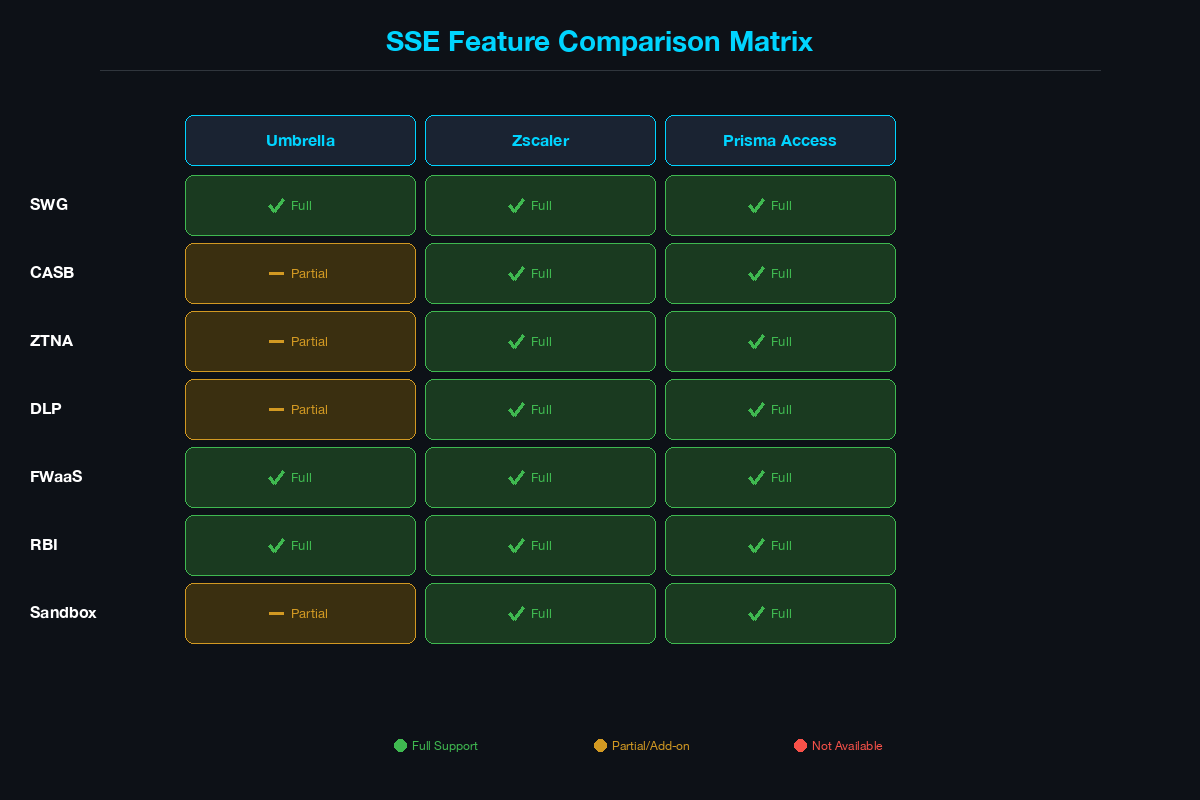
| Feature | Cisco Umbrella | Zscaler (ZIA + ZPA) | Palo Alto Prisma Access |
|---|---|---|---|
| DNS-Layer Security | Core strength - global DNS infrastructure | DNS filtering available but not the primary approach | DNS Security subscription add-on |
| Secure Web Gateway (SWG) | Full SWG via proxy (SIG license) | Full inline proxy SWG - core capability | Full SWG via PAN-OS URL Filtering |
| Cloud Access Security Broker (CASB) | Inline + API CASB (via Cloudlock acquisition) | Inline + API CASB - strong SaaS coverage | Inline CASB + SaaS Security Posture Management (SSPM) |
| Zero Trust Network Access (ZTNA) | Cisco Secure Access (ZTNA 2.0) | Zscaler Private Access (ZPA) - strong market position | Prisma Access ZTNA - GlobalProtect-based |
| Data Loss Prevention (DLP) | Inline DLP + cloud DLP policies | Advanced DLP with EDM, IDM, OCR | Enterprise DLP with ML-based classification |
| Firewall-as-a-Service (FWaaS) | Cloud-Delivered Firewall (L3/L4 + L7 app control) | Cloud Firewall (L3-L7) | Full NGFW in cloud (App-ID, Threat Prevention) |
| Remote Browser Isolation (RBI) | Integrated RBI | Integrated RBI (Cloud Browser Isolation) | Integrated RBI |
| Malware Protection | AMP (Advanced Malware Protection), Cisco Talos | Advanced Threat Protection, inline sandboxing | WildFire cloud sandboxing, Threat Prevention |
| TLS/SSL Decryption | Supported in SWG/proxy mode | Full inline TLS decryption - core capability | Full TLS decryption via PAN-OS |
| Threat Intelligence | Cisco Talos | Zscaler ThreatLabz | Palo Alto Unit 42, AutoFocus |
| SD-WAN Integration | Native with Cisco SD-WAN (Viptela) | Partnerships (Cisco, VMware, Aruba, Fortinet) | Native with Prisma SD-WAN |
| SIEM Integration | Syslog, API, Splunk app | Nanolog Streaming Service (NSS), API, Splunk | Cortex Data Lake, syslog, API, Splunk |
| Agent | Cisco Secure Client (AnyConnect successor) | Zscaler Client Connector (ZCC) | GlobalProtect |
| Agentless Options | DNS pointing (basic), PAC file (SWG) | Limited (PAC file, GRE/IPsec tunnel) | IPsec tunnel from branch (no per-user agentless) |
Deployment Complexity Comparison
Cisco Umbrella
Simplest entry point. DNS-layer protection can be deployed in minutes by changing DNS settings on the DHCP server, firewall, or router - no agent required. This provides immediate protection against malicious domains, phishing, and C2 callbacks for every device on the network.
Full SSE deployment requires the Cisco Secure Client agent on managed endpoints, IPsec/GRE tunnels from branch offices, and configuration of SWG, CDFW, CASB, and DLP policies in the Umbrella dashboard. Certificate deployment is needed for TLS decryption.
Deployment timeline:
- DNS-only: Hours to days
- Full SSE (SIG): 4-8 weeks
Zscaler
Agent-dependent from the start. Zscaler requires the ZCC agent on every managed endpoint to steer traffic to the Zero Trust Exchange. Branch offices connect via GRE or IPsec tunnels. There is no DNS-only lightweight deployment option equivalent to Umbrella.
Configuration is done through the Zscaler Internet Access (ZIA) and Zscaler Private Access (ZPA) admin portals. The UI is SaaS-native and relatively intuitive, but the number of policy options (URL filtering, SSL inspection, DLP, CASB, firewall, bandwidth control) requires careful planning.
Deployment timeline:
- Pilot (100 users): 2-4 weeks
- Full enterprise: 6-12 weeks
Palo Alto Prisma Access
Most complex initial setup. Prisma Access configuration uses Panorama (the same management platform for on-premises Palo Alto firewalls) or the Strata Cloud Manager. Customers familiar with PAN-OS find it familiar but powerful; customers new to Palo Alto face a learning curve.
GlobalProtect agent deployment is required for remote users. Branch offices connect via IPsec tunnels (same as on-premises NGFW site-to-site connectivity). Security policies follow the same zone/rule structure as PAN-OS firewalls.
Deployment timeline:
- Pilot (100 users): 3-6 weeks
- Full enterprise: 8-16 weeks
Performance: PoP Coverage and Latency
| Metric | Cisco Umbrella | Zscaler | Palo Alto Prisma Access |
|---|---|---|---|
| Global PoPs | 30+ DNS data centers; SIG PoPs in fewer locations | 150+ data centers | 100+ PoPs (AWS, GCP infrastructure) |
| DNS Resolution Latency | <10ms (Anycast DNS - among the fastest globally) | Comparable for DNS; inline proxy adds latency | DNS Security add-on; not the primary path |
| Inline Proxy Latency | 10-30ms added (SWG mode) | 10-30ms added (varies by PoP proximity) | 10-30ms added (varies by PoP proximity) |
| TLS Decryption Impact | Moderate (additional processing for SWG traffic) | Moderate (optimized for inline decryption at scale) | Moderate (PAN-OS hardware offload equivalent in cloud) |
| SaaS App Performance | Cloud OnRamp (via Cisco SD-WAN integration) | Digital Experience Monitoring (DEM) built in | App Acceleration for select SaaS apps |
For most North American and European deployments, all three platforms deliver acceptable latency. The performance gap widens in Asia-Pacific, Latin America, and Africa, where Zscaler’s denser PoP network provides a measurable advantage. Always validate PoP proximity for the customer’s specific user locations - a platform with 150 PoPs is irrelevant if none are within 500km of the user.
Pricing Models
| Aspect | Cisco Umbrella | Zscaler | Palo Alto Prisma Access |
|---|---|---|---|
| Licensing Unit | Per user, per year | Per user, per year | Per user, per year (mobile users) or per Mbps (remote networks) |
| Tiers | DNS Security Essentials, DNS Security Advantage, SIG Essentials, SIG Advantage | ZIA (Standard, Business, Transformation, Unlimited), ZPA (separate) | Prisma Access (per edition: Foundation, Advanced, Enterprise) |
| Entry Price | ~$2-4/user/year (DNS only); ~$8-15/user/year (SIG) | ~$15-25/user/year (ZIA Business) | ~$15-30/user/year (varies by edition) |
| ZTNA Pricing | Included in Cisco Secure Access bundles | ZPA licensed separately (~$10-20/user/year) | Included in Prisma Access license |
| Bundling | Cisco Secure Connect (SSE + SD-WAN bundle) | Zscaler SASE bundle (ZIA + ZPA + SD-WAN partners) | Prisma SASE (Prisma Access + Prisma SD-WAN) |
Pricing is highly variable based on deal size, contract length, and competitive displacement opportunities. All three vendors offer aggressive pricing when displacing a competitor. Always get a custom quote rather than relying on list prices.
Integration with Existing Infrastructure
Cisco Umbrella - Best When the Customer Runs Cisco
Umbrella integrates natively with Cisco SD-WAN (automatic tunnel configuration from vManage), Cisco Secure Firewall (policy and threat intelligence sharing), Cisco ISE (identity context for user-based policies), Cisco Secure Endpoint (AMP), and Cisco SecureX/XDR for cross-product visibility. If the customer has a Cisco security stack, Umbrella is the SSE platform that plugs in without integration friction.
Zscaler - Best When the Customer Wants Vendor-Neutral SSE
Zscaler positions itself as vendor-agnostic. It integrates with any SD-WAN platform (Cisco, VMware, Aruba, Fortinet) via IPsec or GRE tunnels. Zscaler partners with CrowdStrike, Okta, Microsoft, and SentinelOne for identity, endpoint, and SIEM integration. Choose Zscaler when the customer does not have a dominant security vendor and wants the SSE platform to stand on its own.
Palo Alto Prisma Access - Best When the Customer Runs Palo Alto Firewalls
Prisma Access shares the same PAN-OS policy engine, Panorama management, and Cortex Data Lake as on-premises Palo Alto firewalls. Customers who have invested in Palo Alto NGFWs, Cortex XDR, and XSOAR get a unified security fabric where policies, logs, and threat intelligence are consistent across on-premises and cloud-delivered security. Choose Prisma Access when the customer is already in the Palo Alto ecosystem.
Which Customers Fit Which Platform
Umbrella Is the Right Fit When
- The customer wants immediate, lightweight protection (DNS-layer) across all devices without deploying agents to every endpoint
- The customer runs Cisco SD-WAN and wants native SSE integration without third-party tunnels
- IoT and unmanaged devices need basic security coverage (DNS-layer does not require an agent)
- The customer is cost-sensitive and wants to start with DNS security ($2-4/user) and grow into full SSE over time
- The existing security stack is Cisco (Firewall, ISE, Secure Endpoint)
Zscaler Is the Right Fit When
- The customer prioritizes inline inspection depth and wants every byte of traffic inspected
- The workforce is heavily remote or distributed globally (Zscaler’s PoP coverage is the broadest)
- The customer does not have a dominant security vendor and wants a best-of-breed SSE platform
- ZTNA (private application access) is a critical use case - ZPA is a market leader
- The customer values a SaaS-native management experience with less operational complexity
Prisma Access Is the Right Fit When
- The customer already runs Palo Alto NGFWs and wants consistent policy across on-premises and cloud security
- Panorama is already deployed for firewall management (Prisma Access plugs into the same management plane)
- The customer is evaluating Cortex XDR and XSOAR - Prisma Access feeds into the same data lake for unified detection and response
- The customer wants the full NGFW feature set (App-ID, Threat Prevention, WildFire) delivered as cloud security
- The organization has Palo Alto expertise on staff
Competitive Positioning Tips for SEs
Positioning Umbrella Against Zscaler
- Lead with deployment speed: “Umbrella provides DNS-layer protection for every device in hours - no agent rollout, no certificate deployment. Zscaler requires an agent on every endpoint before it inspects a single byte of traffic”
- Highlight IoT/OT coverage: “DNS-layer security covers devices that cannot run agents - printers, IoT sensors, HVAC systems, medical devices. Zscaler has a blind spot for unmanaged devices”
- Cisco ecosystem: “If you already run Cisco SD-WAN, Secure Firewall, and ISE, Umbrella shares context across all of them via native integration. Zscaler is a standalone platform that requires custom integration”
Positioning Zscaler Against Umbrella
- Lead with inspection depth: “DNS security tells you the destination is bad. Inline proxy tells you the content is bad. Umbrella’s core is DNS filtering - Zscaler inspects every byte of traffic, including encrypted HTTPS”
- Global presence: “150+ PoPs worldwide versus Umbrella’s 30+. For a globally distributed workforce, latency matters - and PoP proximity determines user experience”
- Market leadership: “Zscaler is the Gartner Magic Quadrant leader in SSE. When the CISO asks the board to justify the choice, market positioning matters”
Positioning Prisma Access Against Both
- Lead with consistency: “You already run Palo Alto firewalls on-premises. Prisma Access extends the same PAN-OS policies, the same App-ID engine, and the same Panorama management to cloud-delivered security. One policy framework, one management plane, one data lake”
- Full NGFW in cloud: “Umbrella gives you a cloud firewall. Zscaler gives you a proxy with firewall features. Prisma Access gives you a real NGFW in the cloud - the same engine that protects your data center, now protecting your remote users”
- Cortex integration: “Prisma Access feeds into Cortex Data Lake, giving Cortex XDR full visibility across network, endpoint, and cloud. No other SSE platform provides that level of detection and response integration”
Summary: Decision Framework
| Decision Factor | Umbrella | Zscaler | Prisma Access |
|---|---|---|---|
| Fastest to deploy | DNS-layer in hours | Weeks (agent required) | Weeks (agent + Panorama) |
| Deepest inspection | SWG mode (agent required) | Inline proxy - strongest | Full NGFW - strongest |
| Best global coverage | 30+ PoPs | 150+ PoPs | 100+ PoPs |
| Best for Cisco shops | Native integration | Partnership | Limited |
| Best for Palo Alto shops | Limited | Partnership | Native integration |
| Best for vendor-neutral | Moderate | Strong | Moderate |
| IoT/agentless coverage | DNS-layer (strongest) | Limited | Limited |
| Entry cost | Lowest ($2-4/user DNS) | Mid ($15-25/user) | Mid-High ($15-30/user) |
| ZTNA maturity | Growing (Secure Access) | Market leader (ZPA) | Strong (GlobalProtect-based) |
The right SSE platform depends on three things: what the customer already has, where their users are, and how deep they need inspection to go. Know all three platforms well enough to recommend the one that actually solves the customer’s problem - not the one on your rate card.
Related Posts in This Series
- How to Position SASE to a CISO - Position SSE as part of the broader SASE consolidation story
- Cisco SD-WAN vs Traditional VPN - Pair the SSE overlay with the right SD-WAN underlay
- Secure Remote Access: VPN vs ZTNA vs SASE - Compare how each SSE platform handles ZTNA for remote users
- Handling the 5 Most Common Security Objections - Overcome objections when positioning a cloud-delivered security stack
- Hybrid Cloud Security Architecture - See where SSE fits in a hybrid cloud security design
Practice with free flashcards, quizzes, and hands-on lab scenarios at cciesec.it-learn.io — built specifically for the CCIE Security v6.1 written (350-701 SCOR) and lab exam.


