
You walk into the CISO’s office with a SASE pitch, and before you open your laptop, you hear it: “I do not want another platform.” The arms are crossed. The face says: I have heard this before. Every vendor in the last three years has told me their product will simplify my life, and I now manage more tools than when I started.
This is not an objection. It is a signal. The CISO is telling you exactly what problem to solve - and if you solve it correctly, SASE is the answer they are looking for. But only if you position it as a replacement strategy, not an addition.
Why CISOs Have Platform Fatigue
Understanding the problem is the first step to solving it. Here is what the CISO is dealing with.
The Tool Sprawl Reality
Enterprise security stacks have grown relentlessly. Industry surveys consistently report that the average enterprise runs 60-80 security tools across network, endpoint, cloud, identity, and data security domains. Each tool has its own management console, its own alerting system, its own log format, its own licensing model, and its own renewal cycle.
The operational cost of this sprawl goes beyond licensing:
- Integration tax: Every new tool must be integrated with the SIEM, the SOAR platform, the identity provider, and the ticketing system. Custom API integrations break when vendors push updates
- Alert fatigue: 80+ tools generate thousands of alerts per day. SOC analysts spend more time triaging false positives across disconnected dashboards than investigating real threats
- Staffing pressure: Each tool requires trained operators. The cybersecurity talent shortage means the CISO cannot hire fast enough to keep up with the tool count
- Vendor management overhead: 40+ vendor relationships means 40+ contracts, 40+ renewal negotiations, 40+ support portals, and 40+ account managers calling every quarter
The Consolidation vs. Best-of-Breed Debate
CISOs are caught between two opposing forces.
The consolidation argument: Fewer vendors mean fewer integrations, fewer consoles, lower operational overhead, and more consistent policy enforcement. Platform vendors (Cisco, Palo Alto, Microsoft, Fortinet) are building integrated suites that promise to replace 5-10 point products with a single platform.
The best-of-breed argument: No single vendor is best at everything. A CrowdStrike EDR outperforms most platform EDR offerings. A Zscaler SWG outperforms most platform web gateways. Consolidation means accepting “good enough” across every function instead of “best” in each one.
The CISO’s decision depends on their priorities: if operational simplicity and cost reduction matter more than marginal detection quality improvements, consolidation wins. If a specific threat vector is critical (e.g., endpoint detection in a SOC-mature organization), best-of-breed wins for that function.
Your job as an SE is not to declare one approach right. Your job is to show that SASE consolidation removes more risk than it introduces - and that the operational gains outweigh any marginal feature gaps.
Frame SASE as Replacement, Not Addition
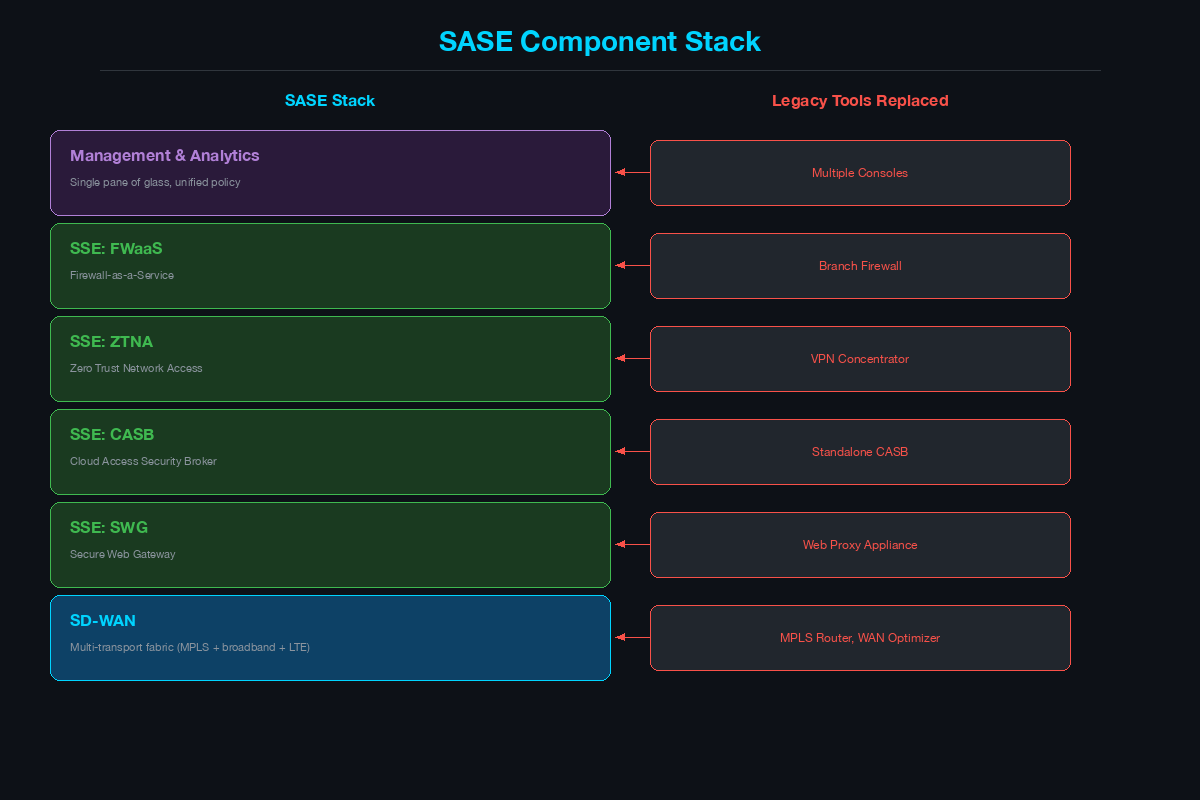
This is the single most important positioning shift. Stop saying “add SASE to your stack.” Start saying “SASE replaces these five tools.”
The Replacement Map
Walk the CISO through exactly what SASE replaces in their current environment:
| Current Tool | SASE Component That Replaces It |
|---|---|
| Standalone Secure Web Gateway (Blue Coat, Forcepoint) | SSE - Secure Web Gateway |
| VPN concentrator (ASA, GlobalProtect, Pulse Secure) | SSE - Zero Trust Network Access (ZTNA) |
| Branch firewall appliances (ASA, FortiGate, Meraki MX) | SSE - Firewall-as-a-Service (FWaaS) |
| Standalone CASB (Netskope, McAfee MVISION) | SSE - integrated CASB |
| DNS security appliance or service | SSE - DNS-layer security |
| MPLS-dependent WAN with VPN overlay | SD-WAN - multi-transport fabric |
| Standalone DLP (Symantec, Digital Guardian) | SSE - integrated DLP |
When the CISO sees that SASE is not tool number 81 but the platform that retires tools 47 through 53, the conversation shifts from resistance to interest.
How to Build the Replacement Map for a Specific Customer
Before the meeting, research the customer’s security stack. Sources include:
- Previous conversations and CRM notes - what tools did they mention in past meetings?
- Job postings - “experience with Zscaler, CrowdStrike, Splunk, and Palo Alto required” tells you their stack
- Technology partner portals - some vendors show customer logos or case studies
- LinkedIn - the security team’s skill endorsements reveal what tools they operate
Walk into the meeting with a pre-built replacement map specific to their environment. This demonstrates that you understand their operational reality - not just your product’s feature list.
The ROI Conversation Framework
CISOs approve budgets based on risk reduction and cost efficiency. Here is how to build the ROI case.
Cost of Maintaining 5 Tools vs. 1 Platform
Build this calculation collaboratively with the CISO. Use their actual numbers - estimated numbers feel like vendor math.
| Cost Category | 5 Standalone Tools | SASE Platform |
|---|---|---|
| Annual licensing | $400K-$800K (aggregate across SWG, CASB, VPN, branch FW, DNS) | $200K-$500K (single platform license) |
| Hardware (amortized) | $100K-$300K (VPN headends, branch firewalls, SWG appliances) | $50K-$100K (SD-WAN edge only; security is cloud-delivered) |
| Support contracts | $80K-$150K (per-vendor support) | $30K-$60K (single vendor) |
| Integration and maintenance | 2-3 FTEs dedicated to integration ($300K-$450K) | 0.5-1 FTE ($75K-$150K) |
| Training | $30K-$60K/year (multi-vendor certifications) | $10K-$20K/year (single platform) |
| Total annual TCO | $910K-$1.76M | $365K-$830K |
| 3-year savings | - | $1.6M-$2.8M |
These are illustrative ranges. The point is not the exact number - it is the framework. When the CISO fills in their actual costs, the math usually speaks for itself.
Risk Reduction Messaging
Cost savings alone do not justify platform changes for a CISO. Risk reduction is the stronger argument.
Policy consistency: When SWG, CASB, DLP, and FWaaS are separate tools, policy is defined in 4 different consoles with 4 different policy languages. Gaps between tools are inevitable. SASE enforces one policy framework across all functions - a DLP rule applies consistently whether the user is in the office, at home, or on a mobile device.
Faster detection: Disconnected tools send alerts to a SIEM, where correlation happens after the fact. An integrated SASE platform correlates DNS queries, web activity, cloud app usage, and private app access in real time - detecting threats that would take hours to correlate across separate tools.
Reduced attack surface: Every standalone appliance (VPN headend, branch firewall, SWG proxy) is an attack target with its own CVE history. Moving to cloud-delivered security eliminates these appliances and their associated patch management burden.
Zero Trust enforcement: SASE platforms implement Zero Trust natively - every connection is verified against identity, device posture, location, and behavior before access is granted. Achieving the same with 5 standalone tools requires complex integration that most organizations never complete.
The “Crawl-Walk-Run” Adoption Pitch
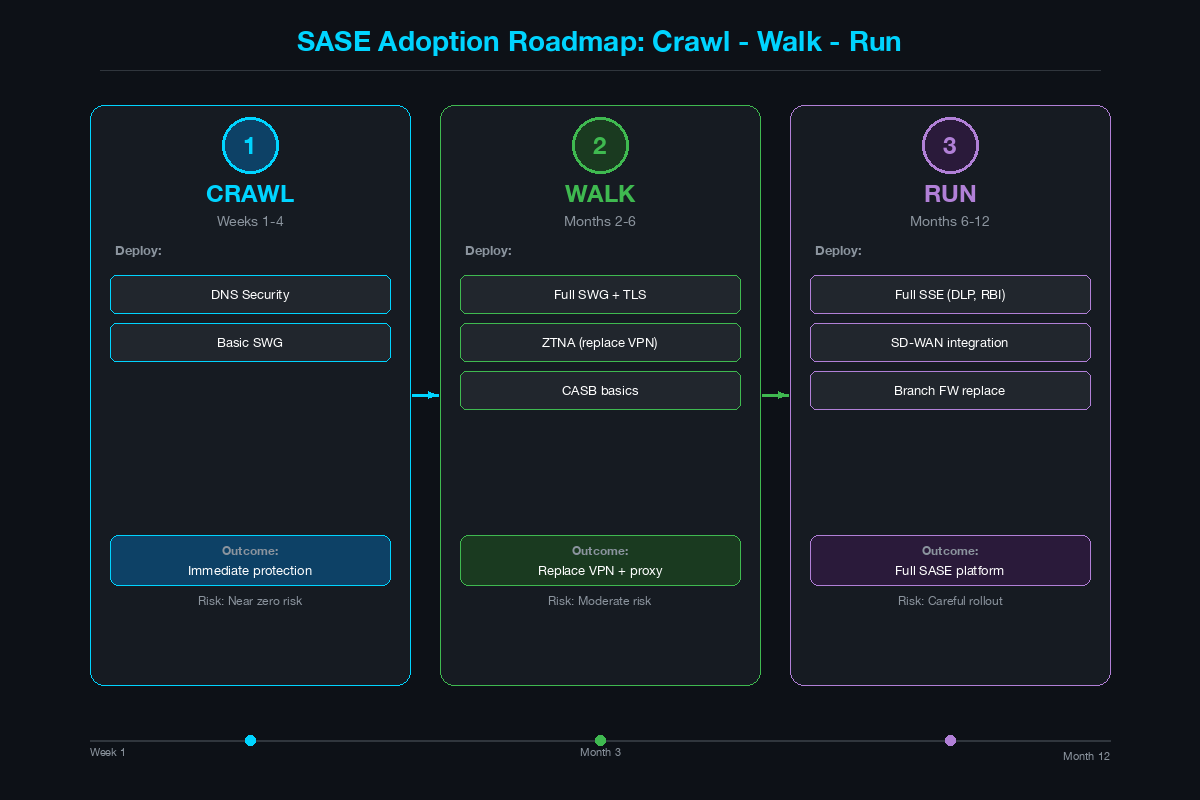
CISOs fear big-bang migrations. They have seen them fail - vendors who promise seamless migration but deliver months of parallel operation, broken integrations, and frustrated users. The crawl-walk-run approach addresses this fear directly.
Crawl: DNS-Layer Security (Weeks 1-4)
What you deploy: DNS-layer security (Cisco Umbrella or equivalent) across all locations by changing DNS resolver settings on DHCP servers, firewalls, or routers. No agent installation required.
What it replaces: Standalone DNS security tools, basic web filtering at the DNS layer.
What it proves: Immediate threat blocking (malicious domains, phishing, C2 callbacks). The CISO sees value in days, not months. Dashboards show blocked threats that the existing stack missed.
Risk level: Near zero. If DNS-layer security causes an issue (a false positive blocking a legitimate domain), it is resolved by adding a bypass entry. No user workflow changes.
Walk: SWG + ZTNA (Months 2-6)
What you deploy: Secure Web Gateway with TLS decryption and Zero Trust Network Access for managed endpoints. This requires the SASE agent on managed devices and certificate deployment for TLS inspection.
What it replaces: The standalone web proxy (SWG appliance), the VPN concentrator (ZTNA replaces full-tunnel VPN), and optionally the branch firewall for internet-bound traffic.
What it proves: Users connect to private applications via ZTNA without a traditional VPN - better performance, granular access control, and no exposed VPN headend. Web traffic is inspected inline with DLP, malware detection, and URL filtering - deeper protection than DNS-layer alone.
Risk level: Moderate. Agent deployment, certificate distribution, and VPN replacement require change management. Plan for a parallel period where both VPN and ZTNA are available.
Run: Full SSE + SD-WAN (Months 6-12)
What you deploy: CASB for SaaS visibility and control, DLP for data protection, FWaaS to replace branch firewalls, RBI for risky web categories, and SD-WAN for WAN transport optimization.
What it replaces: Standalone CASB, standalone DLP, branch firewall appliances, MPLS-dependent WAN architecture.
What it proves: Full SASE - security and networking converged, managed from a single console, with consistent policy across all users and locations. The CISO can now point to a measurable reduction in tool count, cost, and risk.
Risk level: Higher. SD-WAN migration affects network connectivity. CASB and DLP require tuning to avoid blocking legitimate business workflows. Plan for staged rollout with business unit coordination.
Why This Approach Works
- Value at every stage. The CISO does not commit to a 12-month migration hoping for a payoff at the end. Each phase delivers measurable improvements
- Off-ramp at every stage. If the platform does not perform, the customer can stop after crawl or walk without losing what they have deployed
- Budget spread. The CISO does not need to justify the full SASE investment upfront. Crawl can often be funded from existing DNS security budget. Walk replaces the VPN concentrator renewal. Run replaces branch firewall and CASB renewals
- Change management. Users experience minimal disruption because changes are introduced gradually
Handling Specific Objections
“We already have Zscaler.”
Do not attack Zscaler. The CISO chose it for a reason and will defend that decision.
Instead, ask: “Where does Zscaler not cover you today?”
Common gaps to explore:
- IoT and unmanaged devices: Zscaler requires the ZCC agent. Devices that cannot run agents (printers, IoT sensors, HVAC systems, medical devices) have no Zscaler coverage. DNS-layer security fills this gap without agents
- SD-WAN: Zscaler does not provide SD-WAN. If the customer is still running MPLS with VPN overlay, WAN optimization remains a separate problem
- On-premises security: Zscaler is cloud-only. If the customer has on-premises applications that require on-premises security (industrial OT networks, data center east-west traffic), Zscaler does not cover those use cases
Position your offering as complementary first. Once the customer sees the gaps, the consolidation conversation follows naturally.
“We already have Palo Alto everywhere.”
Acknowledge the strength of their investment. Then explore:
- Agent fatigue: GlobalProtect + Cortex XDR agent + Prisma Cloud agent - how many Palo Alto agents are running on each endpoint? Is the endpoint team managing three separate agents from the same vendor?
- Licensing complexity: Palo Alto’s licensing model (Threat Prevention, URL Filtering, WildFire, DNS Security, DLP, CASB - each as a separate subscription) can be expensive when fully enabled. What is the total cost across all Palo Alto products?
- Vendor lock-in risk: If everything is Palo Alto, a single vendor outage, vulnerability, or business decision affects the entire security stack. Has the CISO considered diversification risk?
“Our board just approved a 3-year contract with our current vendor.”
Respect the contract. This is not a deal you close today.
Position for the next cycle:
- “When does the contract come up for renewal? Let us schedule a review 6 months before renewal to benchmark the current platform against alternatives”
- “In the meantime, is there a gap in the current stack we can fill? DNS-layer security, SD-WAN, or ZTNA for a specific use case - without displacing the incumbent”
- Plant the seed: “When renewal comes, you will want three quotes. Let me make sure we are ready to deliver a competitive proposal”
“SASE is just marketing. It is a bunch of tools stitched together.”
This objection is partially valid - and acknowledging that builds credibility.
“You are right that some vendors slap a SASE label on a bundle of acquired products with separate management consoles. Here is how to tell the difference: ask the vendor three questions. First, is there a single management console for all SSE functions? Second, does policy follow the user across all access methods (office, remote, mobile) without separate configuration? Third, does the platform share threat intelligence across functions in real time or batch? If the answer to any of these is no, it is a bundle, not a platform.”
Then demonstrate that your SASE platform answers yes to all three.
Proof Points and Reference Strategy
What CISOs Trust
- Peer references. A CISO at a similar-sized company in the same industry who has deployed the platform and will take a call. This is the most powerful proof point. Build a reference library organized by vertical and company size
- Analyst validation. Gartner Magic Quadrant positioning, Forrester Wave rankings, and IDC market share data. CISOs use these to justify decisions to the board
- Quantified outcomes. Not “improved security posture” - but “reduced mean time to detect from 48 hours to 4 hours” or “eliminated 6 standalone tools, saving $1.2M annually.” Specific, measurable outcomes
What CISOs Do Not Trust
- Vendor case studies with no customer name. “A Fortune 500 financial institution” means nothing
- Feature comparison slides. Every vendor wins their own comparison
- Lab demos. CISOs want to see production deployments, not controlled demos
The Meeting Framework
Before the Meeting (Preparation)
- Research the customer’s current security stack (job postings, LinkedIn, past conversations)
- Build a replacement map: which specific tools does SASE replace in their environment?
- Prepare 2-3 peer references in the same vertical
- Calculate preliminary ROI using estimated tool costs (validate with the CISO during the meeting)
During the Meeting (Conversation Flow)
- Open with empathy: “I know you are managing dozens of security tools and the last thing you want is another platform. What I want to discuss is how to reduce that count.”
- Discovery: “Walk me through your current security architecture for a remote user accessing a SaaS application and a private application. How many tools does that traffic touch?”
- Replacement map: “Based on what you have told me, SASE replaces your [SWG], [VPN], [CASB], [branch firewall], and [DNS security]. That is five fewer tools, five fewer consoles, and five fewer vendor relationships.”
- ROI framework: “Let us calculate the cost of those five tools - licensing, hardware, support, and the staff time to manage them. Then compare it to a single SASE platform.”
- Crawl-walk-run: “We do not have to do this all at once. Start with DNS-layer security this quarter. If it delivers value, we move to SWG and ZTNA next quarter.”
- Proof points: “Here is a CISO at [reference company] in your vertical who made this exact transition. They are willing to share their experience.”
After the Meeting (Follow-Up)
- Send the replacement map and ROI framework within 24 hours
- Schedule the peer reference call
- Propose a crawl-phase pilot with specific success criteria and timeline
- Set a checkpoint meeting in 30 days to review pilot results
Summary
The CISO who does not want another platform is not saying no to SASE. They are saying no to complexity, no to another console, and no to another vendor relationship. Your job is to show that SASE is the opposite of what they fear - it is the strategy that reduces tools, simplifies operations, and consolidates vendors.
Lead with empathy. Build the replacement map. Quantify the ROI with their numbers. Offer the crawl-walk-run path. Back it up with peer references. And most importantly - acknowledge that SASE only works as a consolidation strategy if it actually replaces the tools it promises to replace.
Related Posts in This Series
- Umbrella vs Zscaler vs Prisma Access SSE - Compare the SSE platforms that make up the security side of SASE
- Cisco SD-WAN vs Traditional VPN - Understand the networking foundation of every SASE deployment
- Handling the 5 Most Common Security Objections - Navigate the objections CISOs raise during SASE conversations
- How to Run a Technical Discovery Call for Security Deals - Structure discovery to uncover the consolidation pain SASE solves
- Secure Remote Access: VPN vs ZTNA vs SASE - Position SASE remote access against legacy VPN and standalone ZTNA
Practice with free flashcards, quizzes, and hands-on lab scenarios at cciesec.it-learn.io — built specifically for the CCIE Security v6.1 written (350-701 SCOR) and lab exam.


