

XDR has become one of the most overloaded terms in cybersecurity. Every vendor claims to have it. Most customers are confused by it. And in too many sales conversations, XDR devolves into a feature checklist rather than a clear explanation of what the platform actually does and why it matters.
This guide cuts through the marketing. It explains what XDR is (and is not), compares the three dominant platforms - Palo Alto Cortex XSIAM, CrowdStrike Falcon, and Microsoft Sentinel - and gives you the positioning framework to recommend the right one for each customer profile.
What XDR Actually Is
The Problem XDR Solves
Traditional security operations suffer from three problems:
- Siloed visibility. EDR sees endpoints. NDR sees network traffic. CASB sees cloud apps. Email security sees phishing. Each tool sees one slice of an attack - none sees the full kill chain
- Alert overload. When every tool generates alerts independently, the SOC drowns in thousands of disconnected alerts per day. Analysts spend 80% of their time triaging and correlating, not investigating
- Manual response. An analyst detects a compromised endpoint via EDR, then manually pivots to the firewall to block the C2 IP, then manually checks the email gateway for the phishing message, then manually disables the user’s account in Active Directory. Each step is a different console, a different procedure, and a different delay
XDR solves these problems by:
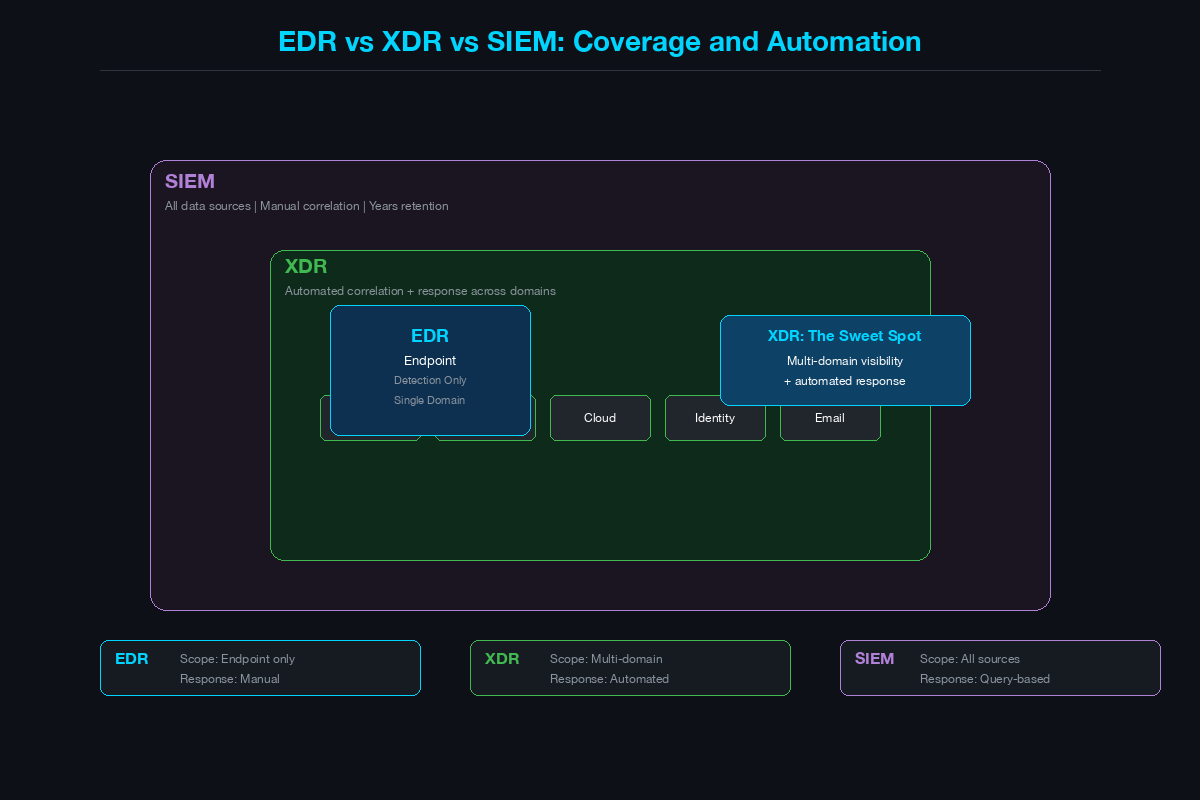
- Ingesting telemetry from multiple domains (endpoint, network, cloud, identity, email) into a single data lake
- Correlating events across domains using analytics, ML, and threat intelligence to surface complete attack stories rather than isolated alerts
- Automating response across all domains from a single console - isolate the endpoint, block the IP on the firewall, quarantine the email, and disable the account in one workflow
XDR vs. EDR vs. SIEM vs. SOAR
| Capability | EDR | SIEM | SOAR | XDR |
|---|---|---|---|---|
| Endpoint telemetry | Deep | Ingested via logs | No | Deep (native or ingested) |
| Network telemetry | Limited | Ingested via logs | No | Native or ingested |
| Cloud/identity telemetry | Limited | Ingested via logs | No | Native or ingested |
| Cross-domain correlation | No | Manual (queries/rules) | No | Automated (ML + analytics) |
| Automated response | Endpoint only | No (alert generation) | Playbook-based | Built-in cross-domain |
| Threat hunting | Endpoint-scoped | Full environment (if logs exist) | No | Full environment |
| Data retention | Days to weeks | Months to years | No | Weeks to months (varies) |
| Primary user | SOC analyst | SOC analyst / SIEM engineer | SOC automation | SOC analyst |
XDR is not a replacement for SIEM in every organization. Large enterprises with compliance-driven log retention requirements (years of data) still need a SIEM. XDR is a replacement for the operational workflow - the day-to-day detection and response that analysts perform. Some XDR platforms (like Cortex XSIAM) explicitly aim to replace the SIEM entirely. Others (like CrowdStrike) position alongside the SIEM as the detection and response layer.
The Three Platforms Compared
Palo Alto Cortex XSIAM
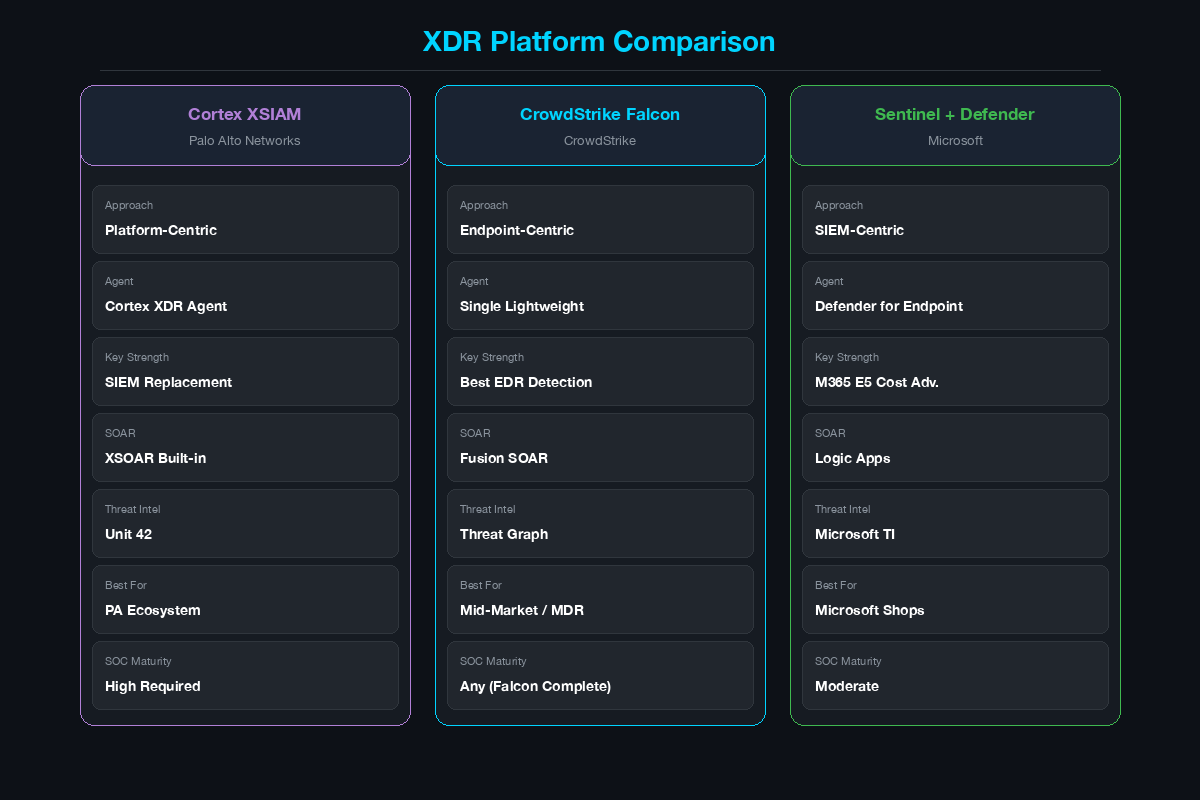
Architecture: Cortex XSIAM (Extended Security Intelligence and Automation Management) is Palo Alto’s bet to replace the SIEM entirely. It combines XDR, SIEM, SOAR, ASM (Attack Surface Management), and threat intelligence into a single cloud-delivered platform. XSIAM ingests data from Cortex XDR agents on endpoints, Palo Alto NGFWs and Prisma Access (network/cloud), third-party sources (via Cortex Data Lake), and identity providers. It uses ML-driven analytics to correlate events and reduce alert volume by up to 98% (Palo Alto’s claim).
Core strengths:
- SIEM replacement - eliminates the need for a separate Splunk, QRadar, or Sentinel deployment
- Native integration with Palo Alto firewalls, Prisma Access, and Prisma Cloud
- XSOAR (SOAR) built into the platform for automated response playbooks
- Stitched alerts - correlates individual alerts into incidents automatically, reducing analyst workload
- Attack Surface Management - discovers and monitors external-facing assets
Core limitations:
- Requires significant Palo Alto ecosystem adoption for maximum value
- Pricing based on data ingestion volume can be expensive for high-volume environments
- Newer platform with a smaller installed base compared to CrowdStrike
- Steep learning curve for teams not already experienced with Cortex
CrowdStrike Falcon
Architecture: CrowdStrike Falcon is a cloud-native platform built on a single lightweight agent that provides EDR, XDR, threat intelligence, vulnerability management, IT hygiene, and identity protection. The Falcon platform started as best-in-class EDR and expanded outward. The single agent collects endpoint telemetry and sends it to CrowdStrike’s Threat Graph - a cloud-based graph database that correlates events across the entire customer base. XDR capabilities extend beyond endpoints through integrations with network (via CrowdStrike Falcon Discover), cloud (Falcon Cloud Security), and identity (Falcon Identity Threat Detection).
Core strengths:
- Best-in-class endpoint detection - consistently leads in MITRE ATT&CK evaluations
- Single lightweight agent with minimal endpoint performance impact
- Fastest time-to-value - deploy across thousands of endpoints in hours, not weeks
- Falcon Complete - turnkey MDR service for customers without a SOC
- Threat Graph - crowdsourced threat intelligence from millions of endpoints
- Strong identity threat detection (acquired Preempt) for Active Directory attack detection
Core limitations:
- XDR data sources beyond endpoints require additional modules and integrations
- Not a SIEM replacement - does not handle long-term log retention or compliance reporting
- Network detection relies on integrations rather than native network sensors
- Premium pricing - CrowdStrike is typically the most expensive per-endpoint option
Microsoft Sentinel + Defender XDR
Architecture: Microsoft’s XDR story is two platforms working together. Microsoft Defender XDR (formerly Microsoft 365 Defender) provides native detection and response for endpoints (Defender for Endpoint), email (Defender for Office 365), identity (Defender for Identity - Active Directory), and cloud apps (Defender for Cloud Apps). Microsoft Sentinel is the cloud-native SIEM/SOAR layer that ingests telemetry from Defender XDR, Azure services, and 300+ third-party data connectors, providing cross-domain correlation, KQL-based hunting, and automated playbooks via Logic Apps.
Core strengths:
- If the customer has Microsoft 365 E5, Defender XDR is included at no additional licensing cost - the most cost-effective entry point to XDR
- Native integration with Azure AD, Microsoft 365, Azure, and Intune - unmatched for Microsoft-centric environments
- Sentinel’s data connector library (300+) ingests from almost any third-party source
- KQL (Kusto Query Language) is powerful for advanced threat hunting
- Copilot for Security - AI-assisted investigation and response (emerging capability)
- Compliance and log retention at cloud-native scale
Core limitations:
- Best when the customer is heavily invested in Microsoft - less compelling for non-Microsoft environments
- Defender for Endpoint detection quality, while improved significantly, still trails CrowdStrike in some independent evaluations
- Sentinel costs can escalate rapidly with high data ingestion volumes
- The two-platform architecture (Defender XDR + Sentinel) can be confusing - it is not a single unified console
- Requires Azure subscription for Sentinel
Detection Capabilities Comparison
| Detection Capability | Cortex XSIAM | CrowdStrike Falcon | Microsoft Sentinel + Defender XDR |
|---|---|---|---|
| Endpoint Detection | Cortex XDR agent - strong (MITRE ATT&CK validated) | Falcon agent - industry-leading (MITRE ATT&CK leader) | Defender for Endpoint - strong (significantly improved) |
| Network Detection | Via Palo Alto NGFW telemetry + third-party ingestion | Via integrations (not native NDR) | Via Azure Network Watcher, NSG flow logs, third-party |
| Identity Threat Detection | Via XSIAM identity analytics | Falcon Identity Threat Detection (AD monitoring) | Defender for Identity (AD monitoring - native) |
| Email Threat Detection | Via third-party email log ingestion | Via integrations | Defender for Office 365 - native (strongest for M365) |
| Cloud Workload Detection | Prisma Cloud integration | Falcon Cloud Security | Defender for Cloud - native for Azure, supports AWS/GCP |
| Behavioral Analytics | ML-driven anomaly detection | Threat Graph behavioral analytics | UEBA (User and Entity Behavior Analytics) in Sentinel |
| Custom Detection Rules | XSIAM Query Language (XQL) | CrowdStrike Query Language (CQL) | KQL (Kusto Query Language) in Sentinel |
| Threat Intelligence | Unit 42 + AutoFocus | CrowdStrike Intelligence (Adversary Universe) | Microsoft Threat Intelligence + third-party TI feeds |
Response Automation Comparison
| Response Capability | Cortex XSIAM | CrowdStrike Falcon | Microsoft Sentinel + Defender XDR |
|---|---|---|---|
| Endpoint Isolation | Native (Cortex XDR agent) | Native (Falcon agent) | Native (Defender for Endpoint) |
| File Quarantine | Native | Native | Native |
| Process Kill | Native | Native | Native |
| Network Containment | Via Palo Alto NGFW integration | Via firewall integrations | Via Azure NSG, firewall integrations |
| User Account Disable | Via identity provider integration | Via AD/Azure AD integration | Native (Azure AD) |
| Email Quarantine | Via third-party integration | Via email integrations | Native (Defender for Office 365) |
| Playbook Automation | XSOAR built-in (500+ playbooks) | Fusion SOAR (workflow automation) | Logic Apps + Sentinel Playbooks |
| Custom Playbooks | XSOAR playbook editor (Python-based) | Fusion workflows | Logic Apps (low-code/no-code) |
| Managed Response | Cortex XMDR (managed service) | Falcon Complete (MDR - market leader) | Microsoft Defender Experts |
CrowdStrike Falcon Complete deserves special attention. It is a fully managed detection and response service where CrowdStrike’s team handles alerting, investigation, and response on behalf of the customer. For mid-market organizations without a dedicated SOC, Falcon Complete effectively outsources security operations to CrowdStrike - and it is one of the most mature MDR offerings in the market.
Data Sources and Integrations
| Data Source | Cortex XSIAM | CrowdStrike Falcon | Microsoft Sentinel |
|---|---|---|---|
| Endpoints (native) | Cortex XDR agent | Falcon agent | Defender for Endpoint |
| Firewalls | Palo Alto NGFW (native), third-party via syslog | Third-party via syslog/API | Third-party via data connectors (300+) |
| Cloud platforms | AWS, Azure, GCP via Prisma Cloud + Cortex Data Lake | AWS, Azure, GCP via Falcon Cloud Security | Azure (native), AWS/GCP via Defender for Cloud |
| Identity | Azure AD, Okta, Ping via ingestion | Active Directory (native), Azure AD, Okta | Azure AD / Entra ID (native), third-party via connectors |
| Via third-party log ingestion | Via integrations | Microsoft 365 (native via Defender for Office 365) | |
| Network | Palo Alto NGFW, third-party NDR | Third-party NDR, flow data | Azure NSG, third-party via connectors |
| Third-party connectors | Cortex Data Lake ingestion (broad but requires configuration) | CrowdStrike Marketplace integrations | 300+ built-in data connectors (broadest ecosystem) |
| Custom data | API ingestion, syslog | API ingestion | Custom data connectors, API, Log Analytics agent |
Microsoft Sentinel has the broadest third-party data connector ecosystem - 300+ pre-built connectors covering virtually every security and IT tool on the market. This makes Sentinel a strong SIEM/XDR choice for heterogeneous environments where the customer runs tools from many vendors.
Pricing and Licensing
| Aspect | Cortex XSIAM | CrowdStrike Falcon | Microsoft Sentinel + Defender XDR |
|---|---|---|---|
| Pricing Model | Data ingestion (GB/day) + endpoint count | Per endpoint, per year (tiered bundles) | Sentinel: per GB ingested; Defender XDR: included in M365 E5 |
| Entry Bundle | Custom scoping required | Falcon Go (~$5/endpoint/month) | Defender XDR: $0 additional if M365 E5; Sentinel: pay-per-GB |
| Mid-Tier Bundle | Custom scoping | Falcon Enterprise (~$10-12/endpoint/month) | Sentinel commitment tiers for volume discounts |
| Full Bundle | Custom scoping | Falcon Elite/Complete (~$15-18/endpoint/month) | Sentinel + Defender XDR + Copilot for Security |
| MDR Add-On | Cortex XMDR (additional cost) | Falcon Complete (included in top tier or add-on) | Microsoft Defender Experts (additional cost) |
| Hidden Costs | Data ingestion overages, Cortex Data Lake storage | Module add-ons (Identity, Cloud, LogScale) | Sentinel data ingestion at scale, Logic Apps execution |
| Cost Advantage | Replaces SIEM - potential savings for customers paying for Splunk/QRadar | Simple per-endpoint pricing - easy to budget | Near-zero marginal cost for M365 E5 customers |
The Microsoft E5 Factor
This is the single most important pricing consideration in XDR evaluations. If the customer has Microsoft 365 E5 licenses (common in enterprises), they already have Defender for Endpoint, Defender for Office 365, Defender for Identity, and Defender for Cloud Apps included in their license. Adding Sentinel for SIEM/SOAR is the only incremental cost - and Sentinel’s per-GB pricing starts at a fraction of what standalone XDR platforms charge.
For a 5,000-endpoint organization already on M365 E5, the effective XDR cost comparison looks like this:
| Platform | Annual Cost Estimate |
|---|---|
| CrowdStrike Falcon Enterprise | ~$600K-$720K |
| Cortex XSIAM | ~$400K-$800K (varies by data volume) |
| Microsoft Defender XDR + Sentinel | ~$50K-$150K (Sentinel ingestion only; Defender included in E5) |
This cost difference is why Microsoft is winning XDR deals in enterprises that are already committed to the Microsoft ecosystem. The detection quality gap between Defender for Endpoint and CrowdStrike has narrowed significantly - and for many customers, the cost savings justify any remaining gap.
Deployment Complexity
| Factor | Cortex XSIAM | CrowdStrike Falcon | Microsoft Sentinel + Defender XDR |
|---|---|---|---|
| Agent Deployment | Cortex XDR agent (moderate complexity) | Falcon agent (simplest - single lightweight agent) | Defender for Endpoint (GPO/Intune - native for Windows) |
| Infrastructure | Cloud-delivered (no on-premises infrastructure) | Cloud-delivered (no on-premises infrastructure) | Cloud-delivered (Azure subscription required for Sentinel) |
| Time to Value (Endpoint) | Days to weeks | Hours to days | Hours to days (if M365 E5 exists) |
| Time to Value (Full XDR) | Weeks to months | Weeks to months | Weeks to months |
| Learning Curve | Steep (XSIAM/XQL, XSOAR playbooks) | Moderate (intuitive SaaS UI) | Moderate to steep (KQL, Logic Apps, Panorama of Defender consoles) |
| SOC Maturity Required | High (designed for mature SOCs) | Low to high (Falcon Complete fills the gap for immature SOCs) | Moderate (built-in analytics rules reduce tuning effort) |
Customer Profile Fit
Enterprise with Palo Alto Security Stack
Best fit: Cortex XSIAM
The customer runs Palo Alto NGFWs, Prisma Access, and Prisma Cloud. XSIAM ingests telemetry from all of these natively through Cortex Data Lake, providing unified detection and response across network, cloud, and endpoint without third-party integration. XSIAM’s SIEM replacement capability means the customer can decommission Splunk or QRadar, consolidating detection, investigation, and response into a single platform. The ROI story is compelling: one platform replacing SIEM + SOAR + EDR + NDR.
Mid-Market without a Dedicated SOC
Best fit: CrowdStrike Falcon (with Falcon Complete)
The customer has 500-3,000 endpoints, 1-2 security staff, and no dedicated SOC. CrowdStrike Falcon deploys in hours, provides immediate endpoint protection, and Falcon Complete delivers 24/7 managed detection and response without requiring the customer to build SOC capabilities. The single agent covers EDR, vulnerability management, IT hygiene, and identity threat detection. The customer gets enterprise-grade security operations without enterprise-grade headcount.
Microsoft-Centric Enterprise
Best fit: Microsoft Sentinel + Defender XDR
The customer runs Microsoft 365 E5, Azure AD (Entra ID), Azure IaaS, and Intune. Defender XDR is already licensed and provides endpoint, email, identity, and cloud app detection with zero additional cost. Sentinel adds SIEM/SOAR capabilities, cross-domain correlation with third-party data sources, and KQL-based hunting. The total cost of XDR is a fraction of alternatives because the endpoint and identity detection layer is included in existing licenses. This customer would be paying twice for the same capability if they deployed CrowdStrike or Cortex on top of their Microsoft stack.
Enterprise with Multi-Vendor Security Stack
Best fit: Microsoft Sentinel (as SIEM/XDR) + best-of-breed EDR (CrowdStrike or Cortex XDR)
The customer runs a heterogeneous security stack - CrowdStrike for endpoints, Palo Alto for network, Okta for identity, and AWS for cloud. No single XDR platform covers all these domains natively. Sentinel’s 300+ data connectors ingest telemetry from all of them, providing cross-domain correlation and automated response. CrowdStrike handles endpoint detection (best-in-class), and Sentinel handles the SIEM/XDR correlation layer across all data sources.
Large Enterprise Replacing an Aging SIEM
Best fit: Cortex XSIAM
The customer is running an on-premises Splunk or QRadar deployment with escalating licensing costs and storage management overhead. XSIAM is explicitly designed to replace the SIEM by combining SIEM, SOAR, and XDR functionality. The customer eliminates SIEM infrastructure management, reduces alert volume through ML-driven correlation, and gains XDR capabilities that their current SIEM does not provide. The migration is complex but the long-term operational savings and capability uplift justify the effort.
Competitive Differentiation Talking Points
When Selling Against CrowdStrike
- If you are positioning Cortex XSIAM: “CrowdStrike is excellent at endpoint detection, but it is not a SIEM. You still need Splunk or QRadar alongside Falcon, which means two platforms, two budgets, and two teams. XSIAM replaces both - XDR and SIEM in a single platform”
- If you are positioning Microsoft: “CrowdStrike charges $10-18 per endpoint per month. If you have M365 E5, Defender for Endpoint is included. The detection gap has narrowed - is CrowdStrike’s marginal advantage worth $600K+ per year?”
When Selling Against Microsoft
- If you are positioning CrowdStrike: “Defender for Endpoint has improved, but CrowdStrike consistently leads in independent evaluations like MITRE ATT&CK. When a breach happens, the detection quality difference between ‘good’ and ‘best’ is the difference between catching the attacker in minutes or days”
- If you are positioning Cortex XSIAM: “Sentinel is a strong SIEM, but it is still SIEM-centric. XSIAM is built for XDR - ML-driven correlation that reduces alerts by 98%, built-in SOAR, and native integration with Palo Alto’s network and cloud security. Sentinel requires Logic Apps, custom playbooks, and manual tuning to achieve the same automation”
When Selling Against Cortex XSIAM
- If you are positioning CrowdStrike: “XSIAM is powerful but complex. It requires a mature SOC team, Palo Alto ecosystem adoption, and significant tuning. CrowdStrike deploys in hours, and Falcon Complete gives you a world-class SOC without building one. Which does your team need - a platform or a partner?”
- If you are positioning Microsoft: “XSIAM’s data ingestion pricing can be unpredictable at scale. Sentinel’s per-GB pricing with commitment tiers is transparent. And if you already have M365 E5, the Defender XDR layer is free - XSIAM would be an additional cost on top of what you already own”
Summary: Quick-Reference Decision Matrix
| Decision Factor | Cortex XSIAM | CrowdStrike Falcon | Microsoft Sentinel + Defender XDR |
|---|---|---|---|
| Best endpoint detection | Strong | Industry-leading | Strong (improved significantly) |
| SIEM replacement | Yes (core design goal) | No (complements SIEM) | Sentinel is the SIEM |
| Fastest deployment | Weeks | Hours to days | Hours to days (if M365 E5) |
| Lowest cost for M365 E5 customers | No | No | Yes (Defender included in E5) |
| Best for no-SOC organizations | No (requires mature SOC) | Yes (Falcon Complete MDR) | Moderate (Defender Experts) |
| Best for Palo Alto shops | Yes (native integration) | No | No |
| Best for multi-vendor environments | Moderate | Strong (endpoint) | Strong (Sentinel connectors) |
| Response automation | XSOAR (most mature) | Fusion SOAR (growing) | Logic Apps (flexible but manual) |
| Threat intelligence | Unit 42 | CrowdStrike Intelligence | Microsoft TI |
XDR is not one thing - it is a spectrum from endpoint-centric (CrowdStrike) to SIEM-centric (Microsoft) to platform-centric (Cortex XSIAM). The right platform depends on the customer’s existing stack, SOC maturity, and budget. Know all three well enough to recommend the one that fits - and know when the answer is a combination rather than a single platform.
Related Posts in This Series
- MITRE ATT&CK Framework Explained for Solutions Engineers - Map XDR detection capabilities to the ATT&CK techniques they cover
- The SE’s Guide to Reading a Vulnerability Report - Understand the vulnerability data XDR platforms ingest and correlate
- Incident Response Plan Template - Build the IR plan that XDR platforms operationalize
- Email Security Stack Comparison - See how email security telemetry feeds into XDR correlation
- How to Demo a Firewall Without Boring the Room - Apply engaging demo techniques when showing XDR dashboards and workflows
Practice with free flashcards, quizzes, and hands-on lab scenarios at cciesec.it-learn.io — built specifically for the CCIE Security v6.1 written (350-701 SCOR) and lab exam.


