

Every solutions engineer in cybersecurity has heard it. You are twenty minutes into a discovery call, the technical champion is nodding along, and then the economic buyer leans in: “We already have a firewall. We’re good.”
That single sentence has stalled more security deals than any competitor ever could. Not because the objection is valid - but because most SEs respond poorly. They either get defensive, launch into a feature dump, or worse, try to scare the customer into buying.
This guide breaks down the five most common security objections, explains why customers raise them, and gives you a repeatable framework to handle each one without burning trust.
The Rebuttal Framework: Acknowledge, Reframe, Evidence, Next Step
Before diving into specific objections, you need a structure. Winging it leads to rambling. Arguing leads to lost deals. The AREN framework gives you a repeatable process for every objection.
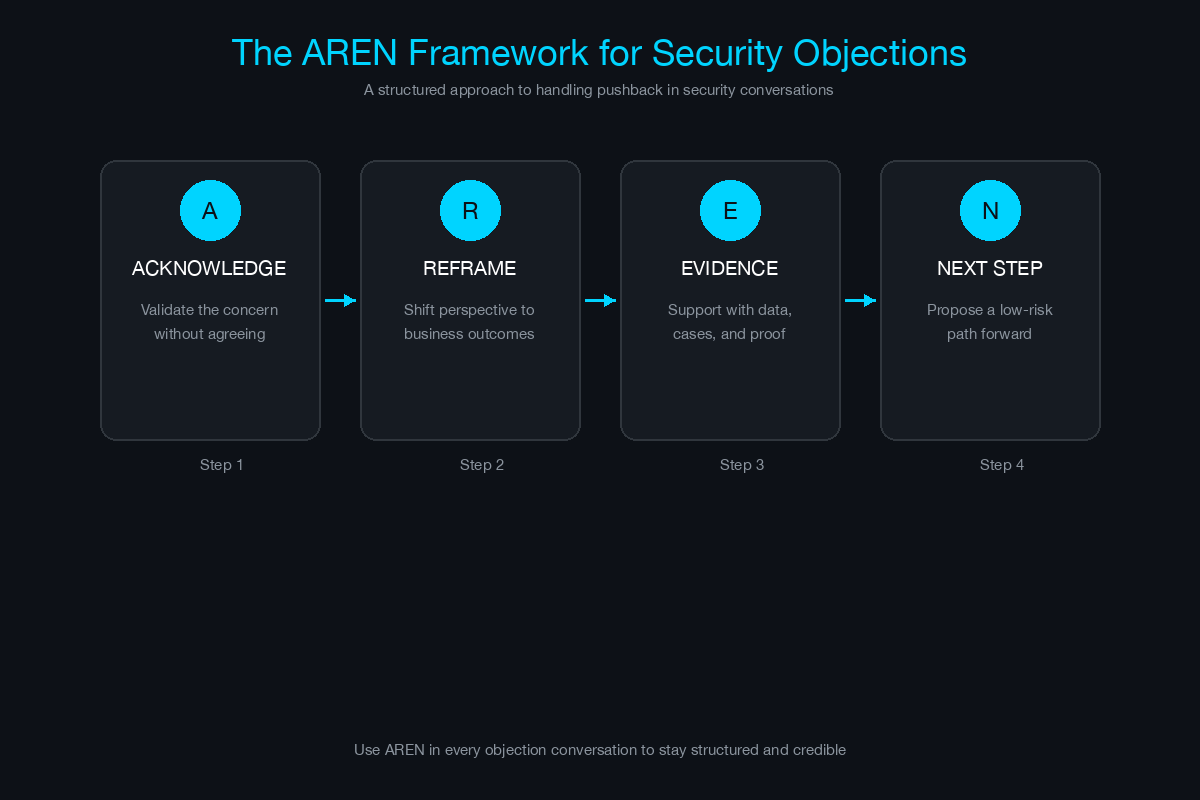
The Four Steps
Step 1 - Acknowledge. Validate the customer’s concern. They are not wrong for raising it. They have constraints, existing investments, and internal politics you may not fully understand. Start by showing you heard them.
Step 2 - Reframe. Introduce a perspective they have not considered. This is not about proving them wrong. It is about expanding the frame so they see the gap between their current state and the threat landscape.
Step 3 - Evidence. Back your reframe with data. Breach statistics, industry benchmarks, compliance requirements, or a live technical demonstration. Abstract claims are easy to dismiss. Concrete evidence is not.
Step 4 - Next Step. Propose a low-friction action that keeps the conversation moving. A risk assessment, architecture review, or scoped POC. Never end on the evidence - always give them somewhere to go.
Objection 1: “We Already Have a Firewall”
Why Customers Say It
This objection comes from a mental model where security equals perimeter defense. The customer bought a firewall (possibly a next-gen firewall), it is operational, and they believe their network is protected. In their mind, adding another security tool is redundant.
Many customers also conflate “firewall” with “security platform.” If their NGFW vendor marketed the product as an all-in-one solution, they genuinely believe they have endpoint protection, threat intelligence, and network segmentation covered.
The Technical Reality
Firewalls inspect traffic at network boundaries. They are essential - but they have well-documented blind spots:
- Lateral movement - Once an attacker is inside the network, east-west traffic between endpoints often bypasses the firewall entirely. Most firewalls only inspect north-south traffic at the perimeter.
- Encrypted traffic - While NGFWs can perform TLS inspection, many organizations disable it due to performance impact or certificate management complexity. Attackers know this.
- Identity-based attacks - Credential theft, pass-the-hash, and Kerberos abuse happen at the identity layer. Firewalls do not authenticate users at every hop.
- Endpoint compromise - Phishing delivers malware directly to the endpoint. The firewall sees the initial connection but cannot detect what executes locally.
- Cloud and SaaS - Traffic to sanctioned SaaS applications often bypasses the on-premises firewall entirely, especially for remote workers.
The AREN Rebuttal
Acknowledge: “Your firewall is a critical piece of your security architecture, and it sounds like your team has invested real effort in getting it configured properly.”
Reframe: “The challenge we are seeing across the industry is that 70% of breaches now involve lateral movement after initial access - and that is traffic your firewall was never designed to inspect. The perimeter is still important, but the attack surface has moved inside the network.”
Evidence: Reference the 2023 MGM Resorts breach. Attackers used social engineering to gain initial access, then moved laterally through the network for days. MGM had perimeter firewalls. The estimated cost exceeded $100 million in lost revenue and remediation. The gap was not perimeter security - it was visibility and control inside the network.
Next Step: “What if we ran a network visibility assessment? We can show you the east-west traffic patterns in your environment and identify where your firewall coverage ends. No commitment - just data you can use regardless of what you decide.”
Objection 2: “We Don’t Have Budget”
Why Customers Say It
Sometimes this is literally true. The budget cycle closed, funds are allocated, and there is no discretionary spending left. But more often, “no budget” means “I don’t see enough value to fight for budget.” It is a priority objection disguised as a financial one.
In cybersecurity specifically, budget often exists but is allocated elsewhere - infrastructure refresh, cloud migration, or application development. Security competes with projects that have more visible business outcomes.
The Technical Reality
The cost of NOT investing in security is quantifiable:
- Average data breach cost: $4.88 million globally (IBM Cost of a Data Breach Report, 2024)
- Average time to identify a breach: 194 days
- Average time to contain a breach: 64 days
- Ransomware average payment: $1.5 million (Sophos State of Ransomware, 2024)
- Compliance fines: PCI DSS violations range from $5,000 to $100,000 per month. GDPR fines can reach 4% of annual global turnover.
These are not theoretical numbers. They represent real costs that organizations pay when security gaps are exploited.
The AREN Rebuttal
Acknowledge: “I completely understand. Every team I work with is managing competing priorities with limited resources. Budget is a real constraint.”
Reframe: “The way I think about it - and what I have seen CISOs present to their boards - is that security spend is not a cost center. It is risk transfer. The question is whether it is cheaper to invest in prevention now or pay for incident response, legal fees, regulatory fines, and business disruption later.”
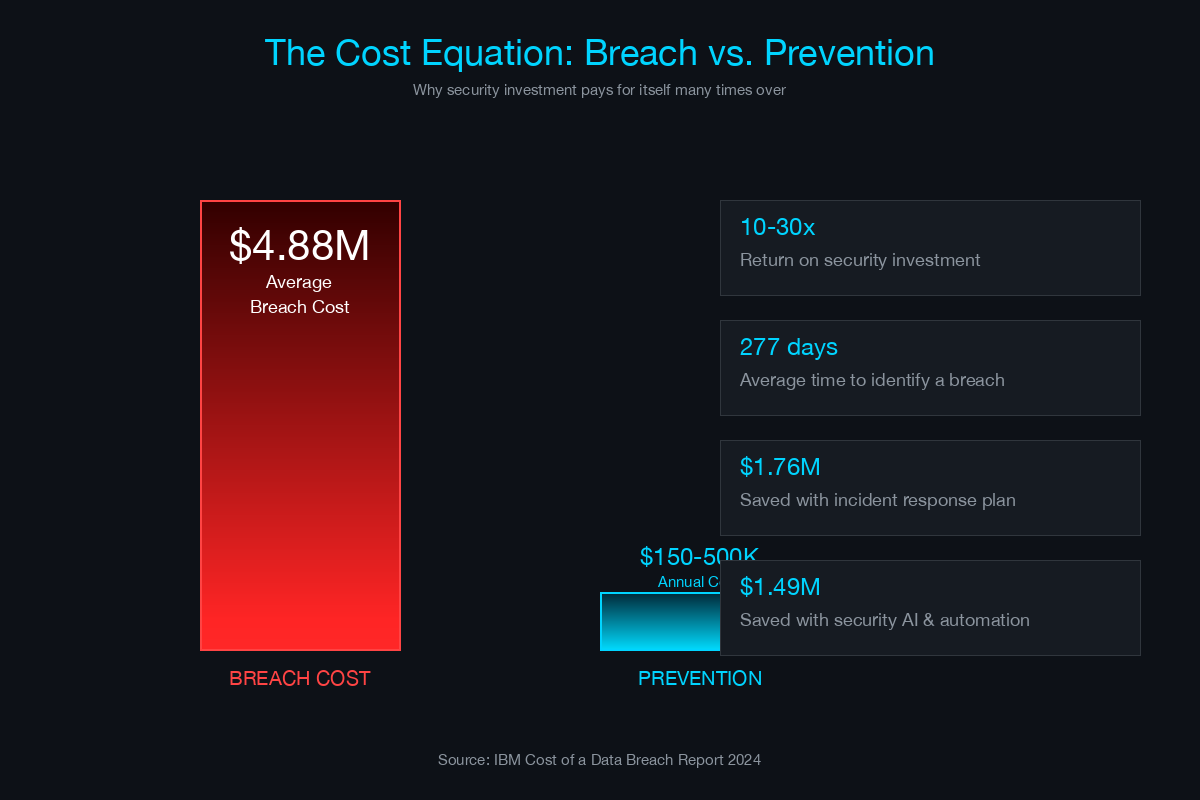
Evidence: Build a simple cost comparison on the whiteboard or in a shared document:
| Category | Without Solution | With Solution |
|---|---|---|
| Annual breach probability (industry avg.) | 25-30% | Reduced by 60-80% |
| Average breach cost | $4.88M | Mitigated |
| Compliance audit remediation | $150K-500K/year | Automated |
| Manual security operations | 2-3 FTE hours/day | Reduced by 70% |
| Cyber insurance premium | Increasing 20-30%/year | Stabilized or reduced |
Next Step: “I can help you build a one-page business case that maps the solution cost against these risk metrics. That gives you ammunition for the budget conversation internally. Would that be useful?”
Objection 3: “Our Team Can’t Manage Another Tool”
Why Customers Say It
This is the most legitimate objection on the list. Security teams are genuinely overwhelmed. The average enterprise runs 60-80 security tools. Alert fatigue is real. Adding another console, another set of policies, and another integration project is a genuine burden.
IT and security staff turnover is also a factor. Teams that are understaffed and undertrained reasonably resist adding complexity to their environment.
The Technical Reality
Tool sprawl is a recognized problem in cybersecurity. But the answer is not fewer tools - it is better-integrated tools and operational efficiency. The right solution should:
- Consolidate visibility rather than fragment it
- Automate responses that currently require manual intervention
- Integrate with existing infrastructure (SIEM, SOAR, ticketing systems)
- Reduce operational workload through policy automation and centralized management
The key metric is not “number of tools” - it is “hours spent per security event.” If a new tool reduces mean time to detect (MTTD) and mean time to respond (MTTR), it is a net reduction in operational burden, not an increase.
The AREN Rebuttal
Acknowledge: “That is a completely fair concern, and I hear it from almost every security team I work with. Nobody wants another dashboard to babysit.”
Reframe: “The question I would ask is: what is your team spending time on today that this solution would eliminate? If your analysts are spending three hours a day manually correlating logs, triaging alerts, or chasing down rogue devices, and this tool automates 70% of that - you are actually giving your team time back, not adding to their workload.”
Evidence: Walk through a day-in-the-life comparison:
Current state (without the solution):
- Analyst receives alert from SIEM (5 minutes)
- Manually queries three different tools for context (15 minutes)
- Determines affected endpoints (10 minutes)
- Manually applies remediation (20 minutes)
- Documents the incident (10 minutes)
- Total: 60 minutes per incident, 8-12 incidents per day
Future state (with the solution):
- Platform auto-correlates alert with endpoint, identity, and network context (automatic)
- Analyst reviews pre-built investigation summary (5 minutes)
- One-click remediation with automated policy enforcement (2 minutes)
- Auto-generated incident documentation (automatic)
- Total: 7 minutes per incident
Next Step: “Can we schedule a 30-minute session with your Tier 1 analysts? I would like to understand their daily workflow and show them specifically how this would change their day-to-day. If they do not see the value, we stop the conversation.”
Objection 4: “We Haven’t Been Breached, So We’re Fine”
Why Customers Say It
This is survivorship bias in action. The customer has operated without a major incident (that they know of), and they interpret this as evidence that their current security posture is adequate. It is the same logic as not wearing a seatbelt because you have never been in a car accident.
There is also a psychological component. Acknowledging vulnerability is uncomfortable, especially for technical leaders who built the current architecture. Admitting gaps feels like admitting failure.
The Technical Reality
The premise is almost certainly wrong. Consider:
- Dwell time: The average attacker remains undetected in a network for 194 days (IBM, 2024). Many organizations have been breached and simply do not know it yet.
- Undetected exfiltration: Data theft does not always trigger alerts. Attackers who move slowly and use legitimate protocols (DNS, HTTPS) can exfiltrate data for months without detection.
- Regulatory changes: Compliance frameworks are tightening. What was “good enough” two years ago may not pass the next audit. PCI DSS 4.0 requirements, updated NIST CSF 2.0 controls, and expanding SEC cyber disclosure rules are raising the bar.
- Insurance requirements: Cyber insurance carriers are now requiring specific controls (MFA, EDR, NAC, segmentation) as conditions for coverage. No controls, no coverage - or dramatically higher premiums.
The AREN Rebuttal
Acknowledge: “That is great to hear, and clearly your team has been doing solid work maintaining your environment. Not every organization can say that.”
Reframe: “The challenge is that absence of evidence is not evidence of absence. The organizations that make the news - Colonial Pipeline, MGM, Change Healthcare - all thought they were fine until they were not. The average dwell time for an attacker is over six months. The honest question is: if someone was in your network right now moving slowly and using legitimate credentials, would your current tools detect them?”
Evidence: Offer a concrete data point. In the 2024 Mandiant M-Trends report, 54% of compromised organizations were notified by an external party (law enforcement, a customer, or the attacker themselves via ransom note) rather than detecting the breach internally. More than half of breached organizations did not know they were breached until someone else told them.
Next Step: “What if we ran a compromise assessment? It is a one-time engagement - we deploy sensors in your environment for two weeks and look for indicators of compromise, lateral movement, and policy violations. If we find nothing, you have documentation that your security posture is solid. If we find something, you caught it early. Either way, you win.”
Objection 5: “We’re Waiting for Next Fiscal Year”
Why Customers Say It
This objection is about timing, not value. The customer may genuinely agree they need the solution, but the budget cycle does not align. Alternatively, they may be using timing as a polite way to defer a decision they are not ready to make.
In enterprise sales, fiscal year timing is a real constraint. Capital expenditure budgets are set 6-12 months in advance, and discretionary spending is often frozen in Q3 and Q4.
The Technical Reality
Attackers do not wait for fiscal years. The threat landscape does not pause because your procurement cycle has a six-month lead time. Every month of delay is a month of exposure.
More practically, waiting creates compounding risks:
- Compliance deadlines do not move. PCI DSS 4.0 enforcement deadlines, DORA requirements for financial services, and CMMC requirements for defense contractors are on fixed timelines.
- Insurance renewals happen on their own schedule. If your carrier requires specific controls at renewal and you have not implemented them, premiums increase or coverage is denied.
- Breach costs increase with time. The longer a gap exists, the more data is at risk, the more endpoints are unprotected, and the more expensive remediation becomes post-breach.
The AREN Rebuttal
Acknowledge: “I understand, and budget cycles are what they are. I would never pressure you into a timeline that does not work for your organization.”
Reframe: “What I can help with is making sure you are ready to move when the budget opens. The organizations that deploy fastest after budget approval are the ones that did the pre-work: scoping, architecture design, success criteria, and internal alignment. If we do that work now, you can go from approval to production in weeks instead of months.”
Evidence: Present a timeline comparison:
Without pre-work (starting from scratch in the new fiscal year):
- Month 1-2: Vendor evaluation and RFP
- Month 3: POC scoping and lab setup
- Month 4: POC execution
- Month 5: Results analysis and business case
- Month 6: Procurement and contracts
- Month 7: Deployment begins
- Total: 7 months from budget approval to production
With pre-work (starting technical validation now):
- Now through fiscal year: Architecture review, POC, success criteria defined
- Month 1 after approval: Procurement (pre-negotiated terms)
- Month 2: Production deployment
- Total: 2 months from budget approval to production
Next Step: “Let me propose this: we run a no-cost architecture review and scoped POC between now and your fiscal year. You get hands-on validation, your team gets trained, and when budget opens you have a shovel-ready project with proven results. Can we schedule the scoping call for next week?”
The Objection Handling Cheat Sheet
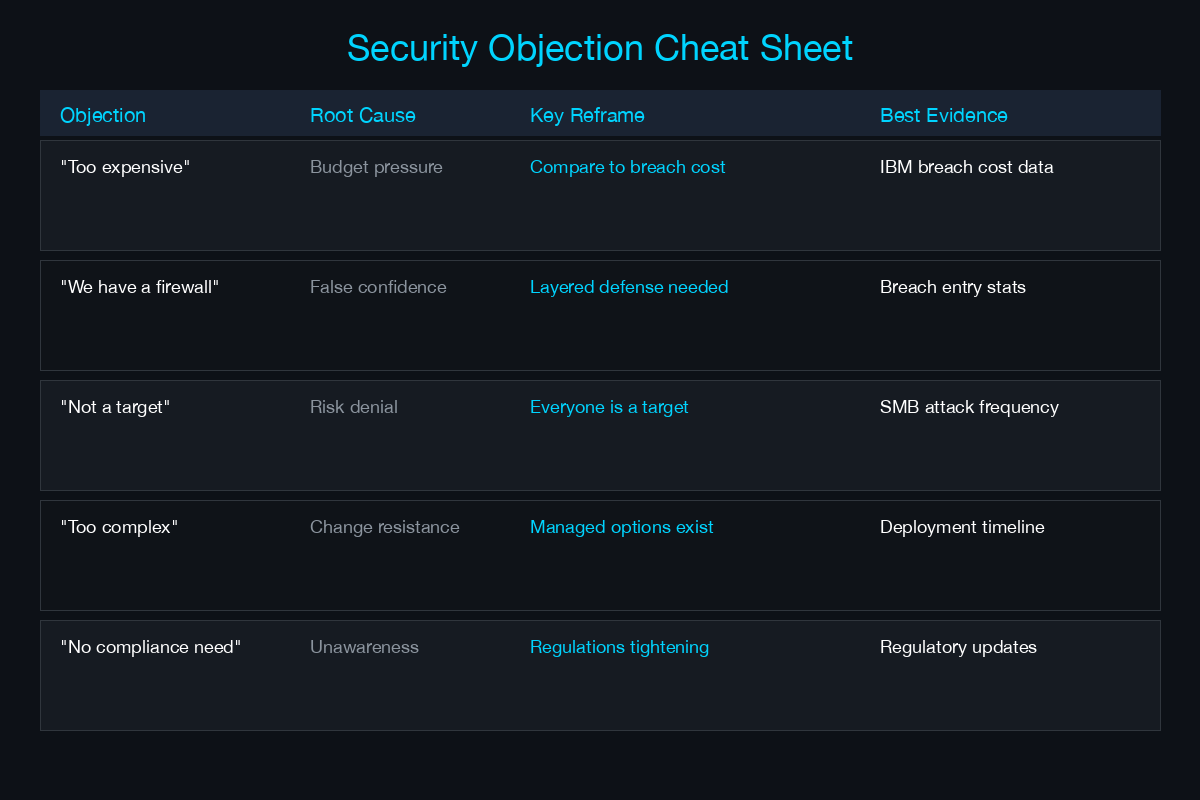
Use this quick-reference during calls:
| Objection | Root Cause | Key Reframe | Best Evidence |
|---|---|---|---|
| “We have a firewall” | Perimeter = security mindset | 70% of breaches involve lateral movement | MGM breach, east-west visibility gap |
| “No budget” | Value not proven | Cost of breach vs. cost of prevention | IBM breach cost data, ROI model |
| “Can’t manage another tool” | Alert fatigue, staff shortage | Right tool reduces workload | Day-in-the-life time comparison |
| “Haven’t been breached” | Survivorship bias | Absence of evidence is not evidence of absence | 194-day dwell time, 54% external detection |
| “Waiting for next FY” | Timing constraint | Pre-work now accelerates deployment later | Timeline comparison, compliance deadlines |
Common Mistakes SEs Make When Handling Objections
Mistake 1: Arguing with the customer. The moment you tell a customer they are wrong, you lose. Objections are not attacks - they are buying signals that tell you what the customer needs to hear before they can move forward.
Mistake 2: Feature dumping. Responding to “we have a firewall” by listing 47 features of your product does not address the objection. It overwhelms the customer and signals that you are not listening.
Mistake 3: Using scare tactics. “You WILL get breached” is not a rebuttal - it is a threat. Fear-based selling erodes trust and positions you as a vendor, not an advisor. Present data objectively and let the customer assess their own risk tolerance.
Mistake 4: Accepting the objection at face value. “No budget” rarely means zero dollars are available. It usually means “I don’t see enough value to reallocate budget.” Dig deeper with questions like “If we could demonstrate a 3x ROI in 90 days, would that change the budget conversation?”
Mistake 5: Not proposing a next step. Every objection handling conversation must end with a concrete action. If you address the objection brilliantly but do not propose a next step, the deal stalls anyway.
Building Your Objection Playbook
Every sales organization should maintain a living objection playbook. Here is a template for documenting and sharing rebuttals across your team:
Objection Playbook Entry Template
OBJECTION: [Exact words the customer uses]
FREQUENCY: [How often you hear this — weekly, monthly]
PERSONA: [Who typically raises it — CISO, CFO, IT Director]
ROOT CAUSE: [The real concern behind the objection]
ACKNOWLEDGE: [Your empathy statement]
REFRAME: [The perspective shift]
EVIDENCE: [Data points, breach examples, demos]
NEXT STEP: [Low-friction action to propose]
OUTCOME: [Win/loss data when this objection appears]
Track which rebuttals lead to positive outcomes and refine continuously. Share wins across the SE team so everyone benefits from what works.
Putting It Into Practice
The best way to internalize these frameworks is deliberate practice:
Role-play weekly. Pair up with another SE and practice objection handling. The person playing the customer should push back hard. Comfortable practice leads to confident execution.
Record your calls (with permission). Review how you handled objections. Did you acknowledge before reframing? Did you propose a next step? Self-assessment accelerates improvement.
Build an evidence library. Maintain a shared document with current breach statistics, case studies, and compliance deadlines. Update it quarterly. Stale data undermines your credibility.
Debrief after every lost deal. What objection killed the deal? Could you have handled it differently? Lost deal analysis is the highest-ROI learning activity in pre-sales.
Customize for your product. The frameworks in this guide are product-agnostic. Map each rebuttal to your specific solution’s capabilities so you can seamlessly transition from objection handling to value demonstration.
Objection handling is not about winning arguments. It is about understanding concerns, providing perspective, and making it easy for the customer to take the next step. Master this skill and you will close deals that other SEs walk away from.
Related Posts in This Series
- How to Run a Technical Discovery Call for Security Deals - Prevent objections by running stronger discovery upfront
- How to Build a Business Case for NAC - Build the ROI case that overcomes budget and priority objections
- How to Position SASE to a CISO - Handle the consolidation fatigue objection in SASE conversations
- Translate a Pen Test Report Into a Sales Opportunity - Use pen test evidence to counter “we are not a target” objections
- The AM’s Guide to Cybersecurity Terminology - Equip your AM to handle early-stage objections before the SE joins
Practice with free flashcards, quizzes, and hands-on lab scenarios at cciesec.it-learn.io — built specifically for the CCIE Security v6.1 written (350-701 SCOR) and lab exam.


