

Every cybersecurity sales cycle eventually arrives at the email conversation. It might start with a phishing incident, surface during a security assessment, or show up as an RFP line item. However it arrives, the Solutions Engineer needs to navigate a market that has fractured into three distinct architectures, each with vocal advocates and legitimate use cases.
The three architectures are the Secure Email Gateway (SEG), the API-based post-delivery solution, and the integrated platform-native approach. Each makes different tradeoffs between deployment complexity, detection capability, and operational overhead. Understanding those tradeoffs - and knowing when to recommend each - is what separates a technical advisor from a feature-list reader.
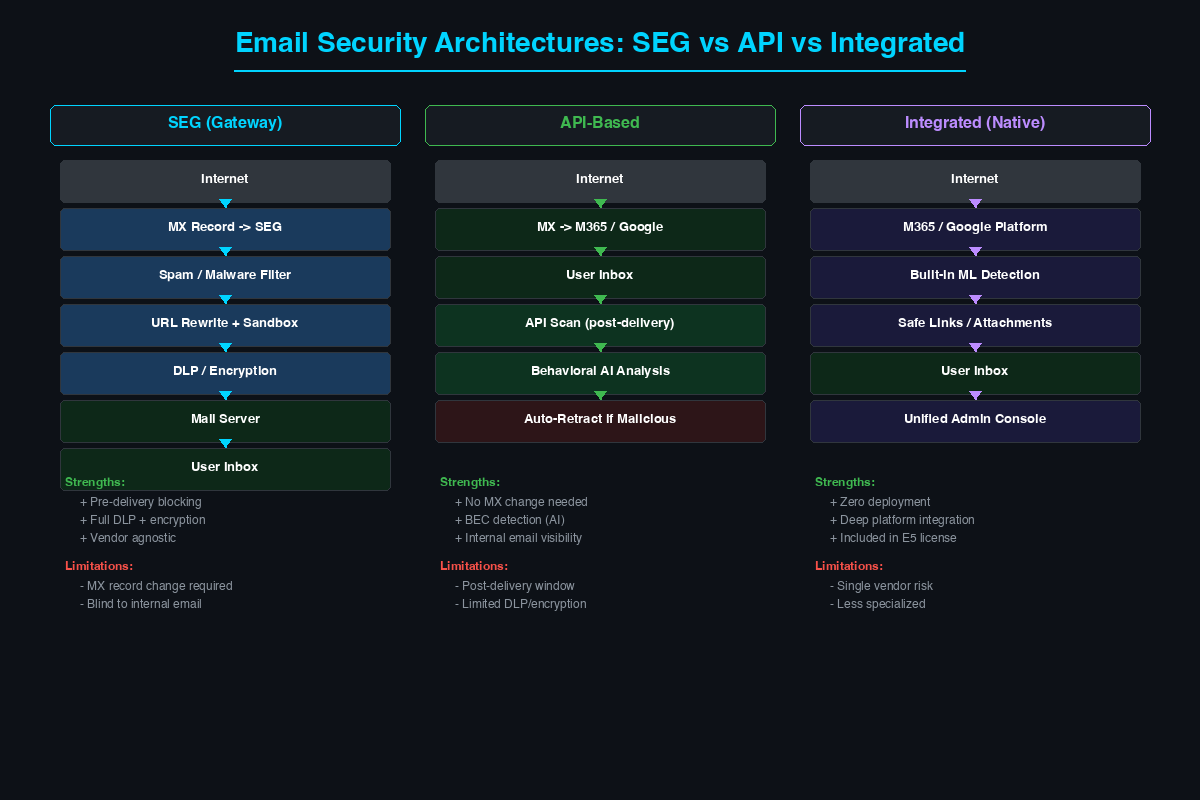
Architecture 1: Secure Email Gateway (SEG)
The SEG is the original email security architecture, the default for over two decades.
The organization’s MX record points to the SEG, not directly to the mail server. All inbound email flows through the SEG first. It inspects each message - anti-spam scoring, anti-malware scanning, URL reputation checking, attachment sandboxing, SPF/DKIM/DMARC validation, and DLP policy enforcement. Clean messages are forwarded to the mail server. Malicious messages are quarantined, rejected, or tagged. Outbound email flows through for DLP, encryption, and compliance.
Strengths: Pre-delivery blocking means malicious email never reaches the inbox - there is no window of exposure. The SEG handles encryption, DLP, archiving, and compliance in a single platform. It is vendor-agnostic, working regardless of the back-end mail platform. And it is mature technology with two decades of refinement and extensive threat intelligence feeds.
Weaknesses: Deployment requires MX record changes, which introduces risk and a maintenance window. The SEG is blind to internal-to-internal email. Traditional SEGs struggle with BEC attacks - text-only social engineering with no malicious indicators for signature-based detection to catch. And adding a hop to the mail flow introduces latency, even if usually negligible.
Key vendors: Proofpoint leads the enterprise SEG market with strong threat intelligence and URL defense. Mimecast offers a comprehensive platform including archiving and continuity. Cisco Secure Email integrates with the Cisco ecosystem and Talos threat intelligence. Barracuda competes strongly in the SMB and mid-market at a lower price point.
Architecture 2: API-Based Post-Delivery
API-based email security emerged as the challenger architecture and has gained significant momentum since 2020.
The MX record points directly to M365 or Google Workspace - no mail flow changes. The API-based solution connects via Microsoft Graph API or Google Workspace API, scans messages post-delivery, analyzes content, sender behavior, and communication patterns, and claws back malicious messages from inboxes when detected.
Strengths: Zero mail flow disruption - no MX record change, deployment takes minutes, rollback is a toggle. Internal email visibility catches compromised accounts phishing colleagues. BEC detection uses behavioral AI trained on communication patterns, sender identity graphs, and intent analysis. Retroactive remediation handles delayed-detonation URLs discovered after delivery.
Weaknesses: A post-delivery exposure window exists - seconds to minutes where malicious email sits in the inbox before detection. The solution depends on platform API stability (Microsoft has made Graph API changes that impacted third-party tools). Outbound DLP and encryption are limited compared to SEGs. There is no archiving or continuity capability.
Key vendors: Abnormal Security focuses exclusively on behavioral AI for BEC and social engineering - no gateway component, strong market momentum. Material Security protects sensitive email content with unique redaction capabilities. IRONSCALES combines API-based detection with crowdsourced threat intelligence and phishing simulation. Perception Point offers dynamic scanning including hardware-level attachment analysis.
Architecture 3: Integrated Platform-Native
The third approach is the security built into the email platform itself.
Microsoft Defender for Office 365 Plan 1 provides Safe Attachments (sandboxing) and Safe Links (URL rewriting with click-time scanning). Plan 2 adds Threat Explorer, automated investigation and response, attack simulation training, and campaign views. Google Workspace includes advanced phishing and malware protection with ML-based detection, security sandbox for attachments, and Gmail confidential mode.
Strengths: Zero additional deployment - active with the right license (E5 for Microsoft, Enterprise for Google). Deepest platform integration - native solutions see mail, calendar, Teams/Chat, SharePoint, and OneDrive. Microsoft and Google invest billions in security, improving capabilities at no incremental cost. Unified management in a single admin console.
Weaknesses: Single vendor dependency - a security bypass affects all customers simultaneously. License complexity - full email security requires E5 or Enterprise Plus, which many organizations do not have. Less specialized than dedicated vendors who build email security as their only product. Limited visibility outside the platform for hybrid environments.
Feature Comparison
| Capability | SEG | API-Based | Integrated (Defender) |
|---|---|---|---|
| Deployment | MX record change | API connection, minutes | Already deployed (with license) |
| Pre-delivery blocking | Yes | No - post-delivery | Yes |
| BEC / Social Engineering | Limited | Strong - behavioral AI | Moderate - improving |
| Attachment Sandboxing | Yes - mature | Varies by vendor | Yes - Safe Attachments |
| URL Protection | Click-time rewriting | Post-delivery scan | Yes - Safe Links |
| Internal Email Scan | No | Yes - API sees all | Yes - native |
| DLP (Outbound) | Yes - full engine | Limited | Yes - Purview integration |
| Email Encryption | Yes - TLS, S/MIME, portal | No | Yes - OME, S/MIME |
| Archiving | Yes - journaling, retention | No | Yes - with compliance license |
| Account Takeover Detection | Limited | Yes - mailbox behavior | Moderate with E5 |
When to Recommend Each Approach
Recommend SEG when: The customer has on-premises Exchange or hybrid environments. Regulatory requirements mandate archiving, encryption, or journaling. Email volume requires dedicated filtering infrastructure. The customer operates multiple email platforms and needs vendor-agnostic coverage. Existing SEG investment includes customized policies they do not want to rebuild.
Recommend API-based when: The customer is fully on M365 or Google Workspace with no on-premises mail servers. BEC and social engineering are the primary concern - they have been hit by wire fraud or executive impersonation. The customer already has Defender and wants to supplement without replacing. MX record changes are blocked by risk, change management, or operational constraints. Internal email visibility is needed to detect compromised accounts.
Recommend integrated (Defender for O365) when: The customer is an M365 E5 shop consolidating vendors. Budget is constrained and Defender is already included in licensing. The security team is small and cannot absorb another management console. The email threat profile is moderate.
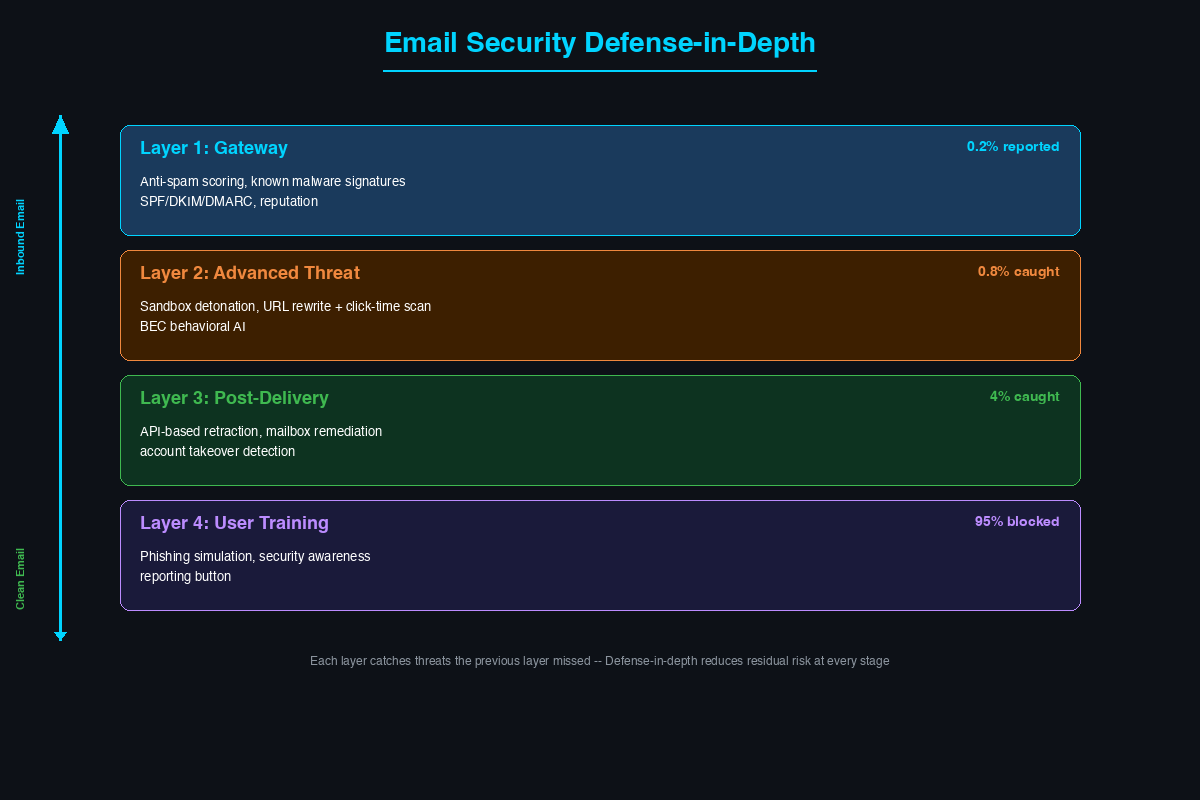
Recommend layered when: The customer is a high-value target requiring defense-in-depth (financial services, healthcare, government). Compliance requires gateway controls AND they have an unaddressed BEC problem. Budget and team capacity support two solutions.
Migration Considerations
When moving from SEG to API-based, the MX record cutover requires careful planning - reduce TTL in advance, test with a small domain first, and maintain a rollback plan. Conduct a feature gap analysis documenting everything the SEG provides beyond detection: DLP, encryption, archiving, transport rules. Each needs a replacement - Purview DLP, Azure Information Protection, Microsoft retention policies. Migrate custom policies, allow/block lists, quarantine settings, and user notification templates.
If the customer is simultaneously migrating from on-premises Exchange to M365, the email security conversation is part of the broader migration. This is the ideal moment to redesign the email security stack from scratch rather than lifting and shifting the existing SEG.
The Customer Conversation Framework
Structure email security discovery around five questions:
“What is your current email platform and where is it going?” determines architecture options. On-premises Exchange limits you to SEG. M365 E5 opens all three approaches. Google Workspace shifts the vendor landscape.
“What email-borne threats are you actually experiencing?” drives the recommendation. Commodity spam and malware? SEG and Defender handle that. BEC targeting finance? API-based shines. Credential harvesting phishing? URL protection is the key capability.
“What does your current email security stack look like and what is it missing?” establishes the baseline. If they run Proofpoint and are happy with everything except BEC detection, supplement with Abnormal rather than replacing Proofpoint. If they are on E3 with only Exchange Online Protection, consider an E5 upgrade.
“What compliance and data governance requirements affect email?” surfaces constraints. HIPAA, PCI-DSS, SEC regulations, and GDPR all have implications for archiving, encryption, and DLP that may mandate a SEG or robust DLP solution.
“How much operational overhead can your team absorb?” determines complexity tolerance. A small team managing fifty other tools does not want another console. API-based or Defender consolidation reduces burden. A large SOC with dedicated email analysts can manage a SEG with custom policies and active threat hunting.
The email security market has three architectures, dozens of vendors, and a constant stream of marketing claiming each approach makes the others obsolete. None of them are obsolete. Each solves a different problem for a different customer profile. Your job as an SE is not to push the architecture you prefer into every deal - it is to understand the customer’s email platform, threat profile, compliance requirements, and operational capacity, then recommend the architecture that fits. Sometimes that is a SEG. Sometimes that is API-based. Sometimes it is both. The framework above gives you the structure to have that conversation credibly.
Related Posts in This Series
- XDR: Cortex vs CrowdStrike vs Sentinel - Email security integrates with XDR for cross-domain threat detection
- Handling the 5 Most Common Security Objections - Overcome objections when positioning email security upgrades
- How to Demo a Firewall Without Boring the Room - Apply the same demo storytelling techniques to email security presentations
- Using Threat Intelligence in Customer Presentations - Use phishing and BEC threat data to drive urgency in email security conversations
- Security Compliance Cheat Sheet: NIST, ISO 27001, SOC 2, PCI DSS - Compliance requirements often mandate specific email security controls
Practice with free flashcards, quizzes, and hands-on lab scenarios at cciesec.it-learn.io — built specifically for the CCIE Security v6.1 written (350-701 SCOR) and lab exam.


