
Nobody plans to become a Solutions Engineer. You fall into it sideways - from network engineering, system administration, technical support, or sometimes from the sales side with enough technical aptitude to be dangerous. One day someone asks you to join a customer call because you know the product better than the account executive, and suddenly you are explaining firewall policy to a CISO while the AE nods along. Six months later, someone offers you a title and a commission plan.
That is how most SE careers start. This post is about what happens after that - the skills you need, the certifications that matter, the career ladder, the money, and how to be intentional about a career path that most people stumble into.
What a Cybersecurity Solutions Engineer Does
The SE role varies by company, but in cybersecurity pre-sales, the core activities are consistent.
Discovery: You join calls with prospects and customers to understand their environment, security posture, and business challenges. You ask questions about their current firewall, remote access strategy, SOC operations, and pain points. Discovery is where deals are won or lost - the SE who asks the right questions uncovers the real problem, not the one written on the RFP.
Demonstrations: You show the product to technical and executive audiences, navigating it live, answering questions on the fly, and adapting to the audience in real time. A demo for a SOC analyst focuses on detection and investigation workflows. A demo for a CISO focuses on risk reduction and operational metrics. Same product, different story.
Proof of Concept / Proof of Value: You deploy the product in the customer’s environment for technical validation. This is the most technically demanding part of the role - production networks, real traffic, real problems. POCs expose every limitation of the product and every gap in your knowledge. They also create the strongest validation when they succeed.
Technical Proposals: You write RFP/RFI responses, create architecture documents, and build Bills of Material. This requires translating technical capability into business language while being precise about what the product does and does not do.
Internal Collaboration: You relay customer feedback to product management, resolve technical issues with engineering during POCs, develop account strategy with sales, and create technical content with marketing. The SE is the bridge between the field and the company.
The Skills Triangle
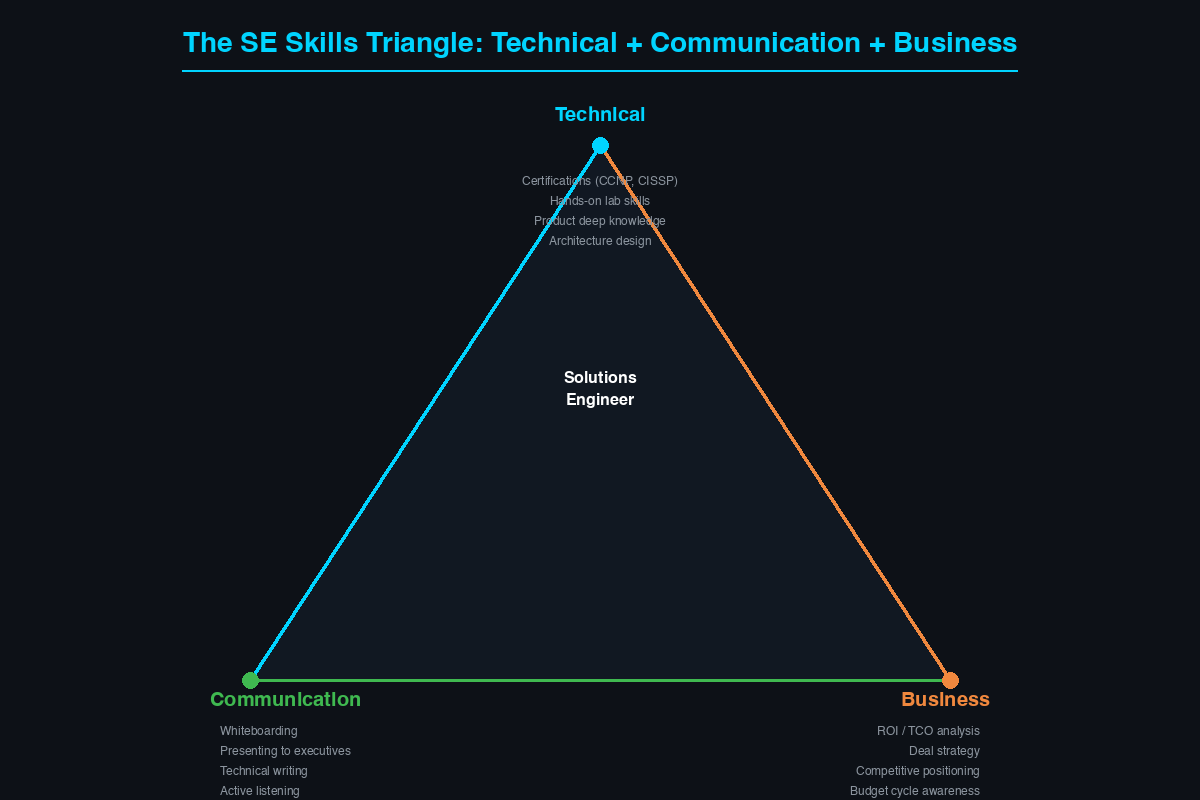
Successful cybersecurity SEs operate at the intersection of three skill sets. Weakness in any one limits career progression.
Technical Depth
You need to know the technology - not just your product, but the ecosystem it operates in. A firewall SE needs to understand routing, switching, network architecture, threat landscapes, and competing products. An identity SE needs to understand Active Directory, RADIUS, 802.1X, SAML, and identity governance. Technical depth builds credibility when a customer’s engineer challenges your architecture or when a POC hits an unexpected issue.
Communication
Technical knowledge without the ability to communicate it is useless in pre-sales. You need to explain complex concepts to non-technical executives, present to rooms of twenty people, write clear documentation, and have productive conversations with skeptical customers. The SE who can make a complex architecture understandable in a whiteboard session will outsell the SE who knows more but cannot explain it.
Business Acumen
Understanding the customer’s business context changes the conversation from feature comparison to value delivery. Understanding ROI, TCO, competitive dynamics, budget cycles, procurement processes, and organizational politics - this is what gets you invited to strategy meetings instead of left in the technical room.
The Career Ladder
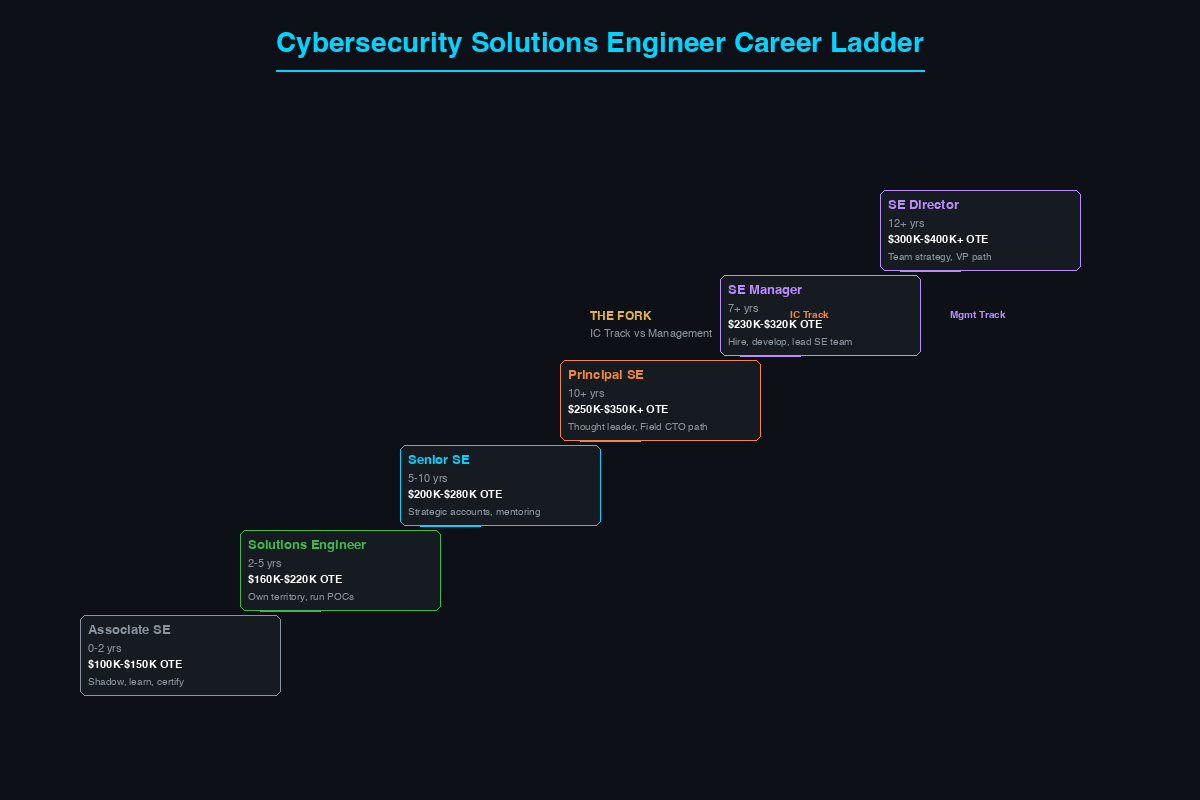
Associate Solutions Engineer (0-2 years as SE, 2-5 years total in IT): Shadow senior SEs on calls and demos. Run demos with supervision. Handle technical RFP questions. Manage smaller accounts. Get promoted by delivering demos independently, completing your first solo POC, and earning product certifications.
Solutions Engineer (2-5 years as SE): Own a territory or account set. Run discovery, demos, and POCs independently. Respond to RFPs. Mentor Associate SEs. Get promoted through consistent technical win rate, becoming the go-to SE for a specific domain, and presenting at company or industry events.
Senior Solutions Engineer (5-10 years): Handle the largest and most complex accounts. Lead multi-product, multi-team deals. Develop technical strategy for strategic accounts. Influence product direction. Train and mentor the broader team. Get promoted by winning landmark deals, building repeatable playbooks the team adopts, and being recognized as a domain expert.
Principal Solutions Engineer (10+ years): Technical thought leadership across the organization. Set technical strategy for the SE team. Engage with C-level customers as a peer. Represent the company at conferences and analyst briefings. This is the individual contributor track for SEs who do not want to manage people.
SE Manager / Director (7+ years with leadership aptitude): Hire, develop, and retain SEs. Set team strategy. Manage quota and performance. Align SE resources with sales strategy.
The fork arrives at the Senior SE level. The Principal track keeps you technical and customer-facing - the path to Field CTO or Chief Evangelist. The Manager track moves you into people leadership - the path to VP of SE or CTO. Both are viable paths to the executive level.
Certifications by Career Level
Foundation (Associate SE)
| Certification | Why It Matters |
|---|---|
| CompTIA Security+ | Baseline cybersecurity credibility across every customer conversation |
| CCNA | Networking fundamentals are the foundation of cybersecurity SE work |
| Vendor associate cert | Your employer’s entry-level cert - PCNSA, NSE 4, CyberOps Associate |
Mid-Level (SE to Senior SE)
| Certification | Why It Matters |
|---|---|
| CCNP Security | Deep security knowledge, strong credibility in Cisco environments |
| PCNSE / NSE 7 | Required for Palo Alto or Fortinet SE roles, recognized by customers |
| CISSP | Broad security knowledge, strong credibility with CISOs and security leadership |
| AWS/Azure Security Specialty | Cloud security knowledge as customer workloads move to cloud |
Expert (Senior SE to Principal)
| Certification | Why It Matters |
|---|---|
| CCIE Security | Mastery-level Cisco certification, extremely hard to earn, instant credibility |
| OSCP | Hands-on offensive security skills, valuable for endpoint/detection product SEs |
| GIAC (GCIH, GPEN, GSEC) | SANS certs are highly respected in the security community |
Certification strategy: Start with employer-required certs. Add a vendor-neutral cert for broader credibility (Security+ early, CISSP mid-career). Pursue a differentiator at the senior level - CCIE, OSCP, or a GIAC specialization. Keep certifications current - an expired CCNP is worse than no CCNP because it suggests you stopped investing.
Salary Ranges (US Market, 2025-2026)
| Level | Base Salary | OTE (On-Target Earnings) |
|---|---|---|
| Associate SE | $80K - $120K | $100K - $150K |
| Solutions Engineer | $120K - $160K | $160K - $220K |
| Senior SE | $150K - $200K | $200K - $280K |
| Principal SE | $180K - $230K | $250K - $350K+ |
| SE Manager | $170K - $220K | $230K - $320K |
| Director of SE | $200K - $260K | $300K - $400K+ |
Key factors: Bay Area and NYC command 20-30% premiums. Remote roles have narrowed but not eliminated this gap. Public cybersecurity companies (CrowdStrike, Palo Alto, Zscaler, SentinelOne) pay at the top of range, often with RSU grants adding $50K-$200K+ annually in total compensation. Vendors pay more than VARs and distributors. SEs specializing in high-demand areas - cloud security, identity, OT/ICS - command premiums over generalists.
Breaking into the SE Role
From Network Engineering or System Administration
The most common transition path. You already have technical depth - you need customer-facing experience and presentation skills. Volunteer for customer-facing activities in your current role: vendor POCs, audit support, customer training. Start presenting internally at team meetings and brown bags. Learn the sales process - read about MEDDIC or solution selling. Apply for Associate SE roles at vendors whose technology you already know. Your operational experience with their products is a differentiator that no amount of training matches.
From Account Management or Inside Sales
You have customer skills and sales process knowledge - you need technical depth. Pursue Security+ and CCNA. Build a lab environment. Shadow SEs during demos and POCs. Apply for Associate SE roles at companies with formal SE development programs - Palo Alto, Cisco, and CrowdStrike run programs specifically for this transition.
From Security Operations or Incident Response
This path gives you a unique advantage: you have seen real attacks. You understand the defender’s perspective. You know what works and what does not. Engage with vendors who sell to your SOC - product feedback, beta programs, user groups. Apply for SE roles at detection and response vendors. Your credibility is built-in: “I ran a SOC for five years, and this is the tool I wish I had.”
Interview Tips
The demo interview: Most SE processes include a demo exercise. Structure it with three acts (context, action, impact). Pick three features and demo them well - do not try to show everything. Close with a next step even in a mock demo.
The technical interview: Expect questions on TLS handshake mechanics, IPS vs IDS differences, VPN troubleshooting scenarios, SASE vs SSE distinctions, and network segmentation design.
The behavioral interview: Prepare for questions about losing deals, disagreeing with the sales team, and handling customers who are technically incorrect but emotionally committed.
Building Your Personal Brand
Technical blog: Writing sharpens your understanding, creates a portfolio for hiring managers, and builds SEO-driven visibility that attracts recruiters. Document what you learn. Explain concepts in your own words.
LinkedIn: Post about cybersecurity topics, share insights from customer engagements (without confidential details), and comment on industry news with technical analysis. Consistent posting builds a following that translates into career opportunities.
Conferences: Start local at meetups and user groups. Build toward Cisco Live, RSA, BSides. Speaking engagements establish domain expertise and expand your network exponentially.
Community: Answer questions in forums, contribute to open-source security tools, and mentor people entering the field. Community contribution builds reputation that outlasts any single job.
Relationships: The cybersecurity SE community is smaller than it appears. The SE at your competitor today might be your colleague tomorrow. The customer you help today might hire you next year. Build genuine relationships across vendors, partners, and customers.
The Solutions Engineer career path in cybersecurity combines technical depth with business impact in a role that is well-compensated and consistently in demand. But the path is not automatic. It requires intentional investment in technical skills, communication ability, and business understanding. It requires certifications that demonstrate commitment and a personal brand that establishes credibility. If you are considering the SE path - from engineering, from sales, from security operations - the door is open. The cybersecurity industry needs people who can bridge the gap between complex technology and customer outcomes. That is the job. And it is a good one.
Related Posts in This Series
- Top 10 Certifications for Cybersecurity SEs - Map certifications to each stage of the SE career path
- How to Build a Home Lab - A home lab accelerates technical growth at every career level
- From AM to SE: Making the Technical Pivot - One of the most common entry points into the SE career path
- How to Stay Current on Cybersecurity - Staying current is essential for career advancement at every level
- The SE’s Toolkit: Scripts, Templates, and Resources - Build the operational toolkit that supports your career growth
Practice with free flashcards, quizzes, and hands-on lab scenarios at cciesec.it-learn.io — built specifically for the CCIE Security v6.1 written (350-701 SCOR) and lab exam.


