
Every Solutions Engineer has been in this meeting: you are presenting a network segmentation architecture to a CISO, the conversation is going well, and then the customer glances at your business card or LinkedIn profile and asks what certifications you hold. Your answer shapes how the rest of that meeting goes.
Certifications in cybersecurity pre-sales are not just resume items. They are trust signals. They tell the customer that a neutral third party has validated your knowledge, and they give you a shared language with security practitioners who hold the same credentials. An SE with a CCIE Security badge walks into a room with a different level of authority than an SE without one - not because the certification makes you smarter, but because the customer assumes it does, and that assumption is your advantage.
But not all certifications are equal, and the order in which you pursue them matters. Some certs are expensive and time-consuming but deliver massive customer impact. Others are cheap and fast but carry little weight in an enterprise security conversation. Some are vendor-specific and only matter if you sell that vendor’s products. Others are vendor-neutral and travel with you across your entire career.
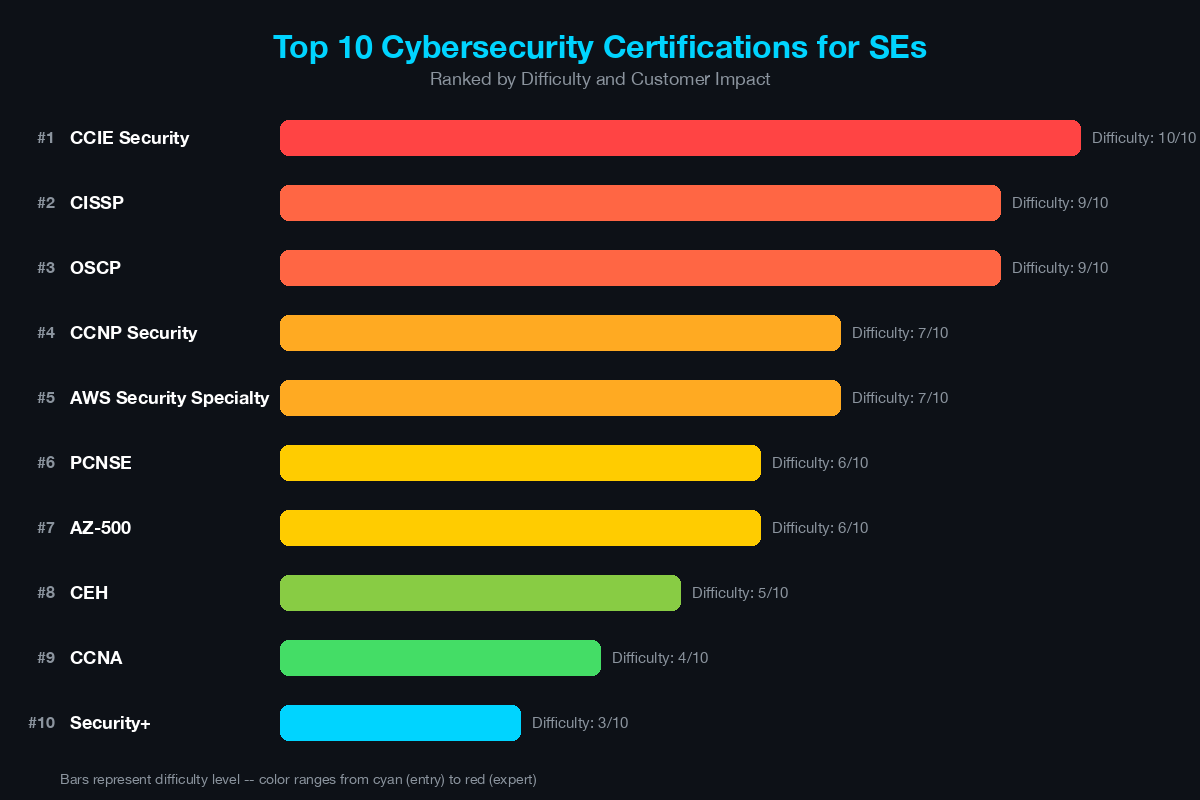
This post ranks the 10 most valuable certifications for cybersecurity Solutions Engineers - not just by technical depth, but by the combination of cost, difficulty, study time, customer perception, and career impact that actually matters in pre-sales.
The Ranking Criteria
Before diving in, here is how each certification was evaluated:
- Technical depth: How much do you actually learn preparing for it?
- Customer impact: Does mentioning this cert change how customers perceive you?
- Cost: Exam fees, training materials, lab access, and renewal costs.
- Study time: Realistic preparation time for a working SE.
- Career portability: Does this cert matter if you change vendors or roles?
- Renewal burden: How much ongoing effort is required to maintain it?
1. CCIE Security
What it proves: You have expert-level knowledge of Cisco security technologies, including network security, cloud security, content security, endpoint protection, secure network access, and visibility and enforcement. The lab exam demonstrates you can configure and troubleshoot complex security architectures under pressure.
Cost: Written exam approximately $450, lab exam approximately $1,600. Total: ~$2,050. Most candidates spend $3,000-$10,000 on training and practice labs.
Difficulty: 10/10. This is the hardest certification on this list. The 8-hour lab exam has a first-attempt pass rate estimated at 20-30%.
Study time: 12-24 months of serious preparation, typically 15-20 hours per week alongside a full-time job.
Customer impact: Extremely high. In enterprise security sales, introducing yourself as a CCIE Security changes the entire conversation. CISOs, network architects, and security engineers immediately assign you a higher level of credibility. In competitive deals, having a CCIE on the account team is a differentiator that account managers reference in executive summaries.
Renewal: Every 3 years. Requires continuing education credits or passing a qualifying exam.
When to pursue it: You have 3+ years in a Cisco-focused SE role, you have already passed CCNP Security, and you are committed to the Cisco ecosystem long-term. Do not attempt this as your first or second certification.
2. CISSP (Certified Information Systems Security Professional)
What it proves: You understand security management across 8 domains: Security and Risk Management, Asset Security, Security Architecture and Engineering, Communication and Network Security, Identity and Access Management, Security Assessment and Testing, Security Operations, and Software Development Security.
Cost: $749 exam fee. Study materials typically $50-$300.
Difficulty: 7/10. The CAT (Computerized Adaptive Testing) format makes it unpredictable. You need 5 years of professional experience in 2+ domains (or 4 years with a relevant degree).
Study time: 8-16 weeks. Most SEs with 3+ years of experience can prepare in 10-12 weeks studying 10 hours per week.
Customer impact: Very high, especially with CISOs and security directors. CISSP is the most recognized security certification globally. When you hold it, CISOs see you as a peer rather than a vendor. It signals that you understand their world - compliance, risk management, governance - not just the products you sell.
Renewal: 40 CPE credits annually, $125 annual maintenance fee.
When to pursue it: You have 4-5 years of security experience, you sell to enterprise accounts, and you want a certification that transcends any single vendor. This is the single best certification for long-term career portability.
3. CCNP Security
What it proves: Professional-level knowledge of Cisco security solutions - firewalls (Firepower/FTD), VPNs, ISE, email security, and web security. Requires passing a core exam (350-701 SCOR) plus one concentration exam.
Cost: Core exam ~$400, concentration exam ~$300-$400. Total: ~$700-$800.
Difficulty: 6/10. Challenging but achievable with focused study. The concentration exams allow you to specialize in your strongest area.
Study time: 8-14 weeks for the core exam, 4-8 weeks for the concentration.
Customer impact: High for Cisco-focused accounts. It tells the customer you know the portfolio beyond surface-level demo scripts. Mid-level security engineers and architects respect it because they know what the exam covers.
Renewal: Every 3 years via continuing education or re-examination.
When to pursue it: You are a Cisco SE with CCNA and 1-2 years of security experience. This is the natural progression and should be your primary target after CCNA.
4. AWS Certified Security - Specialty
What it proves: You can design and implement security solutions on AWS - IAM policies, VPC security, encryption, logging and monitoring (CloudTrail, GuardDuty), incident response, and compliance frameworks in AWS environments.
Cost: $300 exam fee.
Difficulty: 6/10. Requires hands-on AWS experience. Passing the AWS Solutions Architect Associate first is strongly recommended.
Study time: 6-10 weeks with prior AWS experience. If you are new to cloud, add 4-6 weeks for foundational learning.
Customer impact: Increasingly high. As customers migrate workloads to AWS, they want SEs who understand cloud-native security - not just how your product integrates with AWS, but how AWS security works natively. Holding this cert lets you have credible conversations about shared responsibility models, Security Hub configurations, and why the customer’s S3 buckets are misconfigured.
Renewal: Every 3 years via re-certification exam.
When to pursue it: Your accounts are adopting AWS, and you need to position your security products in cloud environments. Also valuable if you are interviewing at cloud-first security companies.
5. PCNSE (Palo Alto Networks Certified Network Security Engineer)
What it proves: Expert-level knowledge of Palo Alto Networks next-generation firewall design, deployment, configuration, and troubleshooting. Covers PAN-OS, Panorama, GlobalProtect, and Prisma Access.
Cost: $250-$300 exam fee. Palo Alto offers free training through Beacon (formerly the Learning Center).
Difficulty: 6/10. The exam is scenario-heavy and requires real-world configuration experience. Lab time is essential.
Study time: 6-10 weeks with existing PAN-OS experience.
Customer impact: Very high in Palo Alto competitive situations - and those are most situations in enterprise firewall deals. If you sell against Palo Alto, understanding their platform at certification level makes you a better competitor. If you sell Palo Alto products, this is table stakes.
Renewal: Every 2 years via re-certification exam.
When to pursue it: You compete against Palo Alto regularly or you sell their products. Even if you are a Cisco SE, understanding PAN-OS at this level makes you far more effective in competitive positioning.
6. Microsoft Azure Security Engineer Associate (AZ-500)
What it proves: You can implement security controls, manage identity and access, protect data and applications, and manage security operations in Azure environments.
Cost: $165 exam fee - the cheapest cloud certification on this list.
Difficulty: 5/10. Requires Azure fundamentals knowledge. Microsoft Learn provides free, comprehensive training.
Study time: 4-8 weeks with cloud experience.
Customer impact: Moderate to high, depending on your customer base. Many enterprises run hybrid environments with Azure AD (now Entra ID) as their identity provider. Understanding Azure security makes you credible in conversations about identity, conditional access, and cloud security posture management.
Renewal: Annual renewal assessment (free) through Microsoft Learn.
When to pursue it: Your customers use Microsoft 365 and Azure, which is most enterprises. The low cost and free training make this a high-ROI certification.
7. CCNA (Cisco Certified Network Associate)
What it proves: Foundational knowledge of networking - IP addressing, routing, switching, network access, IP services, security fundamentals, and automation basics.
Cost: $330 exam fee.
Difficulty: 4/10. Achievable for anyone willing to study consistently.
Study time: 8-12 weeks for someone new to networking. 4-6 weeks for experienced professionals validating existing knowledge.
Customer impact: Low to moderate on its own. CCNA is an entry-level certification, and experienced customers will not be impressed by it alone. However, it is the foundation for everything above it. Without solid networking fundamentals, your CCNP and CCIE studies will struggle.
Renewal: Every 3 years.
When to pursue it: You are entering a technical pre-sales role and do not yet have a networking certification. Get this first, then move to CCNP Security.
8. CompTIA Security+
What it proves: Vendor-neutral security fundamentals - threats, vulnerabilities, risk management, architecture, cryptography, and security operations.
Cost: $404 exam fee. CompTIA bundles with practice exams are available for $500-$600.
Difficulty: 3/10. This is an entry-level security certification designed for professionals with 2 years of IT experience.
Study time: 4-8 weeks.
Customer impact: Low in enterprise sales. Security+ tells a customer that you understand security basics, but it does not differentiate you. However, it meets DoD 8570 compliance requirements (IAT Level II), which matters if you sell to US government accounts.
Renewal: Every 3 years via CEUs or re-examination.
When to pursue it: You are transitioning from a non-security IT role, you sell to government accounts that require 8570 compliance, or you want a vendor-neutral foundation before pursuing vendor-specific certifications.
9. OSCP (Offensive Security Certified Professional)
What it proves: You can identify vulnerabilities, develop and modify exploit code, and successfully penetrate systems in a controlled environment. The 24-hour practical exam is entirely hands-on - no multiple choice.
Cost: $1,649-$2,499 depending on lab access duration (30, 60, or 90 days through the PEN-200 course).
Difficulty: 8/10. The hands-on exam is brutal. You must compromise multiple machines in a 24-hour window and submit a professional penetration testing report.
Study time: 12-20 weeks of intensive lab work. Most candidates spend 200+ hours in the lab environment.
Customer impact: High with technical security teams, moderate with executives. Security operations teams and red teamers have deep respect for OSCP holders. If you are demoing vulnerability management, penetration testing tools, or endpoint security, OSCP gives you enormous credibility because the audience knows you have done it yourself.
Renewal: Does not expire. Once earned, OSCP is yours for life.
When to pursue it: You sell offensive security tools, work with SOC teams regularly, or want to deeply understand the attacker perspective. Not recommended as an early certification - it requires solid networking and Linux skills.
10. CEH (Certified Ethical Hacker)
What it proves: Knowledge of ethical hacking methodologies, tools, and techniques - reconnaissance, scanning, enumeration, system hacking, malware threats, sniffing, social engineering, and web application attacks.
Cost: $1,199 exam fee (through EC-Council authorized channels). Third-party vouchers are sometimes available for less.
Difficulty: 4/10. The exam is multiple-choice and relies more on memorization than hands-on skill. Significantly easier than OSCP.
Study time: 4-8 weeks.
Customer impact: Low to moderate. CEH has name recognition with non-technical stakeholders - a VP of IT might be impressed. But experienced security professionals often view CEH as less rigorous than OSCP. In a meeting with a SOC manager who holds OSCP, mentioning your CEH will not carry the same weight.
Renewal: 120 ECE credits over 3 years, $80 annual membership fee.
When to pursue it: Your employer requires it or pays for it, you need a checkbox certification for government contracts, or you want an introduction to offensive security concepts without the intensity of OSCP.
The Decision Matrix: Which Certification to Get Next
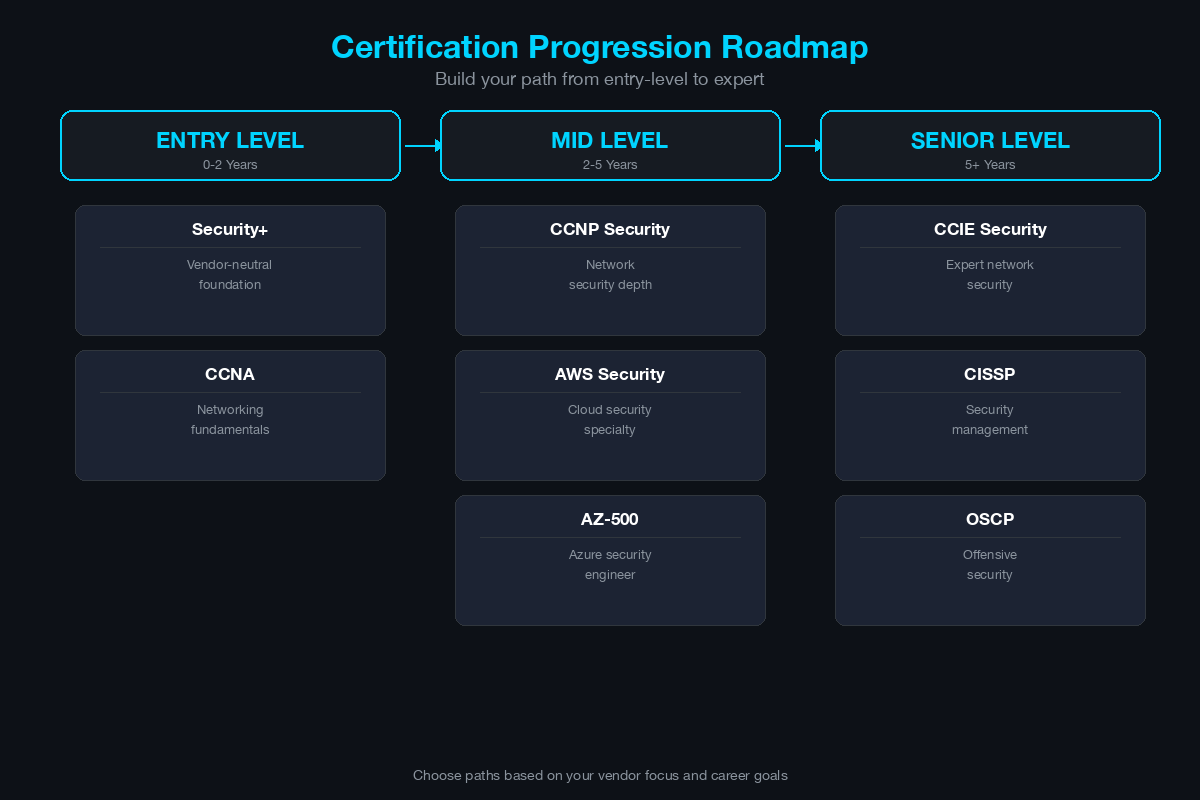
Use this matrix to determine your next certification based on your current level and focus area.
If you are a new SE (0-2 years):
| Current State | Next Cert | Then |
|---|---|---|
| No networking background | CCNA | Security+ |
| Have CCNA | Security+ | CCNP Security (Core) |
| Non-Cisco vendor | Security+ | Vendor-specific cert (PCNSE, etc.) |
| Cloud-focused role | Azure AZ-500 or AWS Security | CCNA |
If you are a mid-level SE (2-5 years):
| Current State | Next Cert | Then |
|---|---|---|
| Have CCNA + Security+ | CCNP Security | CISSP |
| Cisco SE with CCNP | CISSP | CCIE Security |
| Sell against Palo Alto | PCNSE | CISSP |
| Cloud-heavy accounts | AWS Security Specialty | Azure AZ-500 |
| Offensive security focus | OSCP | CISSP |
If you are a senior SE (5+ years):
| Current State | Next Cert | Then |
|---|---|---|
| Have CCNP + CISSP | CCIE Security | Cloud specialty |
| Multi-vendor environment | CISSP + PCNSE | AWS Security Specialty |
| Moving to management | CISSP (if not held) | CISM |
| Want to differentiate | OSCP | Present at conferences |
Cost Summary Table
| Certification | Exam Cost | Typical Prep Cost | Total Investment | Renewal Cycle |
|---|---|---|---|---|
| CCIE Security | ~$2,050 | $3,000-$10,000 | $5,000-$12,000 | 3 years |
| CISSP | $749 | $100-$500 | $850-$1,250 | Annual (CPE + fee) |
| CCNP Security | $700-$800 | $200-$500 | $900-$1,300 | 3 years |
| AWS Security | $300 | $50-$300 | $350-$600 | 3 years |
| PCNSE | $250-$300 | $0-$200 (free Beacon) | $250-$500 | 2 years |
| Azure AZ-500 | $165 | $0 (Microsoft Learn) | $165 | Annual (free) |
| CCNA | $330 | $50-$200 | $380-$530 | 3 years |
| Security+ | $404 | $50-$200 | $454-$604 | 3 years |
| OSCP | $1,649-$2,499 | Included in course | $1,649-$2,499 | Never |
| CEH | $1,199 | $100-$300 | $1,299-$1,499 | 3 years |
Final Advice
Most cybersecurity vendors and VARs have professional development budgets that cover certifications. Tie your certification request to a specific deal or account - “I need my PCNSE to compete effectively on the Acme Corp deal” is more compelling than “I want to learn more about firewalls.” Also check if your company has unused vendor training credits from Cisco, Palo Alto, or AWS partner programs.
Certifications open doors, but they do not close deals. The SE who can design a segmentation architecture on a whiteboard, explain it in business terms to a CFO, and then configure it live is more valuable than the SE who can recite CISSP domains but cannot troubleshoot a RADIUS failure. Choose certifications that force you to learn skills you will use in your day-to-day role. The customer impact will follow.
Related Posts in This Series
- SE Career Path in Cybersecurity - Understand the career levels where each certification matters most
- How to Build a Home Lab - Practice certification skills in a hands-on lab environment
- From AM to SE: Making the Technical Pivot - Certifications to prioritize when transitioning from AM to SE
- Security Compliance Cheat Sheet: NIST, ISO 27001, SOC 2, PCI DSS - Compliance knowledge that complements your certification portfolio
- Running a Cisco ISE POC: Timeline, Scope, and Gotchas - Put your CCNP Security and ISE certifications to work in real POCs
Practice with free flashcards, quizzes, and hands-on lab scenarios at cciesec.it-learn.io — built specifically for the CCIE Security v6.1 written (350-701 SCOR) and lab exam.


