
If you are an Account Manager in cybersecurity reading this, you have probably had this experience: you are on a customer call, your SE is explaining a network segmentation architecture, and you realize you understood about sixty percent of what was said. You nodded in the right places. You took notes. You followed up with the right business questions. But somewhere in the back of your mind, a thought has been forming - “I could do that job. I want to do that job.”
You are not wrong. Account Managers who transition to Solutions Engineer roles often become the most effective SEs on the team, because they bring something that pure technologists spend years developing: the ability to connect technical capabilities to business outcomes, manage customer relationships, and read a room.
The gap is not your business acumen. The gap is technical depth. And that gap is closeable in six months of focused effort.
This post is a practical transition plan - what skills to build, what to study, what certifications to pursue, how to pitch the transition to your manager, and how to survive your first 90 days as an SE.
Why AMs Make Excellent SEs
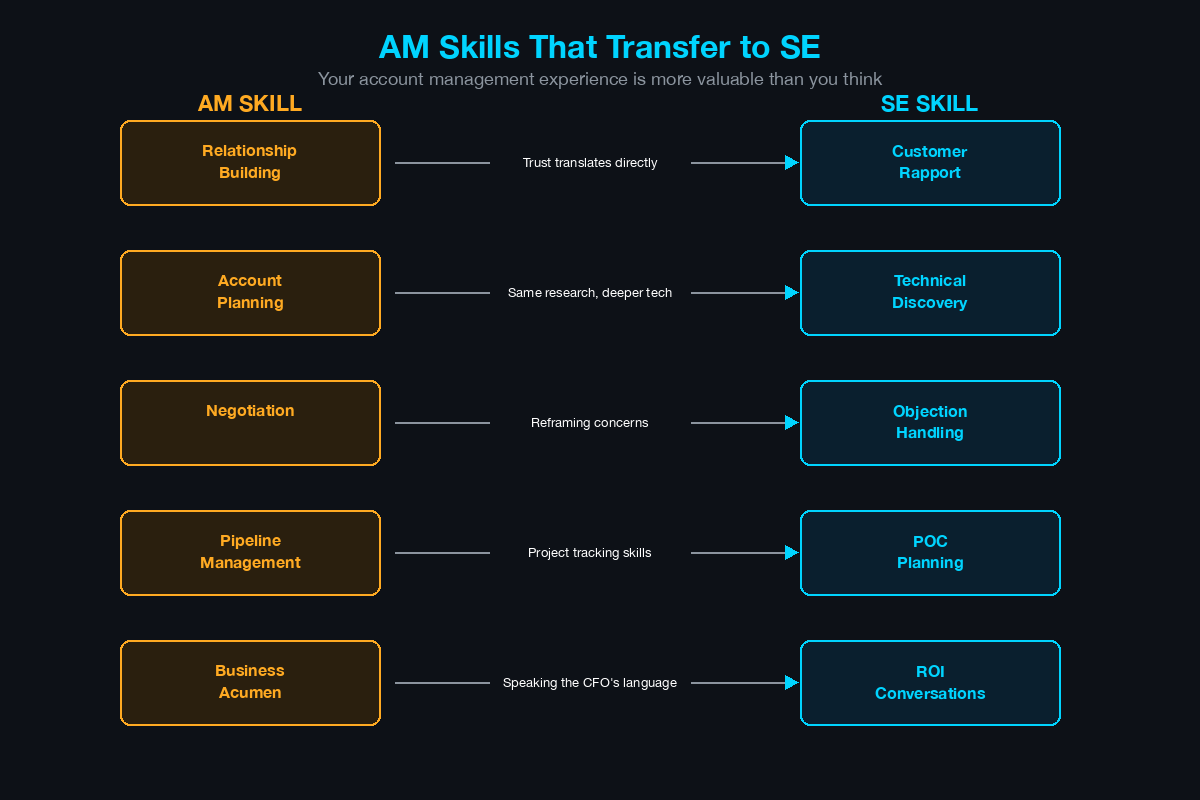
Before mapping the transition, it is worth understanding why your AM experience is an asset, not a liability:
Customer Relationship Skills
SEs who came up through purely technical paths often struggle with the interpersonal aspects of pre-sales. They over-explain technical details. They answer the question the customer asked, not the question the customer meant. They forget that the person across the table has a quota, a board, and a career to protect.
You already know how to read a customer. You know when they are engaged and when they are checking their phone under the table. You know how to navigate organizational politics. You know how to follow up without being annoying. These are not skills that come from a CCNA study guide.
Business Acumen
The best SE presentations connect technical capabilities to business outcomes: reduced risk, faster compliance, lower operational costs, fewer headcount requirements. AMs live in this world. You already know how to frame a conversation around ROI, total cost of ownership, and competitive differentiation. When you add technical depth to this foundation, you become an SE who can own the entire conversation - from the whiteboard to the executive summary.
Sales Process Understanding
You understand pipeline stages, MEDDIC qualification, procurement cycles, and how decisions actually get made in large organizations. Many technically excellent SEs lose deals because they do not understand the sales process surrounding their demos. You will never have that problem.
Communication Skills
You have been presenting to customers, writing proposals, and running meetings for years. The format changes when you become an SE - you are presenting architectures instead of pricing - but the core skill is identical.
The Skills Gap: What You Need to Learn
Here is an honest assessment of the technical skills you need to develop, ordered by priority:
Priority 1: Networking Fundamentals (Weeks 1-6)
You cannot discuss cybersecurity without understanding the network it protects. This is the most critical gap for most AMs.
What to learn:
- OSI model and TCP/IP stack - what happens when a user opens a browser
- IP addressing and subnetting - you need to be able to subnet in your head during customer conversations
- Routing basics - how traffic moves between networks, default routes, static routes
- Switching - VLANs, trunking, spanning tree (conceptual understanding)
- DNS, DHCP, NAT - how these services work and where they break
- Wireless fundamentals - SSIDs, WPA2/WPA3, authentication methods
Free resources:
- Professor Messer’s CompTIA Network+ video series (YouTube, free)
- Jeremy’s IT Lab CCNA series (YouTube, free)
- Cisco Networking Academy Introduction to Networks (free with registration)
- Subnetting practice: subnettingpractice.com
Milestone: You can explain to a non-technical person how their laptop connects to a website, including DNS resolution, routing, and firewall inspection. You can subnet a /24 into /26s without a calculator.
Priority 2: Security Concepts (Weeks 4-10)
Overlapping with your networking study, start building security-specific knowledge.
What to learn:
- Firewalls - stateful inspection, next-generation firewall features, ACLs vs. security policies
- VPN - site-to-site vs. remote access, IPsec vs. SSL/TLS
- Identity and access management - RADIUS, TACACS+, 802.1X, multi-factor authentication
- Endpoint security - antivirus vs. EDR vs. XDR, how endpoint agents work
- SIEM - what it collects, how it correlates, why customers buy it
- Common attack types - phishing, ransomware, lateral movement, privilege escalation
- Frameworks - NIST Cybersecurity Framework, MITRE ATT&CK (conceptual understanding)
Free resources:
- CompTIA Security+ study materials (Professor Messer, YouTube)
- NIST Cybersecurity Framework documentation (nist.gov)
- MITRE ATT&CK website and training (attack.mitre.org)
- Cybrary free courses on security fundamentals
Milestone: You can explain what a firewall does beyond “blocks bad traffic.” You can describe a RADIUS authentication flow. You can list the phases of a ransomware attack.
Priority 3: CLI Comfort (Weeks 6-14)
This is where many AMs feel the most discomfort. Command-line interfaces are not intuitive, and the only way to get comfortable is practice.
What to learn:
- Basic Linux commands - ls, cd, cat, grep, ping, traceroute, netstat, curl, ssh
- Cisco IOS basics - show commands (show run, show ip int brief, show vlan, show access-lists), basic configuration
- Reading log files - syslog, Windows Event Viewer, firewall logs
- Basic scripting concepts - understanding what a Python or Bash script does (you do not need to write complex code)
Free resources:
- OverTheWire Bandit (overthewire.org) - gamified Linux command-line learning
- Cisco Packet Tracer (free with Networking Academy registration) - practice Cisco CLI in a simulator
- Linux Survival (linuxsurvival.com) - browser-based Linux tutorial
Milestone: You can SSH into a network device, run show commands, and interpret the output. You can navigate a Linux filesystem, read a log file, and use grep to find specific entries.
Priority 4: Demo Skills (Weeks 10-20)
Knowing a technology and demonstrating it to a customer are different skills.
What to learn:
- How to structure a technical demo (problem statement, architecture overview, live demonstration, summary)
- Screen sharing best practices - font size, clean desktop, browser bookmarks organized
- Narrating while configuring - explaining what you are doing and why as you type commands
- Handling demo failures gracefully - having backup screenshots, knowing common failure points
- Whiteboarding - drawing network diagrams, security architectures, and data flows in real time
Practice method: Record yourself demoing a technology. Watch the recording. You will immediately notice filler words, long pauses, and moments where you looked lost. Re-record until it is smooth.
Milestone: You can deliver a 20-minute demo of a security product - ISE, a firewall, a SIEM - including a whiteboard overview, live configuration, and Q&A handling.
The 6-Month Transition Plan
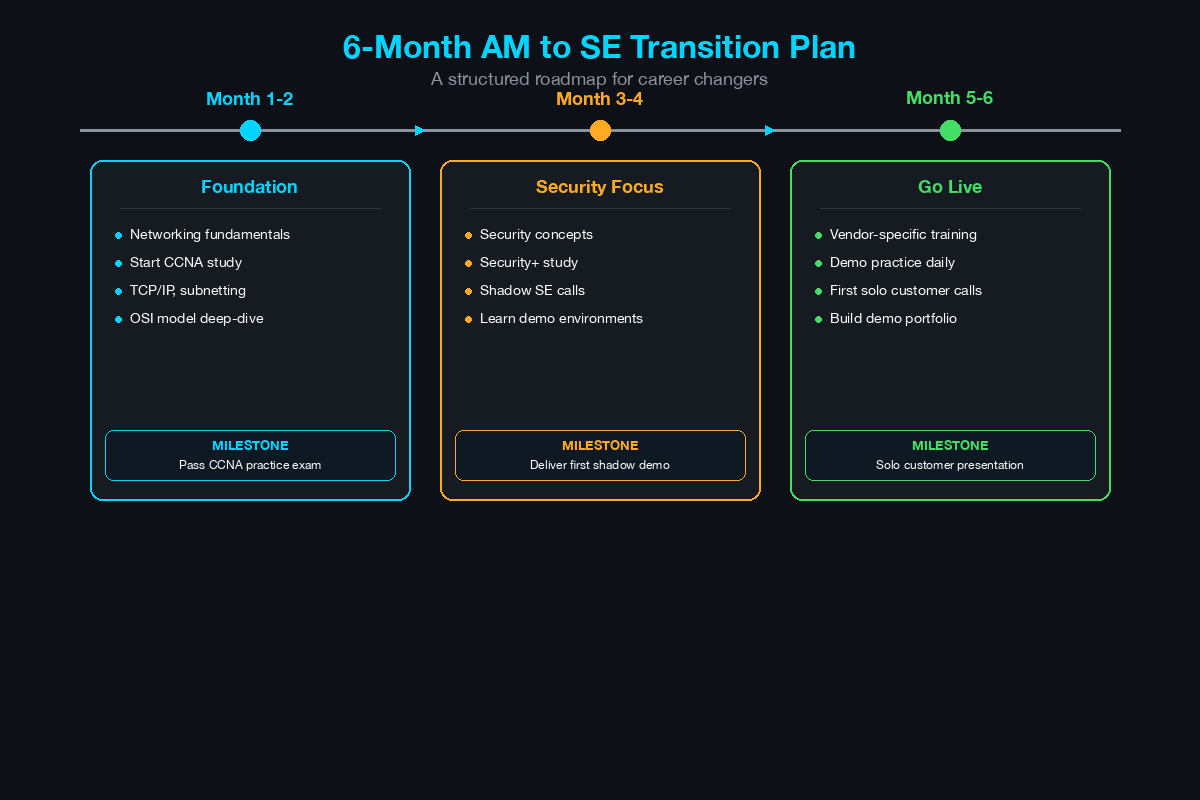
Month 1: Networking Foundation
| Week | Focus | Daily Time | Activity |
|---|---|---|---|
| 1 | OSI Model, TCP/IP | 1.5 hours | Professor Messer videos + notes |
| 2 | IP Addressing, Subnetting | 1.5 hours | Videos + subnetting practice drills |
| 3 | Routing and Switching Basics | 1.5 hours | Videos + Packet Tracer labs |
| 4 | DNS, DHCP, NAT, Wireless | 1.5 hours | Videos + lab exercises |
End-of-month checkpoint: Take a practice Network+ exam. Target score: 70%+.
Month 2: Security Fundamentals
| Week | Focus | Daily Time | Activity |
|---|---|---|---|
| 5 | Firewall concepts, VPN | 1.5 hours | Security+ materials + lab |
| 6 | Identity: RADIUS, 802.1X, MFA | 1.5 hours | Study + observe SE demos |
| 7 | Threats: malware, phishing, ransomware | 1.5 hours | MITRE ATT&CK exploration |
| 8 | SIEM, logging, incident response | 1.5 hours | Splunk Free tutorials |
End-of-month checkpoint: Explain a zero-trust architecture to a colleague without notes.
Month 3: Hands-On and CLI
| Week | Focus | Daily Time | Activity |
|---|---|---|---|
| 9 | Linux command line | 1.5 hours | OverTheWire Bandit levels 1-15 |
| 10 | Cisco IOS basics | 1.5 hours | Packet Tracer labs |
| 11 | Firewall configuration | 2 hours | pfSense or FTDv lab setup |
| 12 | Combined lab scenario | 2 hours | Build VLAN + firewall + RADIUS |
End-of-month checkpoint: Configure a basic network from scratch in Packet Tracer - VLANs, inter-VLAN routing, ACLs, and a RADIUS server.
Month 4: Certification Push
| Week | Focus | Daily Time | Activity |
|---|---|---|---|
| 13 | Network+ or CCNA prep | 2 hours | Practice exams + weak area review |
| 14 | Network+ or CCNA prep | 2 hours | Practice exams + lab review |
| 15 | Take Network+ or CCNA exam | - | Schedule and sit the exam |
| 16 | Security+ preparation begins | 1.5 hours | Domain 1-2 study |
Month 5: Security Certification and SE Shadowing
| Week | Focus | Daily Time | Activity |
|---|---|---|---|
| 17 | Security+ Domains 3-4 | 1.5 hours | Study + practice questions |
| 18 | Security+ Domains 5-6 | 1.5 hours | Study + practice questions |
| 19 | Security+ review | 2 hours | Practice exams + weak areas |
| 20 | Take Security+ exam | - | Schedule and sit the exam |
During this month, also begin shadowing SEs on customer calls. Ask your SE team lead if you can join 2-3 calls per week as a silent observer. Take notes on how SEs structure demos, answer questions, and handle objections.
Month 6: Demo Development and Transition Preparation
| Week | Focus | Daily Time | Activity |
|---|---|---|---|
| 21 | Build a personal demo environment | 2 hours | Home lab or CML setup |
| 22 | Practice delivering demos | 2 hours | Record and review yourself |
| 23 | Interview preparation | 1.5 hours | Mock technical interviews |
| 24 | Formal transition conversation | - | Meet with your manager |
Certifications to Prioritize
For the AM-to-SE transition, here is the recommended certification path:
Step 1: CompTIA Network+ or CCNA (Choose one)
- Network+ if you want vendor-neutral networking fundamentals
- CCNA if you are at a Cisco partner or plan to work with Cisco products
- Timeline: 2-3 months of study
Step 2: CompTIA Security+
- Vendor-neutral security fundamentals
- Meets DoD 8570 requirements if you sell to government
- Timeline: 6-8 weeks of study after Network+
Step 3: Vendor-Specific Certification (After transitioning to SE role)
- CCNP Security if you sell Cisco
- PCNSE if you sell Palo Alto
- AWS Security Specialty if you are in cloud security
- Timeline: 3-6 months in-role
How to Pitch the Transition to Your Manager
Your manager will have two concerns: losing a productive AM, and the risk that you will not succeed as an SE. Address both directly.
Lead with your value proposition: your customer relationships and business acumen, combined with the technical skills you have been building, make you a stronger SE candidate than a purely technical hire. Propose a gradual transition - continue managing your accounts while increasing technical involvement over the next quarter. Show your preparation by referencing certifications you have passed and your home lab. Then propose a 30-day pilot: shadow the SE team on three accounts and deliver a technical presentation. If it goes well, discuss a formal transition. If not, you continue in your AM role with stronger technical skills.
Interview Preparation for SE Roles
SE interviews have three consistent components. First, the technical whiteboard - practice drawing enterprise network topologies, 802.1X authentication flows, and zero-trust architectures. You do not need to draw perfectly; you need to draw clearly and explain each component.
Second, the mock demo. Prepare a 15-minute demo of a security technology: business context (2 minutes), architecture overview (3 minutes), live demo (8 minutes), summary (2 minutes). Practice handling interruptions - interviewers will ask questions mid-demo.
Third, technical questions. Be prepared to explain how HTTPS works end-to-end, the difference between IDS and IPS, a RADIUS authentication flow, and the basics of zero trust. You do not need CCIE-level answers. You need correct, clear, and confident responses.
Your First 90 Days as an SE
Days 1-30: Listen and Learn
- Shadow every SE on the team. Attend every customer call you can.
- Learn the demo environment. Run through every standard demo until you can do it without notes.
- Read the last 20 technical proposals your team delivered. Understand the structure and language.
- Identify your SE mentor - the person who will answer your questions without judgment.
- Do not try to lead customer calls yet. Observe, take notes, ask questions afterward.
Days 31-60: Start Contributing
- Take ownership of one demo scenario that you can deliver confidently.
- Begin answering basic technical questions on customer calls with your SE mentor present.
- Start building your personal demo environment with customizations for your accounts.
- Deliver your first solo technical presentation to an internal audience for feedback.
- Begin studying for your vendor-specific certification.
Days 61-90: Build Independence
- Lead your first customer technical call with your mentor on backup.
- Deliver your first customer demo. Accept that it will not be perfect.
- Write your first technical proposal section (your mentor should review it).
- Identify the top 3 customer scenarios you encounter most frequently and build repeatable demos for each.
- Schedule a 90-day review with your manager to discuss progress and next steps.
The Advantage Nobody Talks About
Here is the truth that most career advice ignores: the SE role is not purely technical. It is a hybrid role that requires equal parts technical knowledge, communication skill, and business understanding. Pure technologists who become SEs often struggle with the communication and business sides. AMs who become SEs arrive with two of the three pillars already built.
Your transition is not starting from zero. It is adding technical depth to an existing foundation of customer skills, business acumen, and professional credibility. That foundation is more valuable than most people recognize - and it is why AMs who complete this transition often become the highest-performing SEs on their teams.
The technical knowledge will come with study and practice. The customer instincts you have already developed take years to learn. You are closer than you think.
Related Posts in This Series
- SE Career Path in Cybersecurity - See the full career trajectory you are entering as a new SE
- Top 10 Certifications for Cybersecurity SEs - Prioritize certifications that accelerate your AM-to-SE transition
- The AM’s Guide to Cybersecurity Terminology - Build the vocabulary foundation before diving into technical depth
- How to Build a Home Lab - A home lab is the fastest way to build hands-on technical skills
- How to Run a Technical Discovery Call for Security Deals - Master discovery calls as your first step into technical customer conversations
Practice with free flashcards, quizzes, and hands-on lab scenarios at cciesec.it-learn.io — built specifically for the CCIE Security v6.1 written (350-701 SCOR) and lab exam.


