Cisco ISE is the policy engine behind network access control on Cisco networks: it decides who and what gets onto the network, and with what access. This page is the map for everything we have written about it. It explains in a few minutes how ISE works as a RADIUS server, gives you a starting switch configuration, and then lists every it-learn ISE guide in the order you would actually build a deployment.
If you are still choosing a platform, start with the comparisons at the end of this page.
⚡ Key Takeaways
ISE is a RADIUS and TACACS+ policy server. Switches, wireless controllers and VPN gateways ask it whether to admit each endpoint.
Every request flows through a policy set, then authentication against an identity store, then first-match authorization rules.
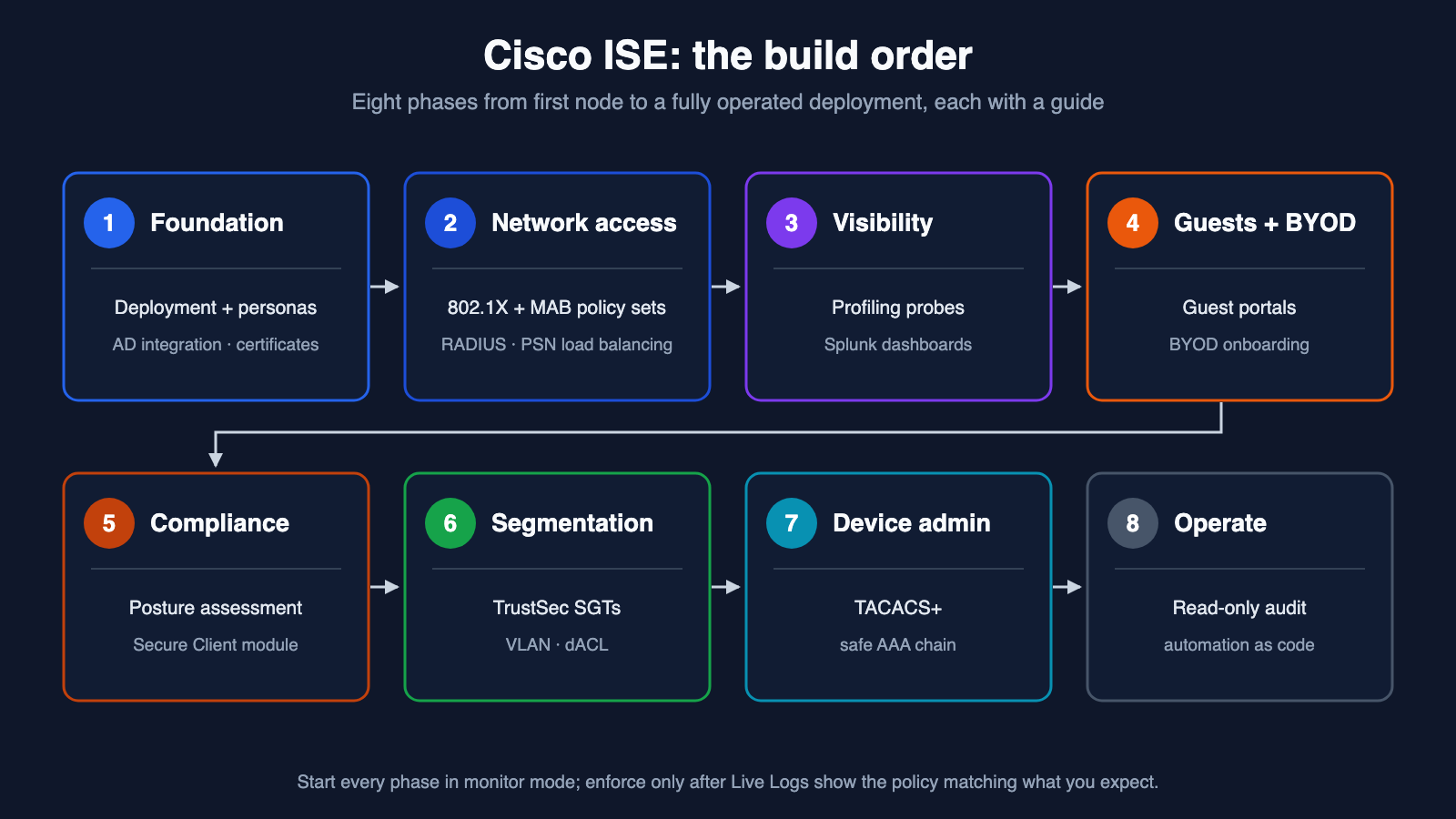
Build in phases: foundation, network access, visibility, guests and BYOD, compliance, segmentation, device admin, operations.
Always start in monitor mode and enforce only when Live Logs show the policy matching what you expect.
How ISE works as a RADIUS server
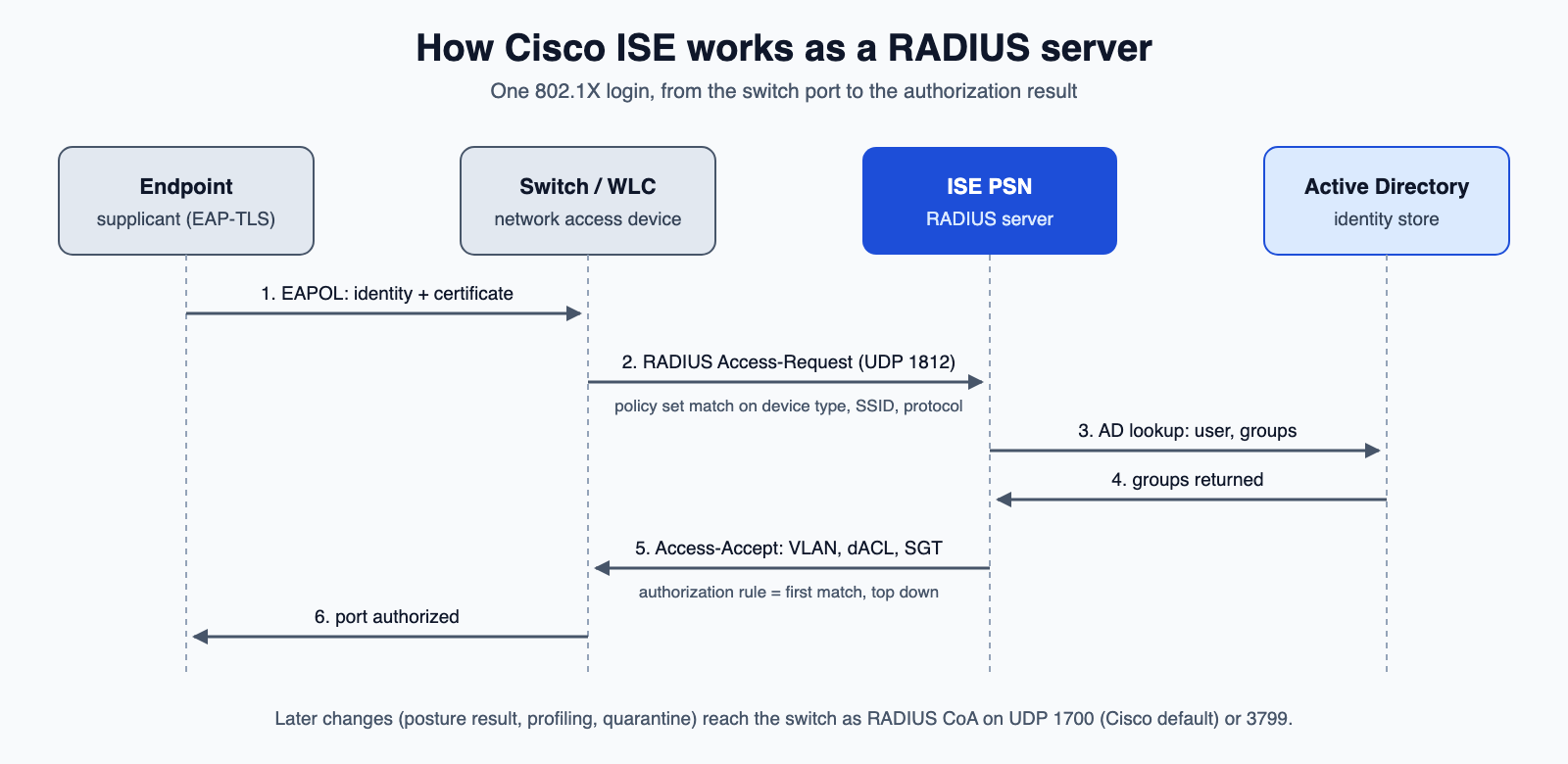
A simplified 802.1X login: the real EAP exchange takes several Access-Challenge round trips
The endpoint’s supplicant sends its identity (and, for EAP-TLS, its certificate) to the switch over EAPOL. Devices without a supplicant fall back to MAB, where the MAC address is the identity.
The switch, configured as a network access device in ISE, wraps the request in RADIUS and sends it to a Policy Service Node on UDP 1812.
ISE matches the request to a policy set (for example “Wired 802.1X”), authenticates it against an identity store such as Active Directory, and reads attributes like group membership.
ISE walks the authorization policy top down and returns the first matching result: a VLAN, a downloadable ACL, a Security Group Tag or a redirect.
If something changes later, such as a posture result or a new profile, ISE sends a Change of Authorization (CoA) to the switch to re-evaluate the session.
Starting switch configuration (IOS XE)
A minimal wired 802.1X and MAB setup for one PSN. Replace the addresses and secret with your own. This uses the classic syntax, which IOS XE accepts and can convert to the newer IBNS 2.0 policy format.
 1aaa new-model
 2!
 3radius server ISE-PSN1
 4 address ipv4 10.1.1.21 auth-port 1812 acct-port 1813
 5 key <shared-secret>
 6!
 7aaa group server radius ISE
 8 server name ISE-PSN1
 9!
10aaa authentication dot1x default group ISE
11aaa authorization network default group ISE
12aaa accounting dot1x default start-stop group ISE
13!
14aaa server radius dynamic-author
15 client 10.1.1.21 server-key <shared-secret>
16!
17dot1x system-auth-control
18!
19interface GigabitEthernet1/0/10
20 switchport mode access
21 authentication port-control auto
22 authentication open
23 mab
24 dot1x pae authenticator
authentication open is monitor mode: authentication runs but failures are not blocked. Remove it when you are ready to enforce.
For multiple PSNs behind a virtual IP, read Cisco ISE RADIUS load balancing before you point switches at the VIP. Session persistence and CoA source addresses are the usual traps.
Every ISE guide, in build order
Build ISE in phases and move each one from monitor mode to enforcement on its own
Practice with free flashcards, quizzes, and hands-on lab scenarios at cciesec.it-learn.io — built specifically for the CCIE Security v6.1 written (350-701 SCOR) and lab exam.
Practical IT, networking, and cybersecurity content for professionals. Tutorials, labs, cert guides, and weekly podcast episodes covering what matters in the field.