

Cisco ISE and Aruba ClearPass are the two RADIUS-based NAC platforms that show up in almost every enterprise shortlist. They solve the same problem: decide who and what gets on the network, and with what access. But they come from different ecosystems and organize policy differently. This guide compares them head to head as of November 2026, with a migration map at the end for teams moving from one to the other.
If you are also evaluating an agentless platform, the three-way ISE vs ClearPass vs Forescout comparison covers where Forescout fits.
⚡ Key Takeaways
- Both are full RADIUS and TACACS+ policy servers with 802.1X, MAB, profiling, posture, guest and BYOD. Feature checklists look almost identical.
- The real split is ecosystem: ISE is the policy brain for Cisco TrustSec, SD-Access and pxGrid; ClearPass is built to be vendor-neutral and fits Aruba role-based access natively.
- ClearPass adds a role-mapping step between authentication and enforcement; ISE writes authorization rules directly against identity, profile and posture conditions.
- Licensing: ISE 3.x uses Essentials, Advantage and Premier subscription tiers plus a separate Device Admin license; ClearPass uses Access plus Onboard and OnGuard add-ons.
- 2026 context: both vendors now also sell a simpler cloud NAC (Meraki Access Manager for Cisco; Central NAC and Mist Access Assurance for HPE). ISE and ClearPass remain the choice when you need posture, TACACS+ or mixed-vendor depth.
At a glance
| Cisco ISE | Aruba ClearPass | |
|---|---|---|
| Vendor | Cisco | HPE Aruba Networking |
| Current line (Nov 2026) | ISE 3.5 (3.6 in beta) | ClearPass Policy Manager 6.x |
| Core role | RADIUS + TACACS+ policy server, TrustSec policy server | RADIUS + TACACS+ policy server |
| Best fit | Cisco campus, SD-Access, TrustSec, Cisco security stack | Aruba wireless and switching, mixed-vendor access |
| Policy model | Policy Sets → Authentication → Authorization → Authorization Profile | Service → Authentication → Role Mapping → Enforcement Policy → Enforcement Profile |
| Segmentation | VLAN, dACL, SGT/SGACL, SD-Access fabric | VLAN, dACL, Aruba user roles (incl. dynamic segmentation) |
| Context sharing | pxGrid 2.0 publish/subscribe, ERS and OpenAPI | Extensions, REST API, syslog/HTTP context actions |
| Posture agent | Cisco Secure Client ISE Posture module, or agentless posture | OnGuard agent (persistent or dissolvable) |
| Cloud sibling | Meraki Access Manager | Central NAC, Mist Access Assurance |
Architecture
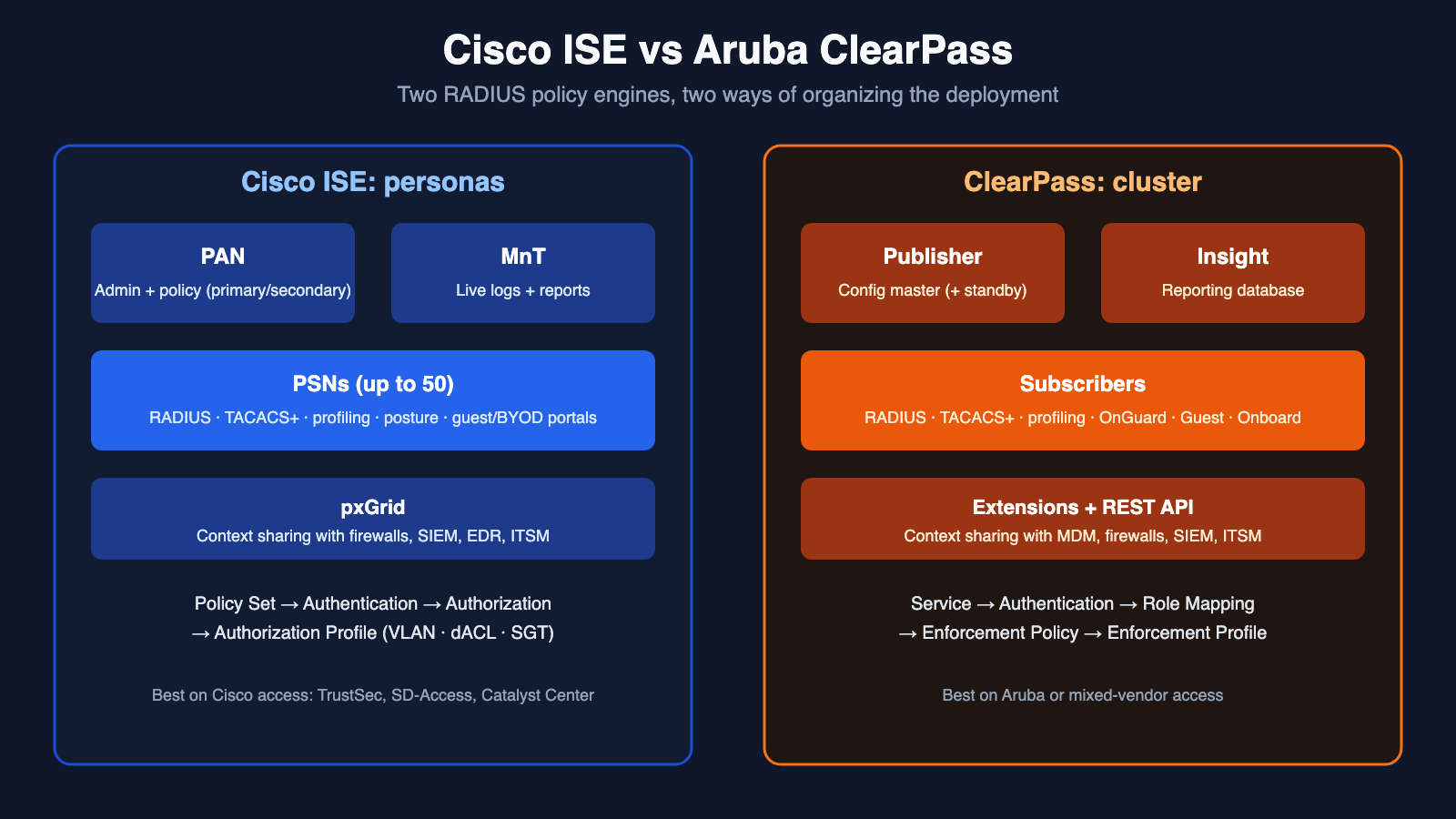
Cisco ISE is built from personas that you place on one or more nodes:
- Policy Administration Node (PAN): the configuration master. You run a primary and a secondary.
- Monitoring and Troubleshooting (MnT): live logs, sessions and reports. Also deployed as a pair.
- Policy Service Node (PSN): the nodes that actually answer RADIUS and TACACS+, run profiling probes, host guest and BYOD portals and evaluate posture. A large deployment supports up to 50 PSNs.
- pxGrid: the context-sharing service that publishes sessions, SGTs and endpoint data to subscribers.
A small site runs every persona on two nodes. A large enterprise runs dedicated PAN and MnT pairs with regional PSNs behind a load balancer (see RADIUS load balancing for Cisco ISE).
ClearPass uses a cluster model:
- Publisher: the configuration master. A standby publisher takes over if it fails.
- Subscribers: receive replicated configuration and handle authentication, TACACS+, guest, Onboard and OnGuard traffic.
- Insight: the reporting database, enabled on one or more nodes.
Both scale to large enterprises. In practice, ISE’s persona split gives more control over where logging and policy service run, while ClearPass is quicker to stand up for small and mid-size clusters.
Policy model: where they really differ
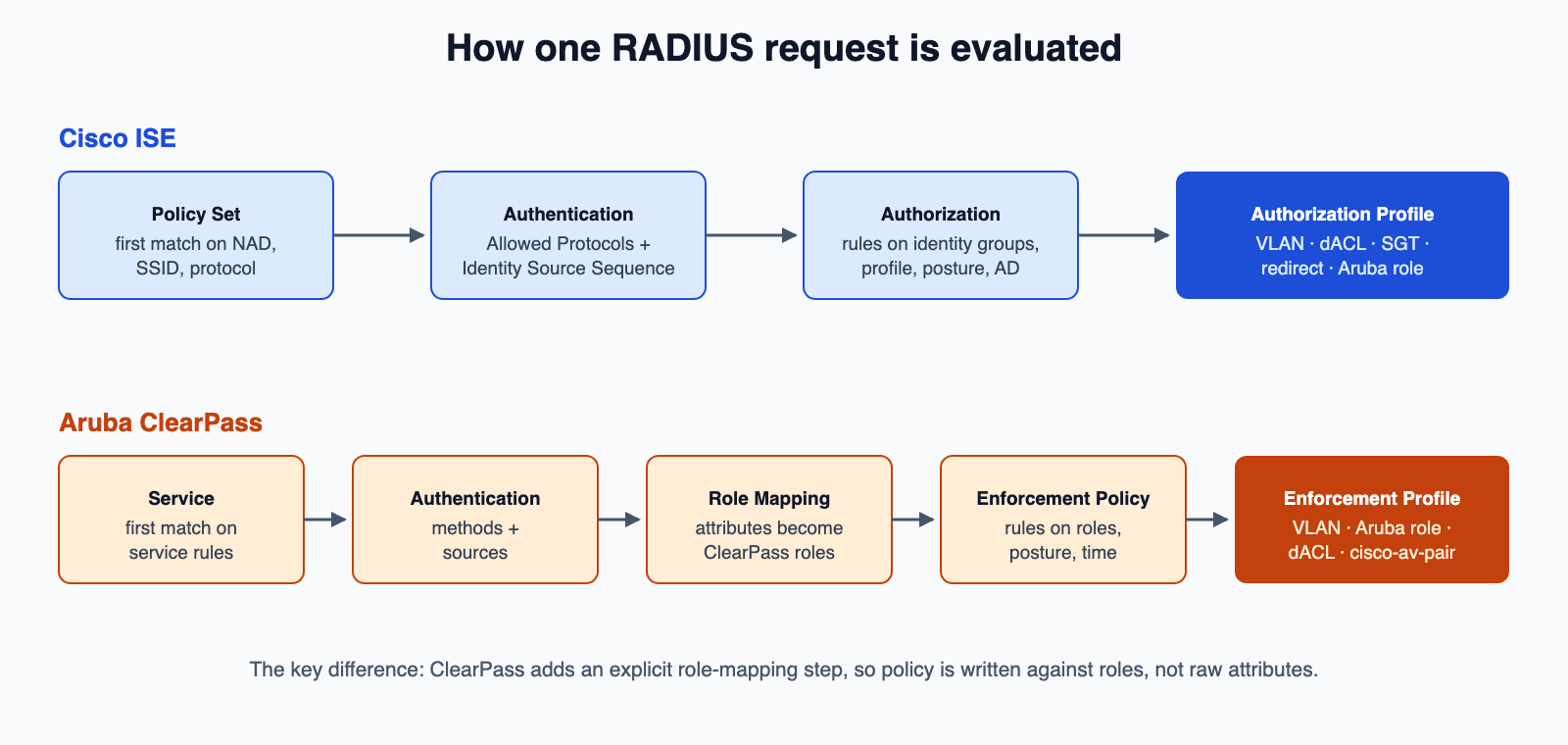
Feature lists hide the biggest day-to-day difference, which is how you write policy.
In ISE, a request first matches a Policy Set (for example “Wired 802.1X” or “Guest Wireless”). Inside it, the authentication policy picks the allowed protocols and identity store, and the authorization policy is a top-down, first-match rule table. Each rule combines conditions (AD group, endpoint profile, posture status, device type, location) and returns an authorization profile with the VLAN, downloadable ACL, SGT or redirect URL.
In ClearPass, a request first matches a Service. The service authenticates against its sources, then a Role Mapping Policy converts attributes (AD group, device category, time of day) into ClearPass roles. The Enforcement Policy is written against those roles plus posture and other conditions, and it returns one or more Enforcement Profiles with the RADIUS attributes to send.
What that means in practice:
- ClearPass policy reads like a business rule (“Contractors on corporate devices get the Contractor role”), and the same role can drive several enforcement policies.
- ISE policy is more direct and easier to trace in Live Logs, because each authorization rule shows exactly which conditions matched.
- Both evaluate top-down with first match, so rule order matters on both platforms.
Feature by feature
| Capability | Cisco ISE | Aruba ClearPass |
|---|---|---|
| 802.1X / EAP | EAP-TLS, PEAP, EAP-FAST, EAP-TTLS, TEAP | EAP-TLS, PEAP, EAP-TTLS, EAP-FAST, TEAP |
| MAB | Native, with endpoint identity groups | Native, with endpoint repository and static host lists |
| Profiling | Probes: DHCP, RADIUS, HTTP, SNMP, NetFlow, DNS, NMAP, AD; Cisco profiler feed updates | DHCP, HTTP user agent, SNMP, mDNS, TCP fingerprints, active scans; Device Insight for ML-based classification |
| Posture | Secure Client ISE Posture module, temporal agent, agentless posture; MDM/UEM compliance | OnGuard persistent or dissolvable agent; MDM/UEM compliance via extensions |
| Guest | Hotspot, self-registered and sponsored portals with a sponsor portal | ClearPass Guest with self-registration, sponsorship and highly customizable pages |
| BYOD onboarding | Native supplicant provisioning with ISE internal CA | Onboard with built-in CA and per-device certificates |
| TACACS+ | Full device administration with command sets and shell profiles | TACACS+ services with command authorization |
| Change of Authorization | Yes, broad support on Cisco gear, profiles for third-party NADs | Yes, with per-vendor enforcement templates |
| Segmentation | VLAN, dACL, SGT + SGACL matrix, SXP, SD-Access | VLAN, dACL, Aruba user roles, dynamic segmentation on Aruba gear |
| APIs | ERS, OpenAPI, pxGrid 2.0 | REST API, extensions, context actions |
| Deployment | SNS appliances; VMware, KVM, Hyper-V; AWS, Azure, OCI | Hardware appliances; VMware, Hyper-V, KVM; cloud images |
Our deeper configuration guides for the ISE side: profiling, posture, guest portals, BYOD onboarding and TACACS+ device admin.
Multi-vendor support
This is the question that decides most deals.
ClearPass was built to be the NAC for any network. It ships enforcement templates and RADIUS dictionaries for many switch and wireless vendors, and on Aruba gear it can push Aruba user roles, which carry firewall policy into the access point or switch. With Cisco switches it sends standard VLAN and dACL attributes, and it can return an SGT through cisco-av-pair.
ISE handles third-party devices through Network Device Profiles, which define how a vendor signals MAB, CoA and URL redirect. Aruba, HPE, Juniper, Ruckus and others work well for 802.1X, MAB and VLAN assignment. What you lose on non-Cisco gear is the Cisco-specific depth: TrustSec enforcement, SD-Access, and some redirect and CoA behaviors.
Rule of thumb: if SGT-based segmentation on Cisco switching is on the roadmap, ISE is the natural policy server. If the access layer is Aruba or mixed and segmentation will be VLAN or role based, ClearPass usually needs less customization.
Licensing
| Cisco ISE 3.x | Aruba ClearPass | |
|---|---|---|
| Base tier | Essentials: 802.1X, MAB, guest, basic AAA | Access: policy manager, RADIUS, guest |
| Middle tier | Advantage: profiling, BYOD, pxGrid, TrustSec, adds Essentials | Onboard add-on: BYOD certificate provisioning |
| Top tier | Premier: posture, MDM/UEM compliance, adds Advantage | OnGuard add-on: posture |
| Device admin | Device Administration license, separate from endpoint tiers | TACACS+ runs on the policy manager; confirm how your bundle counts it |
| Counting | Active endpoint sessions | Concurrent endpoints |
| Model | Subscription | Subscription, with perpetual options historically available |
| Platform | VM node licenses for virtual appliances | Platform license per appliance or VM |
Licensing names and bundles change often, so treat this as orientation, not a quote. Older ISE material that mentions Base, Plus and Apex refers to the pre-3.0 model. Compare vendor quotes at your real concurrent endpoint count, with support included.
The 2026 context: cloud NAC on both sides
Both vendors now sell a simpler, cloud-delivered NAC next to their on-prem engine. This changes the conversation for smaller and distributed customers.
- Cisco: Meraki Access Manager is cloud RADIUS built into the Meraki dashboard, with 802.1X, MAB, iPSK and Adaptive Policy SGTs for Meraki switches and APs. It has no posture, no CoA and Entra ID as its only identity source.
- HPE: offers cloud NAC through HPE Aruba Networking Central, and since closing the Juniper acquisition in 2025 it also has Mist Access Assurance, which keeps shipping features on a rolling cloud release cycle.
For both, the cloud option is easier to run but narrower. If you need posture, TACACS+, complex guest and sponsor flows, third-party NADs or on-prem identity stores, you are still choosing between ISE and ClearPass. If you are an HPE customer, ask your account team how ClearPass, Central NAC and Mist Access Assurance fit together on their roadmap before you commit to a multi-year term.
Which should you choose?
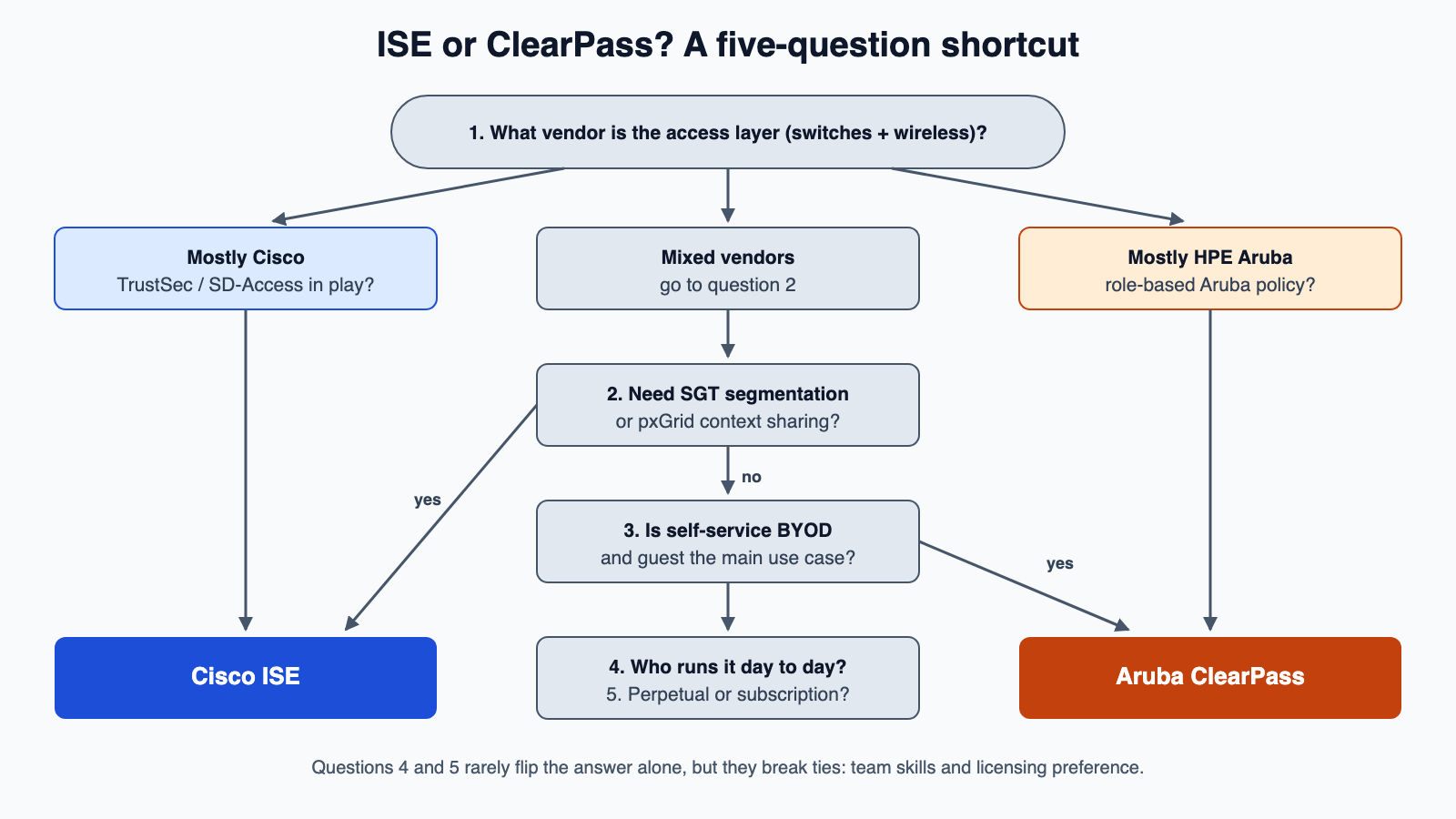
Choose Cisco ISE when:
- The switches and wireless are mostly Cisco, or are moving that way.
- You plan group-based segmentation with TrustSec SGTs or SD-Access.
- You want to share identity context with Cisco Secure Firewall, Secure Network Analytics, Splunk or an EDR over pxGrid.
- You need NAC and network device administration (TACACS+) at scale on the same platform.
Choose Aruba ClearPass when:
- The access layer is HPE Aruba, or a genuine mix of vendors.
- You want Aruba user roles and dynamic segmentation enforced at the AP and switch.
- Self-service guest and BYOD onboarding with heavy portal customization is the main use case.
- The team prefers a service-and-role policy model and a faster initial setup.
Either works when the network is mixed, the main goal is 802.1X with VLAN assignment and posture, and there is no strong segmentation roadmap. In that case decide on team skills, support relationships and total cost over the license term. A short proof of concept on a real access switch and SSID settles it faster than any feature matrix; see running a Cisco ISE POC.
Migration map: ClearPass to ISE (and back)
There is no automated policy converter in either direction. Use this table to translate concepts when you rebuild policy.
| ClearPass | Cisco ISE equivalent |
|---|---|
| Service + service rules | Policy Set + policy set conditions |
| Authentication methods | Allowed Protocols |
| Authentication sources | Identity Source Sequence |
| Authorization sources | Identity stores and attribute lookups in authorization conditions |
| Role Mapping Policy | Authorization conditions on identity groups, AD groups and endpoint profiles |
| Enforcement Policy | Authorization policy rules |
| Enforcement Profile | Authorization Profile (plus downloadable ACL) |
| Aruba user role attribute | Authorization profile returning Aruba-User-Role via the Aruba network device profile |
| Endpoint repository / static host lists | Endpoint identity groups |
| Profiler fingerprints | Profiler policies and conditions |
| OnGuard | Secure Client ISE Posture module or agentless posture |
| Onboard | BYOD native supplicant provisioning with ISE internal CA |
| ClearPass Guest | Guest portals and sponsor portal |
| Insight | MnT Live Logs and reports |
| Publisher / Subscriber | PAN / PSN |
| Extensions and REST API | pxGrid, ERS and OpenAPI |
Practical migration tips:
- Run both servers side by side. Point a pilot switch or SSID at the new server while everything else stays on the old one.
- Start in monitor mode. Use open authentication or low-impact mode on the new platform until Live Logs show the policy matching what you expect.
- Re-learn profiles. Endpoint profiling data does not transfer cleanly; allow a few weeks of probe data before you rely on profile-based rules.
- Plan certificates early. EAP-TLS trust chains, server certificates and any BYOD CA need to be in place before cutover, or clients will fail silently.
- Rebuild guest portals last. They are the most visible to users and the least portable between platforms.
Related guides
- Cisco ISE vs Aruba ClearPass vs Forescout: the three-way comparison, including agentless NAC
- How to build a business case for NAC
- Cisco ISE Active Directory integration
- Network segmentation: VLANs, microsegmentation and TrustSec
- How to integrate Meraki with Cisco ISE
Sources
- Cisco ISE release notes
- Cisco ISE API changelog
- HPE Aruba Networking ClearPass 6.12 release notes
- Juniper Mist product updates
Part of the Cisco ISE guide: every it-learn ISE configuration guide in build order.
Practice with free flashcards, quizzes, and hands-on lab scenarios at cciesec.it-learn.io — built specifically for the CCIE Security v6.1 written (350-701 SCOR) and lab exam.


