

Cisco ISE and Forescout are often compared, but they are built for different jobs. ISE is a policy server in the authentication path: every 802.1X or MAB request goes to it, and it decides what access the endpoint gets. Forescout is an agentless visibility and control platform that watches the network from the side and acts on what it finds. This guide compares them head to head as of November 2026 and shows how teams run both together.
For a three-way view that includes Aruba ClearPass, see the ISE vs ClearPass vs Forescout comparison. For the two RADIUS platforms alone, see Cisco ISE vs Aruba ClearPass.
⚡ Key Takeaways
- ISE enforces in-band: switches and wireless ask ISE before granting access, using 802.1X, MAB and RADIUS.
- Forescout sees out of band: SPAN traffic, switch polling and integrations build an inventory of every device, with no agent and no supplicant.
- ISE wins on identity-based enforcement, TACACS+, guest, BYOD, posture and Cisco TrustSec or SD-Access.
- Forescout wins on fast, agentless visibility and on IoT, OT and medical device classification.
- Most large Cisco shops run both: Forescout classifies, ISE enforces, and pxGrid connects them.
At a glance
| Cisco ISE | Forescout | |
|---|---|---|
| Platform name (Nov 2026) | Cisco Identity Services Engine 3.5 (3.6 in beta) | Forescout Vistaro platform (renamed from Forescout 4D in June 2026) |
| How it sees devices | RADIUS requests, plus profiling probes (DHCP, SNMP, NetFlow, HTTP, NMAP, AD) | Passive SPAN monitoring, switch and controller polling, directory and API integrations |
| How it enforces | RADIUS authorization: VLAN, dACL, SGT, redirect, CoA | Switch and wireless actions (VLAN, ACL), RADIUS plugin and CoA, firewall and EDR integrations, notifications |
| Needs 802.1X? | For full value, yes; MAB covers headless devices | No |
| Agent | Cisco Secure Client for posture; agentless posture available | Agentless by default; optional SecureConnector agent |
| TACACS+ | Yes | No |
| Guest and BYOD | Built-in portals, sponsor portal, internal CA | Basic guest registration; no BYOD certificate provisioning |
| Segmentation | VLAN, dACL, TrustSec SGTs, SD-Access | VLAN and ACL actions; eyeSegment maps traffic and models zones |
| OT depth | Profiling of industrial devices; Cyber Vision is Cisco’s separate OT product | eyeInspect for OT protocol visibility |
| Time to first value | Weeks (monitor mode first) | Days for an inventory |
Architecture: in-band vs out-of-band
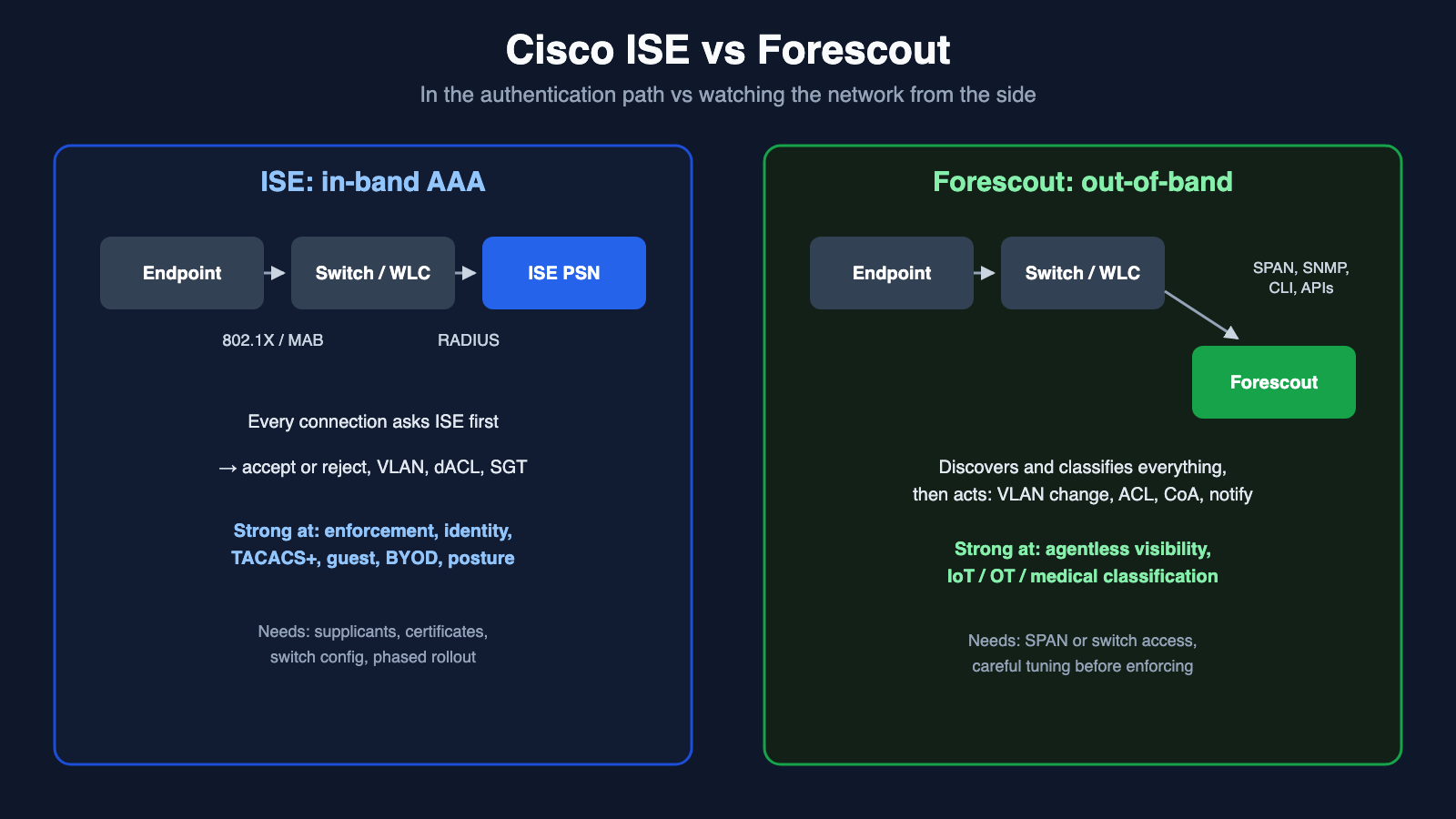
Cisco ISE is deployed as personas: Policy Administration Nodes, Monitoring nodes and Policy Service Nodes (PSNs). Every switch and wireless controller is configured as a network access device that sends RADIUS to the PSNs. Because ISE is in the path, it can stop a device before it gets an IP address, which is what auditors mean by “network access control.” The cost is setup effort: supplicant configuration, certificates for EAP-TLS, switch templates and a phased move from monitor mode to closed mode.
Forescout appliances (physical or virtual) are managed from an Enterprise Manager. They learn about devices from a SPAN or TAP feed and by querying switches, wireless controllers, directories, DHCP and cloud APIs. No endpoint has to change. Once Forescout knows what a device is, policies trigger actions: move it to a quarantine VLAN, apply an ACL, send CoA, open a ticket or tell the firewall. The cost is that enforcement happens just after a device connects, not before, unless you use the RADIUS plugin.
Feature by feature
| Capability | Cisco ISE | Forescout |
|---|---|---|
| Device discovery | Devices that authenticate, plus profiler probe data | Every device seen on SPAN or in switch tables, including ones that never authenticate |
| Classification | Profiler policies with Cisco feed updates | Large device-fingerprint library with strong IoT, OT and medical coverage |
| 802.1X | Full RADIUS server: EAP-TLS, PEAP, TEAP and more | RADIUS plugin for 802.1X and MAB; can also use existing RADIUS as context |
| Posture | Secure Client posture module, agentless posture, MDM/UEM compliance | Agentless checks via WMI, SSH and integrations; optional SecureConnector |
| Guest | Hotspot, self-registration and sponsored portals | Guest registration available; less depth than ISE |
| BYOD | Native supplicant provisioning with internal CA | Not a core use case |
| Device admin (TACACS+) | Yes, with command sets and shell profiles | No |
| Segmentation | TrustSec SGTs and SGACL matrix, SD-Access | eyeSegment traffic maps and zone policies, enforced via network actions |
| Integrations | pxGrid 2.0, ERS and OpenAPI, syslog | eyeExtend modules for EDR, firewalls, SIEM, ITSM, cloud; REST API |
| Licensing | Essentials, Advantage, Premier subscription tiers plus Device Admin license | Per managed device, by module (eyeSight, eyeControl, eyeSegment, eyeExtend, eyeInspect) |
Licensing packages change often on both sides. Treat this as orientation and compare quotes at your real device count, including the eyeExtend modules you actually need.
Where each one wins
Cisco ISE is the better fit when:
- You need true pre-admission control with 802.1X, for compliance frameworks that require authenticated network access.
- The network is Cisco and you plan TrustSec SGTs or SD-Access.
- You need TACACS+ device administration on the same platform; see the ISE TACACS+ guide.
- Guest, sponsor and BYOD onboarding are part of the scope; see guest portals and BYOD onboarding.
Forescout is the better fit when:
- The first goal is a complete, accurate inventory of what is on the network, fast.
- A large share of devices cannot run a supplicant: medical devices, building systems, PLCs, cameras, printers.
- 802.1X cannot be rolled out everywhere in the next year, but you still need to find and contain risky devices.
- The network is multi-vendor and you want one visibility layer across all of it.
Running both: the coexistence pattern
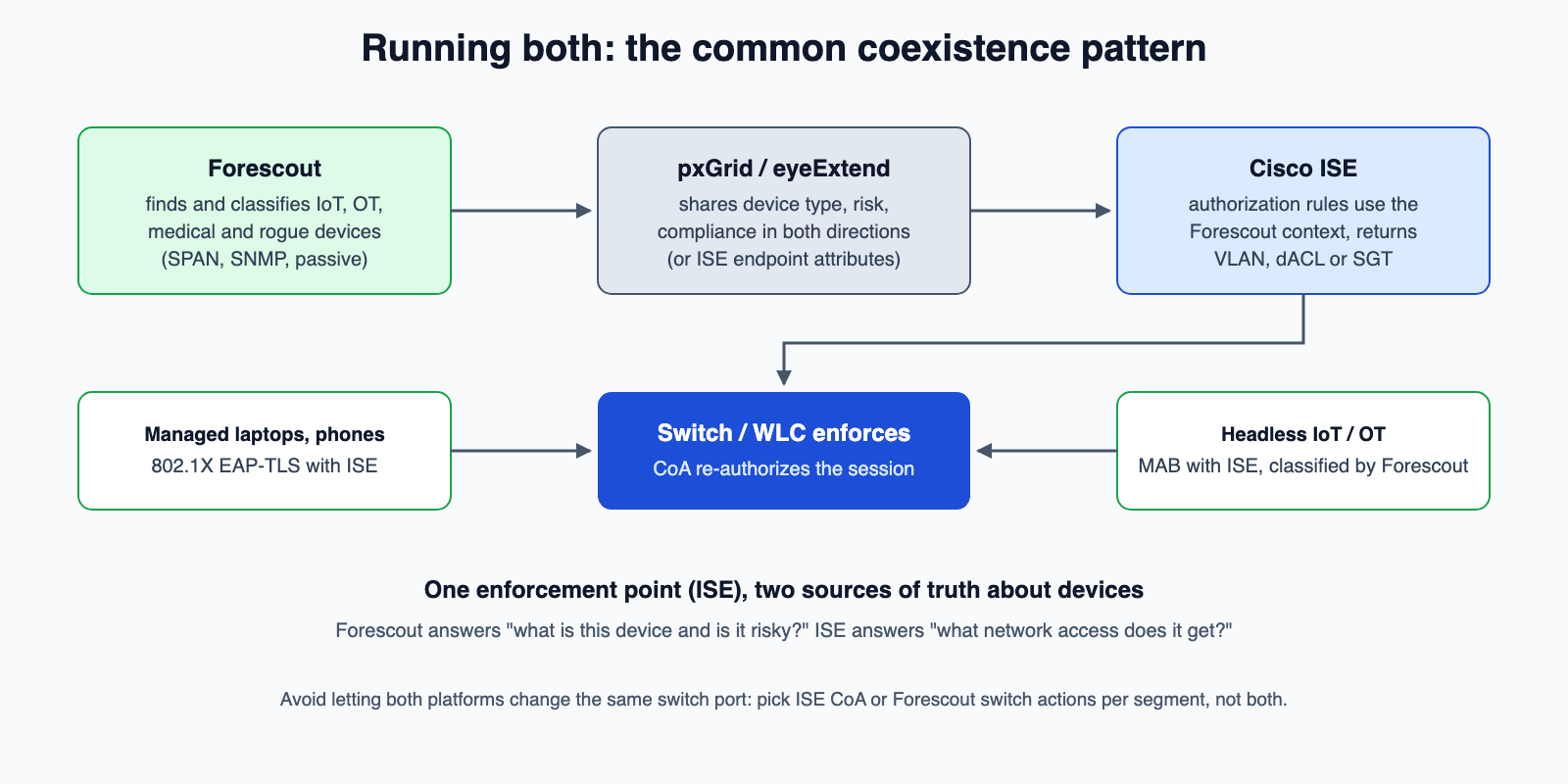
In large Cisco environments the question is often not “which one” but “how do we run both without conflict.” The pattern that works:
- ISE owns admission. Managed laptops and phones use 802.1X EAP-TLS. Headless devices use MAB with ISE.
- Forescout owns visibility. It discovers and classifies everything, including devices ISE only knows by MAC address.
- pxGrid connects them. Forescout’s Cisco pxGrid integration shares classification and compliance context with ISE, and receives identity and session data from ISE.
- ISE authorization rules use Forescout context. For example: if Forescout classifies a MAB device as an infusion pump, ISE returns the medical-device VLAN and dACL.
- One platform changes the port. Let ISE CoA re-authorize the session. Avoid having Forescout switch actions and ISE both change the same port, or you get flapping and confusing logs.
This gives you Forescout’s classification depth with ISE’s enforcement and audit trail, and it lets you tighten ISE policy for IoT without hand-building hundreds of profiling rules. For the ISE side of device classification, see the ISE profiling configuration guide.
Deployment effort
| Phase | Cisco ISE | Forescout |
|---|---|---|
| Prerequisites | Certificates, AD join, switch and WLC AAA config, supplicant settings | SPAN or TAP feeds, read access to switches, WLCs and directories |
| First value | Monitor-mode logs after the first switches are configured | Device inventory within days |
| Enforcement | Low-impact, then closed mode, site by site | Policy tuning, then actions enabled per segment |
| Typical full rollout | Several weeks to a few months | Weeks for visibility; longer for enforcement |
Whichever you pick, start small: one building, one switch stack, one SSID. Our ISE POC guide walks through scoping that first phase.
Decision guide
| Situation | Recommendation |
|---|---|
| Cisco network, compliance requires authenticated access | ISE |
| Hospital or factory, many unmanaged devices, need inventory first | Forescout, add ISE for managed endpoints |
| Cisco network with large IoT or OT population | Both, integrated over pxGrid |
| Multi-vendor network, visibility is the main goal | Forescout |
| Need TACACS+, guest, BYOD on one platform | ISE |
| Already run ISE but IoT classification is weak | Add Forescout, or invest in ISE profiling tuning first |
Related guides
- Cisco ISE vs Aruba ClearPass
- Cisco ISE vs ClearPass vs Forescout
- IoT security architecture for manufacturing and healthcare
- How to build a business case for NAC
- Network segmentation: VLANs, microsegmentation and TrustSec
Sources
- Cisco ISE release notes
- Forescout integration for Cisco pxGrid
- Forescout Vistaro platform rename
- Forescout vs Cisco ISE (Forescout)
Part of the Cisco ISE guide: every it-learn ISE configuration guide in build order.
Practice with free flashcards, quizzes, and hands-on lab scenarios at cciesec.it-learn.io — built specifically for the CCIE Security v6.1 written (350-701 SCOR) and lab exam.


