

CrowdStrike Falcon vs Palo Alto Cortex XDR is the most common endpoint shortlist in enterprise security in 2026. Both pair an endpoint agent with cloud analytics, both sell managed detection and response, and both now push agentic AI into the SOC. The real differences are in where each platform’s data starts, how it fits the rest of your stack, and how you buy it.
This guide is the two-way engineer and buyer comparison: architecture, detection, managed services, identity and cloud, AI assistants, integrations, MITRE results, operational risk and licensing, as of November 2026. If your search was “Cortex XDR vs CrowdStrike”, this is the page that goes deep on just those two. For the three-way category view with Microsoft Sentinel, read XDR explained: Cortex vs CrowdStrike vs Sentinel. If you are studying rather than buying, the Security+ angle on the same two products maps them to exam objectives.
⚡ Key Takeaways
- Same pattern, different center of gravity: Falcon is endpoint-first and adds data sources; Cortex XDR is data-lake-first and already speaks Palo Alto firewall and cloud.
- Palo Alto shops lean Cortex: NGFW, Prisma Access and Cortex Cloud data are stitched with endpoint events in one tenant, with XSIAM as the SIEM upgrade path.
- Mixed shops lean Falcon: one sensor, a broad module menu (identity, cloud, exposure, SIEM) and Falcon Flex licensing to swap modules mid-term.
- MITRE results are not head to head: both ran in 2023, only Palo Alto in 2024, only CrowdStrike in 2025.
- Test update control, not just detection: after July 2024, ask both vendors how content and agent updates are staged, and what you can pause.
At a glance
| CrowdStrike Falcon | Palo Alto Cortex XDR | |
|---|---|---|
| Current release (Nov 2026) | Falcon platform with Charlotte AI agents, Next-Gen SIEM | Cortex XDR 5.x (5.0 in Feb 2026, 5.2 in Jul 2026) |
| Agent | Falcon sensor: one agent for NGAV, EDR and add-on modules | Cortex XDR agent: prevention, EDR collection, optional DLP and more |
| Backend | CrowdStrike cloud and Threat Graph, SaaS only | Cortex tenant (cloud data lake), SaaS |
| Behavioral detection term | IOA (indicator of attack) | BTP (Behavioral Threat Protection) and analytics |
| Query language | CQL (CrowdStrike Query Language) | XQL (XDR Query Language) |
| Isolation term | Network containment | Isolate endpoint |
| Remote shell | Real Time Response (RTR) | Live Terminal |
| MDR | Falcon Complete Next-Gen MDR, OverWatch hunting | Unit 42 MDR, Unit 42 Managed Threat Hunting |
| Identity | Falcon Identity Protection | ITDR add-on, plus CyberArk (acquired Feb 2026) |
| Cloud security | Falcon Cloud Security | Cortex Cloud (successor to Prisma Cloud) |
| SIEM path | Falcon Next-Gen SIEM | Cortex XSIAM |
| AI | Charlotte AI, AgentWorks, Agentic SOAR | Cortex AgentiX, Cortex Agentic Assistant |
| Licensing model | Bundles or Falcon Flex commitment | Prevent, Pro per Endpoint, Pro per GB, plus add-ons |
Architecture: agent and cloud backend
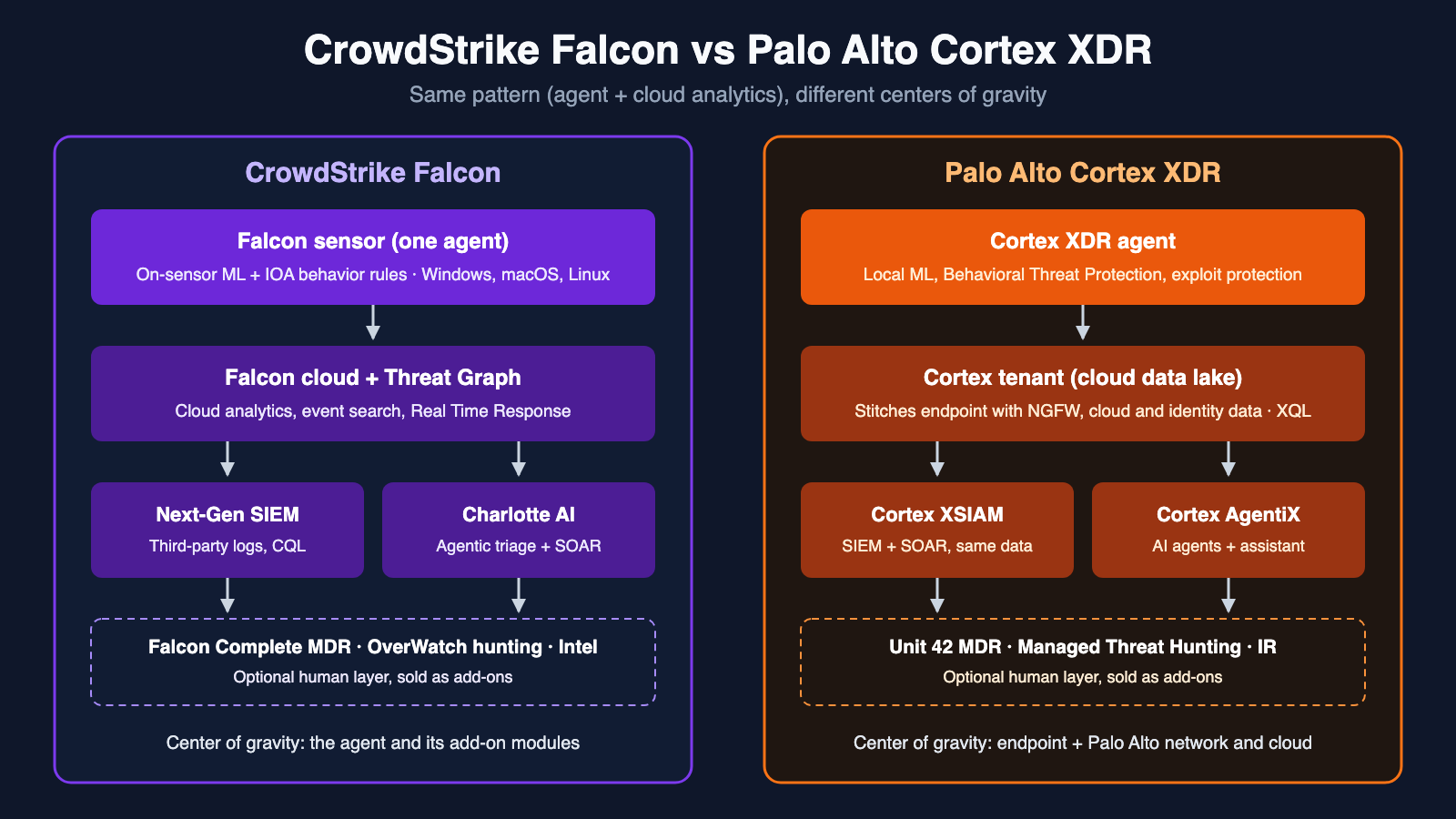
CrowdStrike Falcon was built as a single lightweight sensor talking to a cloud backend, with no on-premises management server. The sensor runs local machine learning and IOA behavior rules for prevention, and streams process, file, network, registry and logon events to the CrowdStrike cloud. There, the Threat Graph correlates events for detection, hunting and investigation. New capabilities (identity, cloud, exposure management, data protection, SIEM) are mostly turned on as modules on the same sensor and console, which is why Falcon rollouts are known for being fast.
Cortex XDR grew out of Palo Alto’s Traps endpoint product and the Cortex data lake. The agent handles prevention (local analysis ML, Behavioral Threat Protection, exploit protection, WildFire file verdicts) and EDR collection. The tenant is the important part: endpoint events sit next to Palo Alto NGFW, Prisma Access, Cortex Cloud and identity data, and Cortex analytics stitch them into causality chains and cases. Cortex XDR 5.0 (February 2026) added on-write file scanning for Linux and macOS, network baseline profiling and on-device DLP classification without a second agent.
Both are Windows, macOS and Linux agents with kernel-mode components on Windows today. Both are SaaS-managed.
Detection and prevention
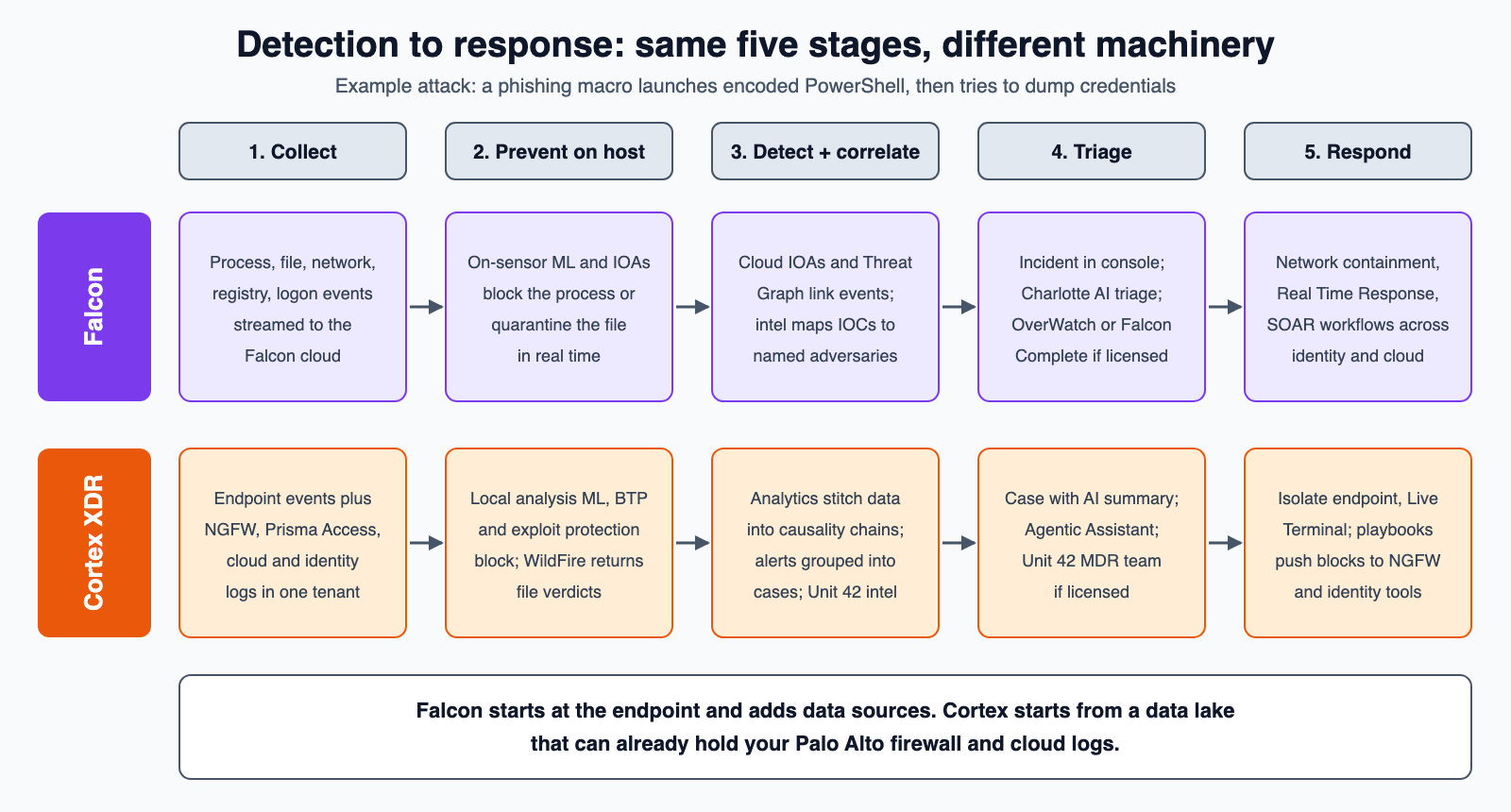
Take a common chain: a phishing macro spawns encoded PowerShell, which then tries to dump LSASS credentials. Both products should stop this on the host. The difference is in what happens around it.
| Stage | CrowdStrike Falcon | Cortex XDR |
|---|---|---|
| On-host prevention | On-sensor ML for files, IOAs for behavior (Office spawning encoded PowerShell, LSASS access) | Local analysis ML, BTP rules, exploit and credential-theft protection, WildFire verdicts |
| Cloud detection | Cloud IOAs and Threat Graph correlation across the host’s history | Analytics engine stitches endpoint data with network and identity logs |
| Grouping | Detections roll up into incidents | Alerts roll up into cases with a causality view |
| Threat intel | CrowdStrike Counter Adversary Operations: named adversaries, IOCs, reports | Unit 42 research and the Cortex XTI threat intel library |
| Hunting | Event search with CQL, plus Next-Gen SIEM for third-party data | XQL across endpoint and every ingested source |
In practice Falcon’s strength is the depth and maturity of its endpoint behavior content and the adversary context behind it. Cortex’s strength shows when the attack touches the network: the same case can show the PowerShell process, the firewall session it opened and the URL category Palo Alto assigned, without a separate integration. For background on the techniques both tools hunt for, see living off the land with LOLBins and MITRE ATT&CK explained.
Threat hunting and MDR: Falcon Complete vs Unit 42
Many buyers are really choosing a managed service, not an agent.
| CrowdStrike | Palo Alto | |
|---|---|---|
| MDR service | Falcon Complete Next-Gen MDR | Unit 42 Managed Detection and Response |
| Managed hunting | Falcon Adversary OverWatch | Unit 42 Managed Threat Hunting |
| Incident response | CrowdStrike Services (also sold through Flex for Services) | Unit 42 Incident Response |
| Working model | Falcon Complete analysts triage and remediate hosts on your behalf | Unit 42 analysts and your team work in the same Cortex tenant |
| Scope beyond endpoint | Depends on the Falcon modules you license | Depends on the data sources in your Cortex tenant |
Falcon Complete has the longer track record and a reputation for hands-on remediation. Unit 42 MDR’s shared-tenant model suits teams that want to keep doing part of the work themselves. For both, get in writing which actions the provider may take without asking (contain a host, disable a user, block on the firewall) and which data sources are actually in scope.
Identity and cloud modules
Identity. Falcon Identity Protection (from the 2020 Preempt acquisition) runs on domain controllers, watches Active Directory and Entra ID authentication in real time, and can challenge or block risky logons with MFA. On the Cortex side, the ITDR module is an add-on to Cortex XDR Pro or XSIAM that adds user risk scoring, identity analytics and AD posture checks. Palo Alto closed its CyberArk acquisition on 11 February 2026 and says CyberArk identity and privileged access will be woven into Cortex and its other platforms; CyberArk is still sold standalone. If identity attacks are your top concern, test real Kerberoasting and password-spray scenarios with each (see Kerberoasting explained).
Cloud. Falcon Cloud Security covers posture management, workload runtime protection with the Falcon sensor and container security. In 2025 Palo Alto launched Cortex Cloud, which moves Prisma Cloud posture and runtime security onto the same Cortex platform as XDR. If you already run Prisma Cloud, that convergence is a real argument for Cortex.
Data platform: Next-Gen SIEM vs XSIAM
Both vendors want to be your SIEM too, briefly:
- Falcon Next-Gen SIEM adds third-party log ingestion and correlation on top of Falcon endpoint data, using the same console and CQL. It is a natural add-on for Falcon customers who want to retire or shrink an older SIEM.
- Cortex XSIAM is Palo Alto’s SOC platform: SIEM, SOAR, XDR, attack surface management and AI agents on one data store. A Cortex XDR customer moving to XSIAM keeps the same agent and data model.
The bigger question of whether either should replace your SIEM is covered in The agentic SOC: is the SIEM dead?.
AI assistants: Charlotte AI vs Cortex AgentiX
Product names here change often, so these are the names in use in late 2026:
| CrowdStrike | Palo Alto | |
|---|---|---|
| Assistant / analyst | Charlotte AI, described by CrowdStrike as an agentic security analyst | Cortex Agentic Assistant inside investigations, with a Case Investigation agent |
| Agent platform | AgentWorks for building custom agents in natural language | Cortex AgentiX, embedded natively in Cortex XDR 5.0 and later |
| Automation | Charlotte Agentic SOAR, built on Falcon Fusion SOAR | AgentiX, which Palo Alto positions as the next generation of XSOAR, with an Automation Engineer that writes scripts from prompts |
| Guardrails | Role-based permissions, execution traces, audit logs, configurable approvals | Actions follow analyst roles, human approval for high-impact actions, full audit log |
Both vendors publish accuracy and time-saving figures for their AI; those are vendor-reported. In a POC, measure triage quality on your own alerts and check which actions the agents can take without a human.
Integrations: Palo Alto firewalls, Prisma and everyone else
- Cortex XDR with Palo Alto gear is the strongest native story: NGFW, Panorama-managed firewalls and Prisma Access send logs into the same tenant, and response playbooks can push blocks back to the firewall.
- Falcon with Palo Alto gear works through CrowdStrike’s Palo Alto Networks data connector, which brings firewall events into Falcon Insight XDR and Next-Gen SIEM, typically via syslog or HTTP log forwarding from Panorama. It works, but it is an integration you build and maintain.
- Cortex with CrowdStrike is also possible: Cortex can ingest third-party data (Pro per GB or XSIAM), and the Cortex marketplace has CrowdStrike Falcon integrations for playbooks. Some customers run Falcon on endpoints and XSIAM as the SOC platform.
- Everyone else: both have large marketplaces covering identity providers, email security, ITSM and cloud. Falcon’s ecosystem is broader on the endpoint side; Cortex’s is deepest on network and SOAR content.
If your SASE choice is still open, our Umbrella vs Zscaler vs Prisma Access comparison covers how Prisma Access changes that calculation.
MITRE ATT&CK Evaluations: read carefully
MITRE’s Enterprise evaluations emulate a named adversary and publish what each product detected and blocked. They do not rank vendors, and every vendor publishes its own “100%” reading of the results. The participation record matters more than the headlines:
| Enterprise round | CrowdStrike | Palo Alto Cortex XDR |
|---|---|---|
| 2023 (Turla) | Participated | Participated |
| 2024 (ransomware, DPRK macOS) | Not among the 19 published participants | Participated |
| 2025 (cloud and cross-domain, adds Reconnaissance) | Participated | Did not participate (also skipped by Microsoft and SentinelOne) |
So there is no shared recent round to compare the two directly. Look at MITRE’s per-step results for the rounds each one ran, and give more weight to your own testing on your own hosts.
Operations: updates, the July 2024 outage and what changed
On 19 July 2024, a Rapid Response Content update for the Windows Falcon sensor (Channel File 291) caused Windows hosts to crash and boot-loop. Microsoft estimated about 8.5 million Windows devices were affected; macOS and Linux sensors were not. Recovery often required hands-on work to remove the file, which was slow on BitLocker-protected machines.
CrowdStrike’s root cause analysis described a new template type that defined 21 input fields while the integration code supplied 20, leading to an out-of-bounds read in the sensor’s content interpreter. A logic error in the content validator let the file through. Rapid Response Content had not been through the same staged testing as sensor code.
What changed afterward, according to CrowdStrike:
- More content validator checks and bounds checking in the content interpreter.
- Staged deployment of Rapid Response Content, starting with internal and canary groups.
- Tenant-level customer control over content deployment, including early access, general availability or pause.
- Third-party reviews of the sensor code and release process.
Microsoft separately started work on a Windows endpoint security platform so that security products can do more of their work outside the kernel, with CrowdStrike and other vendors in the early preview. Treat it as in progress until both vendors confirm support for your Windows versions.
The lesson applies to both vendors: any EDR with kernel components and frequent cloud-pushed content carries this class of risk. In your evaluation, ask each vendor how agent upgrades and content updates are staged, what you can pin or delay, and how fast a bad update can be rolled back. Then put that into your incident response plan.
Licensing model
Neither vendor publishes list prices, and both quote heavily. The structure is what you can compare:
CrowdStrike sells packaged bundles that stack prevention, EDR, device control, IT hygiene and managed services, plus individual modules (Identity Protection, Cloud Security, Exposure Management, Next-Gen SIEM, Charlotte AI). Falcon Flex is a pre-negotiated commitment that you draw down over the term, swapping or adding modules without new agents; in 2026 CrowdStrike extended the model to services with Flex for Services.
Cortex XDR is licensed in layers: Prevent (endpoint protection without EDR collection), Pro per Endpoint (adds EDR data collection and investigation), and Pro per GB (adds third-party data ingestion, priced by volume). Cloud workloads use Cloud per Host. Add-ons in the 5.x era include ITDR, Endpoint DLP, Unified Exposure Management and Advanced Email Security. XSIAM is licensed separately in Enterprise and Enterprise Plus editions.
The practical trap on both sides is the same: the endpoint price looks simple until you add identity, cloud, data ingestion and MDR. Price the full scope you will actually run in year two.
Decision guide: Cortex XDR vs CrowdStrike Falcon
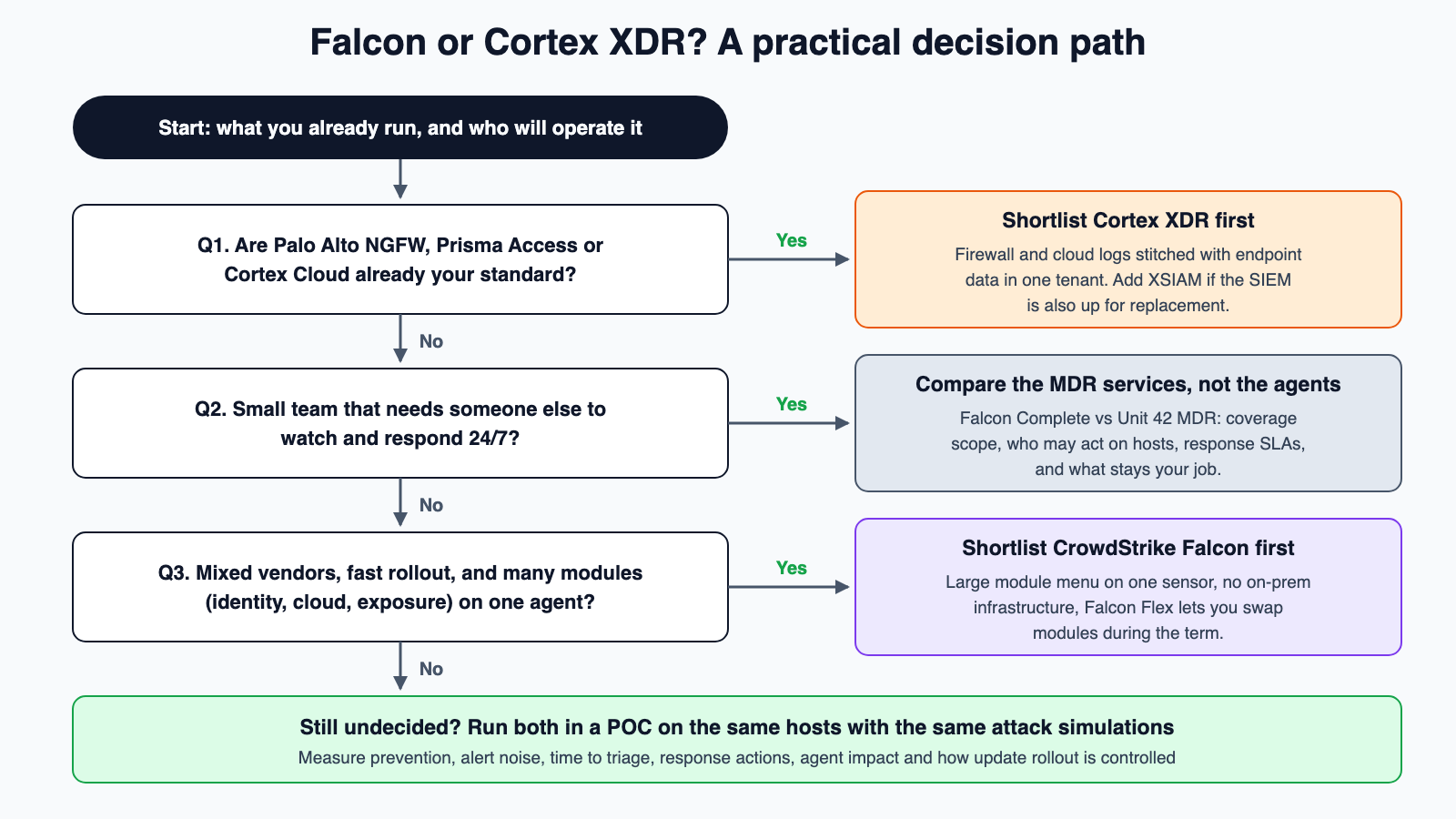
| Situation | Lean toward |
|---|---|
| Palo Alto NGFW, Prisma Access or Cortex Cloud is your standard | Cortex XDR |
| You also want to replace the SIEM with one SOC platform | Cortex XSIAM, or Falcon with Next-Gen SIEM if Falcon already runs everywhere |
| Mixed network and cloud vendors, fastest endpoint rollout | CrowdStrike Falcon |
| Small team, wants a provider to remediate hosts | Falcon Complete is the more established option; compare Unit 42 MDR |
| Active Directory attacks are the top risk | Test Falcon Identity Protection and Cortex ITDR side by side |
| Want flexibility to change modules mid-contract | Falcon Flex |
| Need deepest network-plus-endpoint correlation | Cortex XDR |
When the answer is not obvious, run a two-to-four-week POC with both on the same hosts. Use the same attack simulations, measure prevention, alert volume and time to triage, and include an update-rollback drill.
Related guides
- XDR explained: Cortex vs CrowdStrike vs Sentinel
- Cortex XDR vs CrowdStrike Falcon for Security+ students
- The agentic SOC: is the SIEM dead?
- MITRE ATT&CK framework explained
- Incident response plan template
Sources
- CrowdStrike: Channel File 291 remediation hub and root cause analysis
- CrowdStrike: 2025 MITRE ATT&CK Enterprise Evaluation results
- Palo Alto Networks: MITRE ATT&CK Evaluations Enterprise 2025 participation statement
- Palo Alto Networks: Introducing Cortex XDR 5.0
- Palo Alto Networks: completes acquisition of CyberArk
- Cortex XDR documentation: Identity Threat Module (ITDR)


